airship

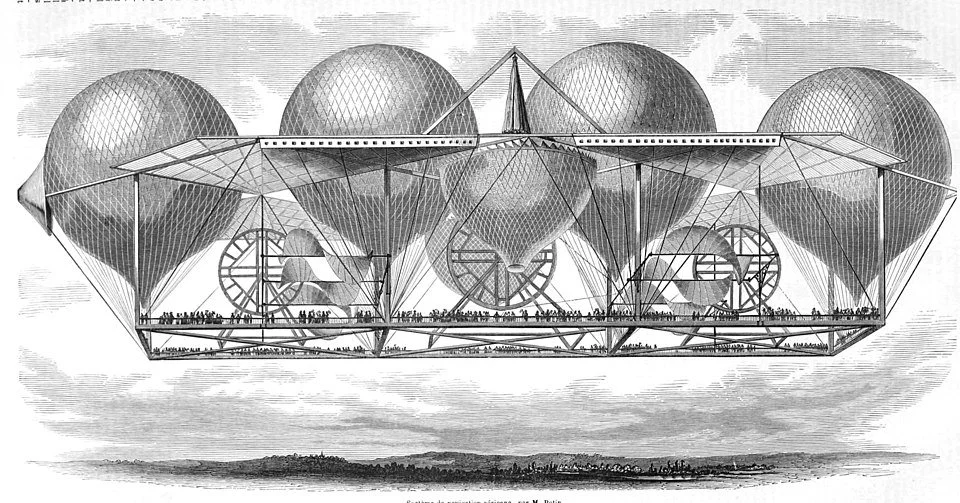
Engraving of a large platform carrying many people held aloft by four large balloons

Ernest Petin’s 1850 design of an airship

20 February 2026

As we use the word today, airship generally refers to a dirigible, but that specific usage became common only after 1900 and the launch of Ferdinand Zeppelin’s aircraft. The word appears as early as 1817 in reference to balloons and aircraft in general.

Airship is, quite obviously, a compound of air + ship. While the English word was formed within that language, it is preceded by the German Luftschiff, used in 1735 to denote a fictional craft and in 1783 to refer to the Montgolfier brothers’ balloon.

The first English use of the term is in reference to a failed attempt at a flying machine, which despite the claims to the contrary, seems to have only gained altitude by happenstance. From London’s Morning Post of 20 September 1817:

A country clergyman, in Lower Saxony, has been so happy as to succeed in accomplishing the invention of an Air Ship. The machine is built of light wood; it is made to float in the air chiefly by means of the constant action of a large pair of bellows, of peculiar construction, which occupies in the front the position of the lungs and the neck of a bird on the wing. The wings on both sides are directed with thin cords. The height to which the farmer’s boy (10 or 12 years of age) whom the inventor has instructed in the management of it has hitherto ascended with it, is not considerable, because his attention has been more directed to give a progressive than an ascending motion to his machine.

The Times of London of 11 October 1817 carried this item verbatim with the exception of the spelling with a hyphen and the term not being italicized: “air-ship.”

By 1823, the phrasal air ship was being used to refer to a balloon. From the Leeds Intelligencer of 11 September 1823:

The balloon would have been launched precisely at that hour, had not Mr. Green been requested by several respectable gentlemen present to defer it awhile, in consequence of the continued influx of company, which had not diminished at twenty-five minutes to four, when the signal of ascent was given and the balloon released. Nothing could exceed the magnificence with which, on bursting from her moorings, this air ship soured at once in a nearly perpendicular direction into the highest heavens.

And in 1850 we see the hyphenated air-ship being used to refer to something that approached what we would consider a dirigible, Ernest Petin’s design for a ligher-than-air flying machine. From the Paris correspondent of New York’s Ladies’ Repository of October 1850:

The subject of aerian [sic] navigation is exciting a good deal of interest here. A. M. Petin, member of the Academie Nationale de l’Agriculture and Commerce has been lecturing, for some months, in the Palais Nationale, upon the subject, and exhibiting models of an air-ship of his invention, which he thinks he can propel through the air at the rate of 20 to 120 miles an hour, and by means of which he promises to transport several thousand passengers, or a corresponding weight of freight, the air itself furnishing both the point of support and the motive power. This ship is an odd-looking machine of some 250 yards in length by 200 in width. It is open every-where, having neither top, bottom, nor sides, so that air may pass through every part of it without resistance. It is, in fact, like the frame of a bird-cage with all the wires taken out, and minus the floor.


Sources:

“Flying Machine.” Times (London), 11 October 1817, 2/4. Gale Primary Sources: Times Digital Archive.

“Letter to the Editor.” Ladies’ Repository (New York), October 1850, 317/1. Gale Primary Sources: American Historical Periodicals from the American Antiquarian Society.

Morning Post (London), 20 September 1817, 2/5. Gale Primary Sources: British Library Newspapers.

“Mr. Green’s Ascent.” Leeds Intelligencer (England), 11 September 1823, 3/4. Gale Primary Sources: British Library Newspapers.

Oxford English Dictionary Online, June 2008, s.v. airship, n.

Image credit: Unknown artist, 1850. Wikimedia Commons. Public domain image. 
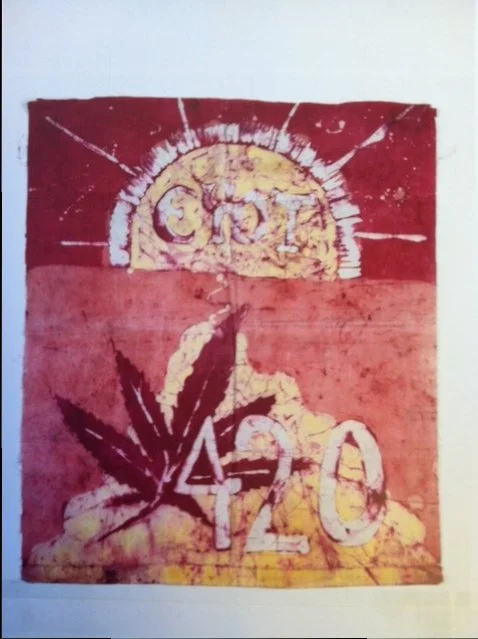
four-twenty / 420

Batik-dyed flag bearing the words “Eyot 420” and a cannabis leaf

Batik flag created by Patty, a friend of the Waldos, in the early 1970s

18 February 2026

There are many origin stories for 420, a slang term referring to marijuana, but unlike most slang terms, researchers have been able to pin down its actual origin with specificity. 420 was first used by a group of students at San Rafael High School in 1971, and it refers to the time of day, 4:20 pm, when they would meet to smoke pot and go off search for a mythical crop of marijuana plants.

San Rafael is in Marin County, on the other side of the Golden Gate Bridge from San Francisco, and in 1971 a group of students who called themselves the Waldos—because they used to congregate along a wall near the high school—got wind of a crop of pot plants allegedly growing near Point Reyes, further north. They would meet each day at 4:20 pm, after the school’s athletic practice, and venture north in search of the cannabis cache. They never found the pot, but in the course of their quest they smoked a lot of weed, had a lot of fun, and began using the term 420.

Marin County in the 1970s was also the stamping grounds of the Grateful Dead, and members of the Waldos had friends and family members associated with the band. 420 was picked up and used by Deadheads, as fans of the band call themselves, and from there the slang term spread to the wider world.

There is testimonial evidence that 420 was in use by the Waldos in 1971, but the first known use in print is from the “Question Man” column in the Red & White, San Rafael High School’s newspaper from 7 June 1974. The question reads: “If you had the opportunity to say anything in front of the graduating class, what would you say?”

The response from Question Man is “420.”

A 23 September 1975 letter from Dave Reddix to fellow Waldo Steve Capper, reads, in part:

My brother is Phil Lesh’s manager and last weekend I had a job as a doorman (backstage) at a concert. I smoked out with David Crosby and lesh [sic], got paid 20 bucks. I was laid off about three weeks ago Im [sic] collecting un-employment or “funenjoyment” that’s what it really is.

[…]

P.S. a little 420 enclosed for your weekend

The 420 in the letter is a reference to a joint that was enclosed.

420 got a big boost in May 1991 when the magazine High Times printed the text of a flyer that had been handed out at a Grateful Dead New Year’s concert. The flyer, however, gave a false origin for the term, that of 420 being a police code, one of many myths about the term that were to come. The flyer read:

Four-twenty started in San Rafael, CA in the late ’70s. It started as the police code for Marijuana Smoking in Progress. After local heads heard of the police call, they started using the expression “420” when referring to the herb—“Let’s go 420, dude!” After a while, something magical started to happen. People began getting stoned at 4:20 am and/or pm. There’s something fantastic about getting ripped at 4:20, when you know your brothers and sisters all over the country and even the planet are lighting up and tokin’ up right along with you. Now, there’s something even more grand than getting baked at 4:20. We’re talking about the day of celebration, the real time to get high, the grand master of holidays: 4/20, or April 20th. This is when you must get the day off work or school. We are going to meet at 4:20 on 4/20 for 420-ing in Marin County at the Bolinas Ridge sunset spot on Mt. Tamalpias [sic]. Just go to downtown Mill Valley, find a stoner and ask where Bolinas Ridge is. If you make it to Marin, you will definitely find it.

HELPFUL HINTS: Take extra care that nothing is going to go wrong within that minute. No heavy winds, no cops, no messed-up lighters. Get together with your friends and smoke pot hardcore.

After this was published in High Times, the term started to be widely used outside of Marin County and Deadheads.

Among the other false explanations that have been proposed over the years are:

  • It was a section of [insert state here]’s penal code referring to marijuana

  • It is the number of chemical compounds in marijuana

  • It was the date [insert name of famous rock musician here] died

  • It refers to Hitler’s birthday (Hitler was indeed born on 20 April, but the association with pot is never adequately explained).

And there are many other explanations. All without any evidence.

Discuss this post


Sources:

Green’s Dictionary of Slang, accessed 17 January 2026, s.v. four-twenty, n.

Grim, Ryan. “Here’s the Real Story of Why We Celebrate 4/20.” Huffpost, 20 April 2016.

Mikkelson, Barbara. “The Origins of 420.” Snopes.com, 20 April 2023.

Oxford English Dictionary Online, March 2017, s.v. 420, n.

Reddix, Dave. Letter to Steve Capper, 23 September 1975. 420Waldos.com.

“Wake ’n’ Bake!” High Times, May 1991, 20.

Zinko, Carolyn. “Heads of the Class: The High School Kids Who Created 420.” San Francisco Chronicle, 20 April 2019, A1, A8. Newsbank: Access World News.

Image credit: Patty, 1970s. 420Waldos.com. Fair use of a copyrighted image to illustrate the topic under discussion.

ring / ringleader

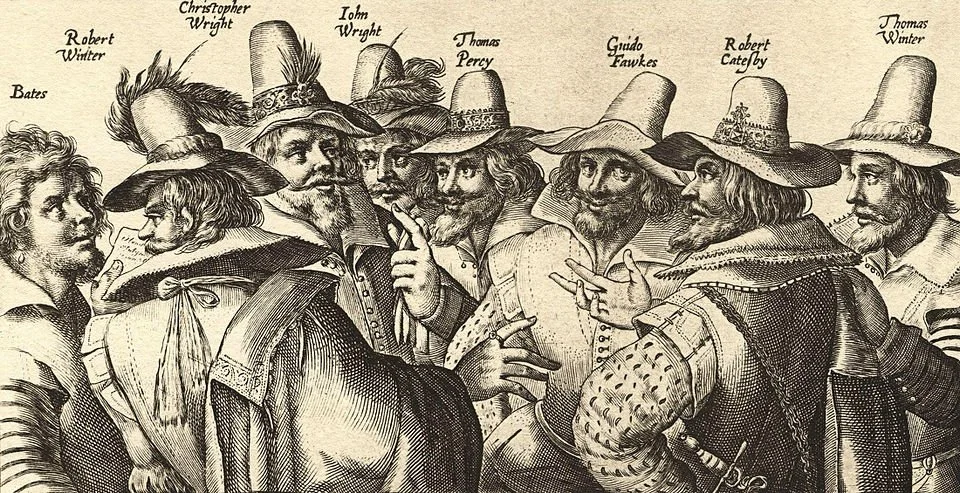
Engraving of 8 bearded men, all but one wearing hats, gathered in a circle, talking

Crispijn de Passe the Elder, c. 1605, engraving of the Gunpowder Plot conspirators; Guy Fawkes is third from right

16 February 2026

Ring comes down to us from the Old English hring with much the same meaning as today, a circlet, often made of metal, to be worn as an ornament, or more generally, any similar circular structure, or a group of people arranged in a circle, as in a dance. (Cf. ring around the rosie)

By the thirteenth century ring was being used metaphorically to refer more generally to a group of people joined by some association, not simply those arranged in a circle. We see this usage in Hali Meidenhad, a homily that encouraged young women to enter religious orders rather than be married:

For ȝif ha beoð acwiket & imaket hale, ha beoð i widewene ring, & ſchulen, i widewene ring, bifore þe iweddede ſingen in heuene.

(For if they are quickened and made whole, they are in the ring of the widowed, and must, in the widowed ring, sing before the wedded in heaven.)

And by the beginning of the sixteenth century, ring was being used to describe a criminal or mutinous conspiracy. This is evident by the appearance of the word ringleader, which can be found in a c. 1503 letter from English soldier and politician John Flamank to King Henry VII:

“Thees men,” he said, “never lovyd the kyngis grace, nor never woldo, with many mo of the same mynd within this toune. Now that I have shewed all the wyrst. This be a sherwde company sett in yll mynde. Dout ye not but this will falle in dede but good provysion be made for the remedy in tyme.

[…]

“And we do wysly, I doutnot but by good counsell we shalbe able by good polici to distrii alle the captayns and ryngledres that be of yll and contrarij mynde.”

The earliest citation of the sense of ring to mean a criminal conspiracy in the Oxford English Dictionary is from John Bee’s 1823 slang dictionary:

Ring—the word was applied by the city-officers to that connexion, circle, or secret understanding which is supposed to exist among the caddees of stage-coaches who are upon the lay—or kedge; and in this sense of a ring representing a circle, round, or connexion, better heads than their’s concur.

But the existence of ringleader from centuries before indicates that this sense of ring must have been circulating for at least as long, and probably earlier than c.1503.

Discuss this post


Sources:

Bee, John. (pseud. John Badcock). Slang. A Dictionary of the Turf, the Ring, the Chase, the Pit, of Bon-Ton, and the Varieties of Life. London: T. Hughes, 1823, 212. Archive.org.

Flamank, John. Letter to Henry VII (c. 1503). In Gairdner, John, ed. Letters and Papers Illustrative of the Reigns of Richard III and Henry VII, vol. 1. London: Longman, Green, Longman, and Roberts, 1961, 237–238. Archive.org.

Furnivall, F. J., ed. Hali Meidenhad: An Alliterative Homily of the Thirteenth Century (c. 1225). Early English Text Society O.S. 18. Oxford: Oxford UP, 1922, 29. London, British Library, Cotton MS Titus D.18. Archive.org.

Middle English Dictionary, 3 January 2026, s.v. ring, n.

Oxford English Dictionary Online, June 2010, s.v. ring, n.1, ringleader, n.

Image credit: Crispijn de Passe, the Elder, c. 1605. Wikipedia Commons. UK National Portrait Gallery, NPG 334a. Public domain image.

sur-

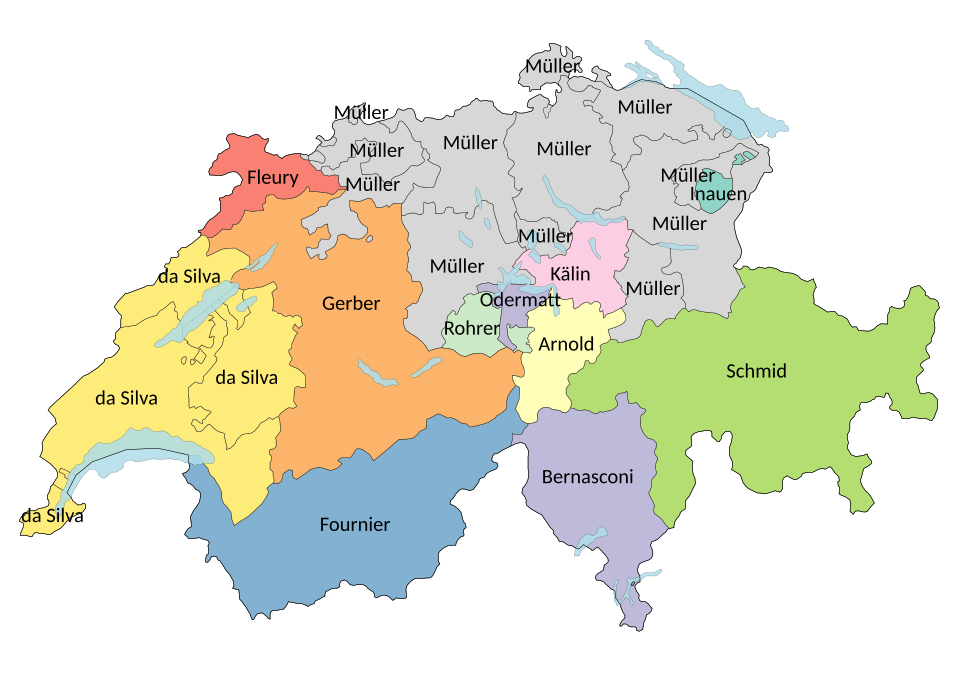
Map of Switzerland showing the most popular surname in each canton

Most common Swiss surnames by canton

13 February 2026

The other day I was wondering about the word surname. What is the sur-? prefix. The etymology, while perhaps not immediately obvious, is quite straightforward; the sur- is a French variation on the Latin super, meaning above or beyond. It comes to us, like many French roots, from the Normans. So a surname is one’s second or higher name, and the word dates to the fourteenth century.

But there are other sur- words, some like surname, borrowed whole from French (Anglo-Norman surnum, early fourteenth century), while others have been formed in English:

surcharge, an additional charge, originally a verb (fifteenth century) borrowed from the Old French surcharger and turned into a noun in English by 1601

survive, to live beyond or after (fifteenth century), from the Anglo-Norman survivre, which was formed from the Latin vivere, to live

surpass, to go over or beyond (sixteenth century), from the French surpasser.

Discuss this post


Sources:

Anglo-Norman Dictionary, AND2 Phase 5, 2018–21, s.v. sur2.

Oxford English Dictionary Online, 1918, s.v. sur-, prefix, surname, n.

Image credit: Pymouss44, 2024. Licensed under the Creative Commons Attribution-Share Alike 3.0 Unported License.

rap/rap sheet

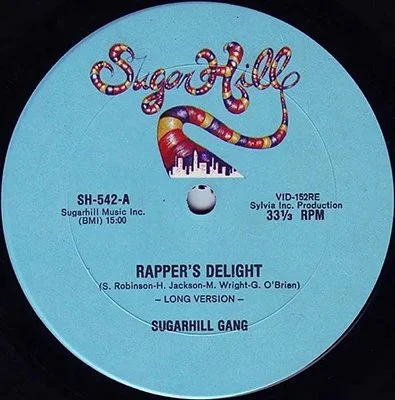
Record label of the single “Rapper’s Delight” by Sugar Hill Gang, 1979

11 February 2026

Rap has four broad senses, all stemming from the first: a blow or strike; a criminal charge; an utterance or conversation; and a musical genre.

The sense of rap meaning a blow or strike is probably echoic in origin. Much like tap and clap, it represents the sound of the blow. The earliest citation in both the Oxford English Dictionary and the Middle English Dictionary is from the poem Roland and Vernagu, found in the Auchinleck manuscript, which was copied c. 1330. The passage depicts a battle between the knight Roland and the giant Vernagu:

Þai gun anoþer fiȝt,
And stones togider þrewe.
Gode rappes for þe nones,
Þai ȝauen wiþ þe stones,
That sete swithe sore.

(They began another fight and together threw stones. In that place for the moment, they very violently gave good raps with the stones.)

The verb appears a few decades later.


The sense of rap, meaning a criminal charge comes from the sense of a blow or strike. It probably developed out of the metaphorical use of rap across the knuckles. We see this longer phrase used literally in a description of a juggler’s trick in Reginald Scot’s 1584 The Discouerie of Witchcraft, which also exposes the tricks of jugglers and stage magicians:

How to rap a Wag on the knuckles.

[…]

Laie one ball upon your shoulder, an other on your arme, and the third on the table: which because it is round, and will not easilie lie upon the point of your knife, you must bid a stander by laie it thereon, saieng that you meane to throwe all those three balles into your mouth at once: and holding a knife as a pen in your hand, when he is laieng it upon the point of your knife, you may easilie with the haft rap him on the fingers, for the other matter wilbe hard to doo.

Roman Catholic historian Hugh Tootell, under the pseudonym Charles Dodd, used rap over the knuckles metaphorically in his 1715 The Secret Policy of the English Society of Jesus to refer to a rebuke:

I shall call upon no other evidence upon this Occasion than his Holiness himself Clement VIII who acquitted the appealing Clergy in a special Brief, and reprimanded the Arch Priest for what he had acted against them; and if it be no Crime to mention the Society upon this Account, you also, Reverend Fatker [sic], have a sensible rap over the Knuckles in the same Brief.

And several decades later we have the lone rap being used metaphorically to mean a rebuke. From a 7 February 1777 letter by William Whipple to Josiah Bartlett, both signatories to the US Declaration of Independence:

I received your favor of 2d December, but not till the 26th January; what occasioned this delay in the post know not, but suppose the fault must lay with the post master general; he has lately had a rap, which I hope will have a good effect.

By the early nineteenth century, rap had acquired a slang sense f an arrest or criminal charge We see it in this poem about the 1838 act of parliament the previous year that abolished imprisonment for suspicion of debt:

But, any way, it does seem rather funny
To lock a man within four walls, and bid him seek for money.
There’s no occasion now for me to hide,
Tho’ once I was a deeply versed court guide;
I fear not now a single rap,
Nor startle at a tap.
From my boot’s sole to my hat crown,
I’ll have it all set down;
As to my tailleur, his suit’s a failure,
And talking of a writ, quite a mis-fit;
So, spite his measures, I’ll take my pleasures;
And, since for debt I need not run away,
Shall I, like vulgar traders, stoop to pay?
Nay!

Rap here, like suit and measures, is being used as a double entendre meaning both a physical blow and a criminal arrest.

The term rap sheet, meaning a police record of a person’s criminal arrests and charges dates to at least 31 May 1931, when it appears in the Tulsa Tribune:

W. F. Worley, another on the liquor defendants list, has a seven-year sentence for arson on his rap sheet, and Jess S. Shive did time at McAlester for grand larceny.

Several of the earliest uses are from Tulsa, hinting that rap sheet may have originated in the local police slang. Here’s another from 8 December 1932 in the Tulsa Daily World:

“The heaviest rap sheet, however, doesn’t mean the most desperate criminal,” Charles Carr, detective sergeant will tell you.

A crafty criminal like [Pretty Boy] Floyd will be picked up only once in a while and the police record on him will be incomplete. It’s those who don’t know their racket and bungle their jobs who get the heavy rap sheet records.

Some incorrectly believe this use is from an acronym for record of arrests and prosecutions, but while you can find this etymology in police manuals and forms, it is a backronym and not the origin of rap.

Another false belief is that this criminal sense of rap comes from counterfeiting and carries a connotation of the criminal charge being false. Rap did once refer to a counterfeit coin. This slang sense probably comes from the Irish rapaire, also meaning a counterfeit coin, but one cannot discount the possibility that it comes from the English as coins are also said to be struck when they are minted. Jonathan Swift refers to such raps in a 1724 open letter about a new brass coin being privately minted in Ireland:  

The Fact is thus, It having been many Years since COPPER HALF PENCE or FARTHINGS were last Coined in this Kingdom, they have been for some time very scarce, and many Counterfeits passed about under the name of RAPS, several Applications were made to England, that we might have Liberty to Coin New ones, as in former times we did; but they did not succeed.

But this sense of a counterfeit coin was dying out in the nineteenth century when the criminal sense of rap developed. The connection of a criminal charge to the counterfeit coin is claimed because of the phrase bum rap, meaning a false criminal charge, but the use of the modifier bum indicates that the unmarked rap is not necessarily, or even usually, false.


The sense of to rap, meaning to speak arose in the sixteenth century, originally meaning to speak sharply, quickly, or vigorously, as if one’s words were blows. It was commonly used in reference to swearing an oath. Thomas Wyatt writes in 1541 in his own defense regarding the charges by Edmund Bonner and Simon Heynes that he had an immoral lifestyle and had spoken against the king:

By this you may perceave that ether theie lye in the tyme and the place, or else thei lye in the reportinge the thynge. But by cawse, I am wonte some tyme to rappe owte an othe in an erneste tawlke; looke how craftylie theie have put in an othe to the matter to mayke the matter seme myne.

By the eighteenth century it was being used in criminal slang, meaning to give evidence, to inform on another. In 1728 criminal James Dalton gave a Genuine Narrative of his crimes in which has this:

This practice of Haul Cly [i.e., pickpocketing], he says, they frequently follow'd  at the Playhouse, when the Audience came out; and there, says he, the Whores are our Safeguard; for when we sling for a Cly, if we are taken on Suspicion, they’ll rap for us, if they are not of the Community of Fro Files [i.e., female pickpockets].

And the glossary at the back of the book defines rap as “swearing against a person.” This criminal slang ties in with and may have influenced the previously discussed sense of a criminal charge.

And by the mid eighteenth century, to rap could also mean to recite poetry. From Henry Fielding’s 1742 novel Joseph Andrews:

Adams then rapt out a hundred Greek verses, and with such a Voice, Emphasis and Action, that he almost frighten’d the Women.

While it is tempting to link Fielding’s use here with present-day rap music, this poetic connection doesn’t seem to have been a distinct sense, for later in the book Fielding writes:

He stopt his Horse, and swore she was the most beautiful Creature he ever beheld. Then instantly alighting, and delivering his Horse to his Servant, he rapt out half a dozen Oaths that he would kiss her; to which she at first submitted, begging he would not be rude.

Rap also developed a sense of ordinary speech or conversation. Joseph Ritson writes in a 1787 letter:

I shall be most glad of my Lords arrival if it were only for the raps you promise me.

The editor of the 1833 volume in which the letter is published glosses this use of raps as “news.”

By the beginning of the twentieth century this sense had crossed the Atlantic. There is this example from the 16 June 1900 issue of the National Police Gazette where boxer John L. Sullivan uses rap meaning a speech, but given the context, the metaphor of a blow or punch is clearly evident:

Justice Martin finally got Sullivan to understand that he was not an expert, and could not testify as he was doing, and the big fellow left the stand disgusted.

“I knew it was agin evidence,” he said when he got into the corridor, “but I got in my rap before they could duck, see? Say, if they’d given me the chance I’d have made the whole lot of them look like 30 cents, especially that lawyer.

And Damon Runyon writes in 1929:

I get to the Marberry around nine o’clock and who opens the door of Madame La Gimp’s apartment for me but Moosh, the door man from Miss Missouri Martin’s Sixteen Hundred Club. Furthermore, he is in his Sixteen Hundred Club uniform, except he has a clean shave. I wish Moosh a hello, and he never raps to me buy only bows, and takes my hat.

And Timothy Leary writes this in 1966:

He started a three-hour rap abou[t] energy, electronics, drugs, politics, the nature of God and the place of man in the divine system.


The musical sense of rap flows out of the speech sense, a reference to the rhythmic delivery of the lyrics. There is this in the 5 May 1979 issue of Billboard:

Rapping DJs reminiscent of early r&b radio jocks such as Jocko and Dr. Jive are making an impressive comeback here—not in radio but in black discos where a jivey rap command as much attention these days as the hottest new disk.

Young DJs like Eddie Cheeba, DJ Hollywood, DJ Starski, and Kurtis Blow are attracting followings with their slick raps All promote themselves with these snappy show business names.

Many black disco promoters now use the rapping DJs to attract young fans to one-shot promotions and a combination of the more popular names have filled this city’s [i.e., New York] ballrooms.

The young man credited with reviving the rapping habit in this area is DJ Hollywood, who started gabbing along with records a few years ago while working his way through school as a disco DJ.  

Hollywood is now so popular that he has played the Apollo with billing as a support act. It is not uncommon to hear Hollywood’s voice coming from one of the countless portable  tape players carried through the city’s streets. Tapes of Hollywood’s raps are considered valuable commodities by young blacks, here.

[…]

Cheeba says the rapping craze grew out of a need for something more than records.

“These people go to discos every week and they need more than music to motivate them,” Cheeba observes. “I not only play records, but I rap to them and they answer me.”

[…]

[Starski] generally works with Cool DJ AJ, who does not rap but is a master of B-beats. B-beats are series of short rhythm breaks strung together to sound like one song.

Starski is proud of his ability to excite a crowd with his rapping. “It’s a beautiful thing to see a dance floor full of people dancing to your music and answering your rap,” Starski says.

In September of that year the Sugarhill Gang released their single Rapper’s Delight, which had the lyrics:

Now, what you hear is not a test, I’m rapping to the beat
And me, the groove, and my friends are gonna try to move your feet

The Sugarhill Gang is often credited with coining this particular sense of rap, but while they were one of the first to use it in published form, and perhaps were the first to use the word in song lyrics, they were using a word that was already familiar among their musical circle.

By the following year rap had become the name for the musical genre.

Discuss this post


Sources:

“Abolition of Arrest on Suspicion of Debt, 1838” (October 1839). The Comic Almanack, first series 1835–43. London: Chatto and Windus, 191. HathiTrust Digital Library.

“Criminals and Pictures Change Since First Police Photograph Back in 1913.” Tulsa Daily World (Oklahoma), 8 December 1932, 9/6. Readex: America’s Historical Newspapers.

Dodd, Charles (Hugh Tootell). The Secret Policy of the English Society of Jesus. London: John Morphew, 1715, 151–52. Gale Primary Sources: Eighteenth Century Collections Online (ECCO).

Fielding, Henry. The History of the Adventures of Joseph Andrews, vol. 2. London: A. Millar, 1743, 18, 163. HathiTrust Digital Library.

Ford, Jr., Robert. “Jive Talking N.Y. DJs Rapping Away in Black Discos.” Billboard, 5 May 1979, 3, 54. ProQuest: Billboard (Archive: 1963–2000).

A Genuine Narrative of All the Street Robberies Committed Since October Last by James Dalton. London: J. Roberts, 1728, 10–11, 60. Archive.org.

Green’s Dictionary of Slang, accessed 21 December 2025, s.v. rap, n.1, rap, n.2, rap, v.1, rap, v.2.

“John L. as an Art Critic.” National Police Gazette (New York), 16 June 1900, 7/4. ProQuest Magazines.

Leary, Timothy. “God’s Secret Agent A.O.S.3” (1966). Politics of Ecstasy. Berkeley: Ronin, n.d., 277. Archive.org.

Middle English Dictionary, 2001, s. v. rappe, n.; rappen, v.(1).

“Once Wealthy Stockman Now Facing U.S. Liquor Charge.” Tulsa Tribune (Oklahoma), 31 May 1931, 7/6. Newspapers.com.

Oxford English Dictionary Online, December 2008, s.v. rap, n.2, rap, v.2, rap, n.4, rap sheet, n.

Ritson, Joseph. Letter to Jack Rowntree, 28 October 1787. In The Letters of Joseph Ritson, Esq., vol. 1 of 2. London: William Pickering, 1833, 129. HathiTrust Digital Library.

Robinson, Sylvia, Henry “Big Hank” Jackson, Michael “Wonder Mike” Wright, and Guy “Master Gee” O’Brien (Sugar Hill Gang). “Rapper’s Delight.” Sugar Hill Records, 1979. AZLyrics.com.

“Roland and Vernagu” (c. 1330). Edinburgh, National Library of Scotland, Advocates MS 19.2.1.

Runyon, Damon. “Madame La Gimp. Cosmopolitan, October 1929. 65/2. Archive.org.

Scot, Reginald. The Discouerie of Witchcraft. London: Henry Denham for William Brome, 1584, book 13, chapter 23, 324. ProQuest: Early English Books Online (EEBO).

Shapiro, Fred. “Re: [ADS-L] ‘rap sheet’ (1932).” ADS-L, 25 December 2025.

Swift, Jonathan (pseud. M. B. Drapier). A Letter to the Shop-Keepers, Tradesmen, Farmers, and Common-People of Ireland, Concerning the Brass Half-Pence Coined by Mr. Woods. Dublin: J. Harding, 1724, 3. Gale Primary Sources: Eighteenth Century Collections Online (ECCO).

Whipple, William. “William Whipple’s Letter. No. III” (7 February 1777). American Pioneer, 2.1, January 1843, 17. HathiTrust Digital Library.

Wyatt, Thomas. “37 Wyatt’s Defence.” In Kenneth Muir, ed. Life and Letters of Sir Thomas Wyatt. Liverpool: Liverpool UP, 1963, 199. Archive.org.

Image credit: Sugar Hill Records, 1979. Fair use of a low-resolution copy to illustrate the topic under discussion.