Turtle Island

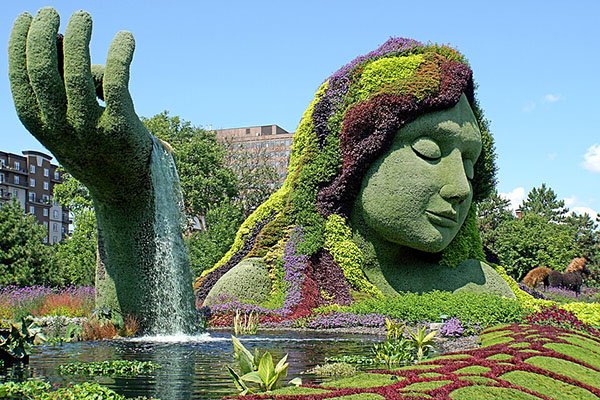
Photo of a giant floral sculpture of a woman rising from the earth and sea

 Sculpture “Mother Earth: The Legend of Aataentsic” in the Jacques-Cartier Park, Gatineau, Québec, inspired by the Haudenosaunee story of Sky Woman

2 March 2026

Turtle Island is a calque of a Native American term from the creation accounts of tribes speaking languages of the Iroquoian and Algonquian families. It originally was a name for the world, taken from various stories in which the world is said to be the back of giant turtle swimming in the cosmic sea. In more recent use, Turtle Island has been used as a name for North America.

Turtle Island and the creation accounts came to attention of European settler-colonists in the Walum Olum (Red Record) which was claimed to be a historical narrative of the Lenape people. It was allegedly translated into English by C. S. Rafinesque in 1836. His version, however, doesn’t use the phrase Turtle Island calling it instead “that island” and “the turtle back”:

Meantime at TULA, at that island, NAMA-BUSH (the great hare Nana) became the ancestor of beings and men. Being born creeping, he is ready to move and dwell at TULA. The beings and men (Owini and Linowi) all go forth from the flood creeping in the shallow water, or swimming afloat, asking which is the way to the turtle back TULAPIN.

The term itself first appears in D. G. Brinton’s 1885 version of the Walum Olum, which also includes Rafinesque’s alleged transcription of the Lenape:

Tulapit menapit Nanaboush maskaboush owinimokom linowimoken. Giskikin-pommixin tulagishatten-lohxin. Owini linowi wemoltin, Pehella gahani pommixin, Nahiwi tatalli tulapin.

Nanabush, the Strong White One, grandfather of beings, grandfather of men, was on Turtle Island [Tulapit]. There he was walking and creating, as he passed by and created the turtle. Beings and men all go forth, they walk in the floods and shallow waters, down stream thither to the Turtle Island [Tulapin].

The Walum Olum is, however, now widely considered to be a hoax perpetrated by Rafinesque. Still, the idea that the world is the back of a giant turtle is a component of a number of genuine creation accounts of North American Indigenous peoples. For instance, there is the Haudenosaunee (Iroquois) story of Sky Woman, the mother of humanity, who fell from the sky into the water-covered earth, and various animals gathered dirt from the bottom of the ocean, piling it on the back of a turtle to create land one which she could live.

Outside of Indigenous creation stories, one is likely to encounter Turtle Island as a name for North America. This particular usage is relatively recent. The earliest use in print that I’m aware of is in a pair of newspaper articles of 9 January 1972. One of these is in the Syracuse Herald-Journal:

The historic scene painted by Lyons shows foundation of the Great League, or Iroquois Confederacy, hundreds of years ago at Onondaga.

It includes the two founders of the Great League, the Great Peace Maker, at left, in the print, and Hiawatha.

Behind them is the Great Tree of Peace growing from the Great Turtle Island, symbolizing the North American Continent.

[…]

The Hou-du-no-shaun-ee, the People of the Long House, say formation of the confederation occurred hundreds of years before the first white man set foot on the Great Turtle Island.

The second is in Alabama’s Birmingham News:

THEY WERE Mohawk Indians from Akwesasne in Northern New York state, showing University of Alabama in Birmingham and others the Round Dance, part of the Indian heritage handed down through the generations since this continent was called Turtle Island.

And a few days later, poet and environmental activist Gary Snyder uses it in the New York Times of 12 January 1972:

On Hopi and Navajo land, at Black Mesa, the whole issue is revolving at this moment. The cancer is eating away at the breast of Mother Earth in the form of stripmining. This to provide electricity for Los Angeles. The defense of Black Mesa is being sustained by traditional Indians, young Indian militants and longhairs. Black Mesa speaks to us through an ancient complex web of myth. She is sacred territory. To hear her voice is to give up the European word “America” and accept the new-old name for the continent, “Turtle Island.”

Note that Hopi and Navajo use of the term, which undoubtedly predates Snyder’s article, represents an adoption of the name by Indigenous peoples other than the Haudenosaunee and Lenape, from whose myths the term arose.

Discuss this post


Sources:

Brinton, D. G., ed. The Lenâpé and Their Legends. Library of Aboriginal American Literature, no. 5. Philadelphia: 1885, 178–79. Archive.org.

Case, Richard G. “Honors Indians: Lyons Designs Print for Bank.” Syracuse Herald Journal (New York), 9 January 1972, 43. Newspapers.com.

O’Toole, Garson. “Re: [ADS-L] ‘Turtle Island’ (January 1972), ADS-L.

Oxford English Dictionary Online, 2016, s.v. Turtle Island, n.

Rafinesque, C. S. The American Nations; or, Outlines of Their General History, vol. 1. Philadelphia: 1836, 127–28. Archive.org.

Reeves, Garland. “Mohawk Indians Tell Students of Heritage Before White Man.” Birmingham News, 9 January 1972, 31-A/3–4. Newspapers.com.

Snyder, Gary. “Energy Is Eternal Delight.” New York Times, 12 January 1972, 43/5–6. ProQuest Newspapers.

Photo credit: Dennis G. Jarvis, 2018. Wikimedia Commons. Flickr. Licensed under the Creative Commons Attribution-Share Alike 2.0 Generic license.

arch

Photo of a black dog in front of a natural stone arch

Stella visiting Natural Bridge, a natural stone arch in Virginia

27 February 2026

Arch, in English, encompasses three broad senses. It can be a combining form signifying chief or high as in archangel or archbishop, it can mean clever or cleverly humorous, and it can mean a curved structure or to make a curved structure.

Of these, the combining form, arch-, is the oldest, dating to before the Norman Conquest. The combining form comes from the Greek ἀρχι- (arci-), as in ἀρχάγγελος (arcagelos). Borrowed into Latin, the Greek took the form arch-. In Old English, the original such combining form was heah-, the root of our modern high, as in heahbiscop or heahengel. But eventually Old English borrowed the Latin arch-, and heahbisecop became arcebisceop. In Middle English, under the influence of Anglo-Norman French, the arce- form became arch-, and we got words like archangel.

By the latter half of the sixteenth century, the combining form started to be used as a standalone adjective signifying chief or principal. Here we see arch so used in a translation from Latin of a 1574 biography of Matthew Parker, the seventieth (and first Protestant) archbishop of Canterbury:

For who woulde haue beeleued / that anye man / not in the behalfe off him selfe / but in the fauour off anye thoughe neuer / so arch a Prelate / would wrighte suche thinges / as you haue hearde heere.

About a century later, this use of arch started to be used to mean rogueish. We see both the older and the newer senses used back to back in the 1684 second part of John Bunyan’s The Pilgrim’s Progress:

Greath[eart]. Above all that Christian met with after he had past throw Vanity-Fair, one By-ends was the arch one.

Hon. By-ends; What was he?”

Greath. A very arch Fellow, a downright Hypocrite; one that would be Religious, which way ever the World went, but so cunning, that he would be sure neither to lose, nor suffer for it.

And by the early eighteenth century arch was being used in the sense of waggish or playful, especially in a conscious and affected manner. We see it in the 1–4 July 1710 issue of The Tatler in which Isaac Bickerstaff tells how actor Thomas Doggett asked him to make mention of his latest play:

Dogget thanked me for my Visit to him in the Winter; and after his comick Manner, spoke his Request with so arch a Leer, that I promised the Drole I would speak to all my Aquaintance to be at his Play.

(Isaac Bickerstaff is a pseudonym used in The Tatler by Richard Steele, Joseph Addison, and Jonathan Swift. I don’t know which one penned this one.)

Arch meaning a curved structure comes from a different root. It’s a fourteenth century borrowing from the Old French arche, which in turn coms from the Latin arca (chest, coffer) and arcus (bow), from the curved shape of both. We see this sense in John Trevisa’s 1387 translation of Ranulf Higden’s Polychronicon. The passage is part of a description of the city of Rome, and Trevisa uses arch to translate the Latin arcus:

Fast by þat temple is an arche of marbel, and is þe arche of Augustus Cesar his victories and grete dedes. In þat arche beeþ all Augustus Cesar his dedes descryued. Þere is also Scipions arche; he ouercom Hanibal.

(Close by that temple is an arch of marble, and it is the arch of Augustus Caesar, his victories, and great deeds. In that arch all of Augustus Caesar’s deeds are described. There is also Scipio’s arch; he overcame Hannibal.)


Sources:

Bickerstaff, Isaac. The Tatler, 1–4 July 1710, no. 193, 1/1–2. In The Lucubrations of Isaac Bickerstaff, Esq., vol. 1. London: John Morphew, 1710  Gale Primary Sources: Eighteenth Century Collections Online.

Bunyan, John. The Pilgrim’s Progress from this World to that which Is to Come: The Second Part. London: Nathaniel Ponder, 1684, 165. ProQuest: Early English Books Online (EEBO).

Dictionary of Old English: A to Le, 2024, s.v. arce-

Higden, Ranulf. Polychronicon Ranulphi Higden Monachi Cestrensis; together with the English Translations of John Trevisa and of an Unknown Writer of the Fifteenth Century, vol. 1. Churchill Babingon, ed. London: Longman, Green, Longman, Roberts, and Green, 1865, 215. Archive.org.

The Life off the 70. Archbishopp off Canterbury Presentlye Sittinge Englished. Zurich: 1574, sig. D.vii.r. ProQuest: Early English Books Online (EEBO).

Middle English Dictionary, 3 January 2026, s.v arch(e n.

Oxford English Dictionary Online, 1885, s.v. arch- comb. form, arch adj. & n., arch v.1, arch n.1.

Photo credit: David Wilton, 2025. Licensable under the Creative Commons Attribution-NonCommercial-ShareAlike 4.0 International License.

dirigible

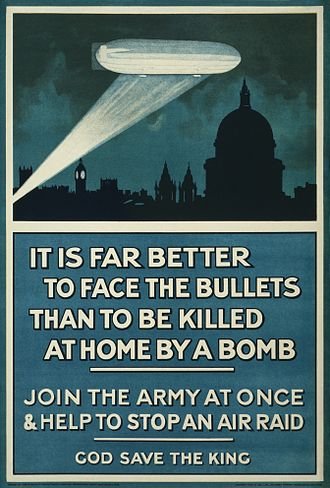
Poster of a dirigible over London at night, saying “It is far better to face the bullets than to be killed at home by a bomb”

WWI British recruiting poster referring to German dirigible air raids on London

25 February 2026

Today, the word dirigible is almost always used as a noun, referring to a zeppelin-type airship, and I always had it in my head that the word was related to rigid, a reference to the rigid frame of such an aircraft. But that is not the case. The word began life as an adjective meaning capable of being directed or steered. It was formed from the Latin verb dirigere, meaning to direct, steer, or guide. So a dirigible is a steerable balloon.

The adjective makes its appearance in English by the late sixteenth century. Here is an example from William Lambarde’s 1588 Eirenarcha: or the Office of the Iustices of the Peace on oaths of office:

It would auayle greatly to the furtherance of the Service, if the Dedimus potestatem [delegated power] to giue these Oaths were dirigible to the Iustices (and none other) to minister the same not elsewhere, but in their open Sessions.

The adjective begins to be applied to balloons by latter half of the nineteenth century. From Littell’s Living Age of 21 August 1875:

The more important problem is, how to make a balloon travel, not with, but through the air; in the same manner as boat, instead of being floated along with the stream, is made to move in an independent course through the water. In short, we want what, if we may coin a word for the purpose, we may call a dirigible balloon.

And the noun dirigible, meaning a steerable balloon, is in place by the end of that century. From Montana’s Anaconda Standard of 11 September 1898:

[The French] have spent $80,000 some years upon their aeronautical department, and keep their progress secret, but statements have been made by those who ought to know that French dirigibles can now attain a speed of 25 miles an hour.


Sources:

“Balloons and Voyages in the Air.” Littell’s Living Age (Boston, Massachusetts), 21 August 1875, 451–68 at 465/1. Gale Primary Sources: American Historical Periodicals from the American Antiquarian Society.

“Balloons Neglected.” Anaconda Standard (Montana), 11 September 1898, 18/5. Readex: America’s Historical Newspapers.

Lambarde, William. Eirenarcha: or the Office of the Iustices of the Peace, revised. London: Ralph Newberry, 1588, 62. ProQuest: Early English Books Online (EEBO).

Oxford English Dictionary Online, 1896, s.v. dirigible, adj. & n.

Image credit: UK government, 1915. Wikimedia Commons. Library of Congress, cph.3g10972. Public domain image.

sapphire

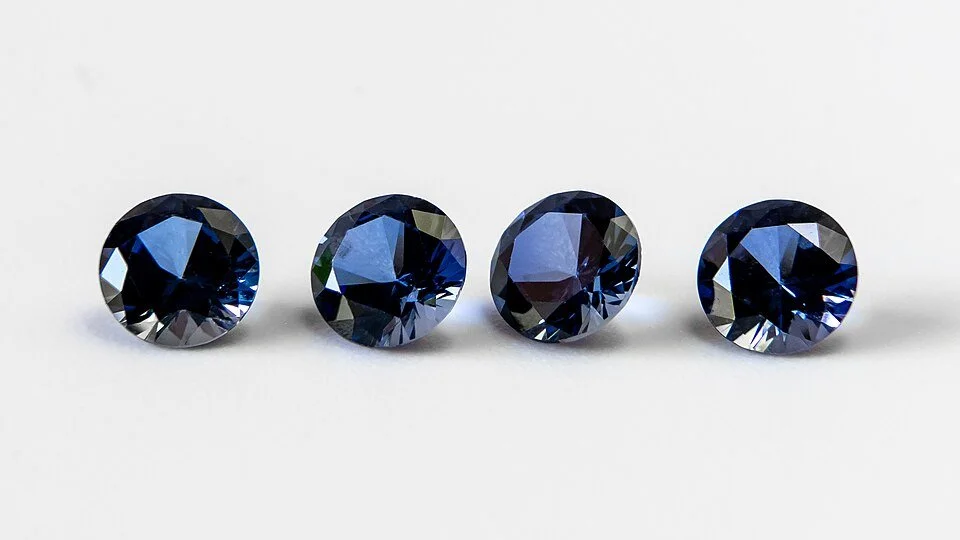
Photo of four, blue, faceted gemstones

Four man-made sapphires

23 February 2026

Sapphire is a gem, usually blue in color, a variety of corundum. The word came into English from the Anglo-Norman saphir, which is from the Latin sapphirus, which, in turn, is from the Greek σάπφειρος (sappheiros). After the Greek, the trail gets muddy. It may come from a Semitic root, akin to the Hebrew sappir or the Aramaic sampirina, or it may come from a Proto-Indo-European root, akin to the Sanskrit canipriya, literally meaning dear to the planet Saturn, and used to refer to some dark gemstone. The difficulty in tracing the origin stems from the possibility of earlier borrowings between Semitic and Indo-European languages.

The earliest use of the word in English may be in Thomas of Hales’s thirteenth-century Love Ron:

Hwat spekestu of eny bolde
þat wrouhte þe wise salomon
of iaspe, of saphir, of merede golde,
& of mony on-oþer ston?
Hit is feyrure if feole volde
more þan ich eu telle con;
Þis bold, mayde, þe is bihote
if þat þu bist his leouemon.

(What do you say of any temple that the wise Solomon built of jasper, of sapphire, of refined gold, and of many other stones? It [i.e., the dwelling that God will give you] is fairer by many times, for than I can tell you. This temple, maid, is promised if you are his lover.)


Sources:

Anglo-Norman Dictionary, AND2 Phase 5, 2018–21, s.v. saphir, n.

Middle English Dictionary, 3 January 2026, s.v. saphir(e, n.

Oxford English Dictionary Online, 1909, s.v. sapphire, n.

Thomas of Hales. “Friar Thomas de Hales’s Love Ron.” Carleton, Brown, ed. English Lyrics of the XIIIth Century. Oxford: Clarendon Press, 1932, lines 113–20, 71. Oxford, Jesus College, MS 29. Archive.org.

———. “Love Rune.” Susanna Fein, ed. Middle English Text Series (METS).

Photo credit: W. Carter, 2020. Wikimedia Commons. Licensed under the Creative Commons Attribution 4.0 International license.

airship

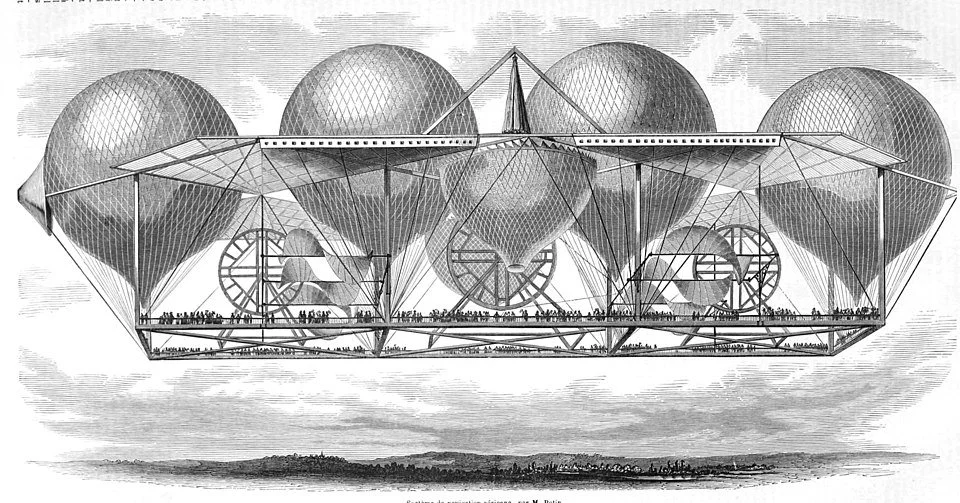
Engraving of a large platform carrying many people held aloft by four large balloons

Ernest Petin’s 1850 design of an airship

20 February 2026

As we use the word today, airship generally refers to a dirigible, but that specific usage became common only after 1900 and the launch of Ferdinand Zeppelin’s aircraft. The word appears as early as 1817 in reference to balloons and aircraft in general.

Airship is, quite obviously, a compound of air + ship. While the English word was formed within that language, it is preceded by the German Luftschiff, used in 1735 to denote a fictional craft and in 1783 to refer to the Montgolfier brothers’ balloon.

The first English use of the term is in reference to a failed attempt at a flying machine, which despite the claims to the contrary, seems to have only gained altitude by happenstance. From London’s Morning Post of 20 September 1817:

A country clergyman, in Lower Saxony, has been so happy as to succeed in accomplishing the invention of an Air Ship. The machine is built of light wood; it is made to float in the air chiefly by means of the constant action of a large pair of bellows, of peculiar construction, which occupies in the front the position of the lungs and the neck of a bird on the wing. The wings on both sides are directed with thin cords. The height to which the farmer’s boy (10 or 12 years of age) whom the inventor has instructed in the management of it has hitherto ascended with it, is not considerable, because his attention has been more directed to give a progressive than an ascending motion to his machine.

The Times of London of 11 October 1817 carried this item verbatim with the exception of the spelling with a hyphen and the term not being italicized: “air-ship.”

By 1823, the phrasal air ship was being used to refer to a balloon. From the Leeds Intelligencer of 11 September 1823:

The balloon would have been launched precisely at that hour, had not Mr. Green been requested by several respectable gentlemen present to defer it awhile, in consequence of the continued influx of company, which had not diminished at twenty-five minutes to four, when the signal of ascent was given and the balloon released. Nothing could exceed the magnificence with which, on bursting from her moorings, this air ship soured at once in a nearly perpendicular direction into the highest heavens.

And in 1850 we see the hyphenated air-ship being used to refer to something that approached what we would consider a dirigible, Ernest Petin’s design for a ligher-than-air flying machine. From the Paris correspondent of New York’s Ladies’ Repository of October 1850:

The subject of aerian [sic] navigation is exciting a good deal of interest here. A. M. Petin, member of the Academie Nationale de l’Agriculture and Commerce has been lecturing, for some months, in the Palais Nationale, upon the subject, and exhibiting models of an air-ship of his invention, which he thinks he can propel through the air at the rate of 20 to 120 miles an hour, and by means of which he promises to transport several thousand passengers, or a corresponding weight of freight, the air itself furnishing both the point of support and the motive power. This ship is an odd-looking machine of some 250 yards in length by 200 in width. It is open every-where, having neither top, bottom, nor sides, so that air may pass through every part of it without resistance. It is, in fact, like the frame of a bird-cage with all the wires taken out, and minus the floor.


Sources:

“Flying Machine.” Times (London), 11 October 1817, 2/4. Gale Primary Sources: Times Digital Archive.

“Letter to the Editor.” Ladies’ Repository (New York), October 1850, 317/1. Gale Primary Sources: American Historical Periodicals from the American Antiquarian Society.

Morning Post (London), 20 September 1817, 2/5. Gale Primary Sources: British Library Newspapers.

“Mr. Green’s Ascent.” Leeds Intelligencer (England), 11 September 1823, 3/4. Gale Primary Sources: British Library Newspapers.

Oxford English Dictionary Online, June 2008, s.v. airship, n.

Image credit: Unknown artist, 1850. Wikimedia Commons. Public domain image.