tawdry

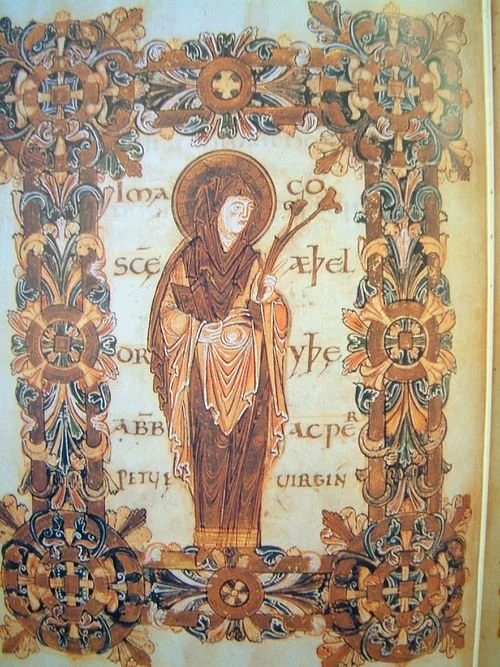
Medieval image of a woman with a halo

Saint Æthelthryth of Ely from the Benedictional of St. Æthelwold, a tenth-century illuminated manuscript in the British Library

11 March 2026

(Edit: minor factual corrections, 20 March 2026)

Something that is tawdry is cheap and gaudy. The word comes from the story of Saint Æþelðryþ (Æthelthryth), also known as Audrey, the daughter of Anna, a seventh-century king of East Anglia. Æthelthryth’s tale is recounted by Bede in his eighth-century Ecclesiastical History and by Ælfric in his late tenth-century Lives of Saints. It is said that Æthelthryth took a vow of perpetual virginity and managed to get through two marriages without sleeping with either husband. Her first husband died before he could get her into the marital bed, and the second marriage was eventually annulled, much to the relief of the very frustrated young man, who had gone so far as attempting to bribe the local bishop to release her from her vow and who, when she fled his advances, had chased after her across England. After the annulment, Æthelthryth took holy orders and went on to found an abbey in the town of Ely in East Anglia. Æthelthryth died of a large tumor on her neck, which she attributed to punishment for having worn many expensive jeweled necklaces in her younger years.

In the sixteenth and seventeenth centuries, lace necklaces, known as St. Audrey’s lace, were sold at the fair held each year on her feast day. And over time, the name of these lace necklaces became clipped to tawdry lace. The merchandise at this fair was the type of stuff that you would find at any tourist trap, cheap and gaudy, hence the fashion eventually became associated with finery of inferior quality.

John Palsgrave includes Seynt Audries lace in a glossary in his 1530 Lesclarcissement de la langue Francoyse, thought to be the first French grammar written in English. (Despite the French title, the text is in English.) Palsgrave translates the phrase with the French cordon, meaning tie. And we get tawdry lace by 1548, when we see it in a list of objectionable (i.e., Roman Catholic) religious practices in William Patten’s The Expedicion into Scotlande:

setting vp candels too saincts in euery corner, & knak kynge of beadstones in euery pewe, tollyng of belles against tempestes, Scala coeli Masses, Pardon Beades, Tanthonie belles, Tauthrie laces, Rosaries, Collets, charmes for euery diseas, and Suffrain suffrages for euery sore

(setting up candles to saints in every corner, & knacking of beads in every pew, tolling of bells against tempests, Scala coeli [ladder of heaven] Masses, Pardon Beads, Tantony [St. Anthony] bells, Tawdry laces, Rosaries, Collets, charms for every disease, and Suffering suffrages for every sore)

And we see tawdry lace, without any opprobrium, in Edmund Spenser’s 1579 Shepheardes Calender:

Ye shepheards daughters, that dwell on the greene,
     hye you there apace:
Let none come there, but that Virgins bene,
     to adorne her grace.
And when you come, whereas shee is in place,
See, that your rudenesse doe not you disgrace:
     Binde your fillets faste,
     And gird in your waste,
For more f[i]nesse, with a tawdrie lace.

But a century later, after the wearing of tawdry lace had fallen out of fashion, we see the adjective tawdry being used to mean cheap and gaudy. This usage appears in Nehemiah Grew’s 1672 Anatomy of Vegetables:

So that a Flower without its Empalement, would hang as uncouth and taudry as a Lady without her Bodies.

That’s how the name of an early medieval English saint came to mean something cheap and in poor taste.

Discuss this post


Sources:

Grew, Nehimiah. The Anatomy of Vegetables. London: for Spencer Hickman, 1672, 131. ProQuest: Early English Books Online (EEBO).

Oxford English Dictionary Online, 1910, s.v. tawdry, n. & adj., tawdry lace, n.

Palsgrave, John. Lesclarcissement de la langue Francoyse. London: Richard Pynson and John Hawkins, 1530, fol. 63r/2. ProQuest: Early English Books Online (EEBO).

Patten, William. The Expedicion into Scotlande, London: Richard Grafton, 1548, sig. c4v. ProQuest: Early English Books Online (EEBO).

Spenser, Edmund. The Shepheardes Calender. London: Hugh Singleton: 1579, fol. 13v. ProQuest: Early English Books Online (EEBO).

Image credit: Unknown tenth-century artist. London, British Library, Add MS 49598. Wikimedia Commons. Public domain image.


notorious

Photo of Ruth Bader Ginsberg, in judicial robe, sitting in a chair

The Notorious R.B.G.

9 March 2026

Usage manuals like to point out that notorious refers to someone or something of unfavorable reputation and that the word should not be used to mean merely famous or notable. While this is true to an extent, like many questions of usage the answer is more complicated, and in fact few writers actually use the word mistakenly.

Notorius comes into English a Medieval Latin word meaning famous, well-known, but it could also carry a negative connotation, infamous. When it was originally adopted into English it carried both of these connotations, the value-neutral one and the negative one. The adjective notorious isn’t recorded in English until the 1530s, but the adverb notoriously appears several decades earlier, around 1495, in a bill of attainder for Gerald fitz Thomas, earl of Kildare for treason and other crimes. Since adjectives generally predate their adverbial forms it is believed that the adjective is at least this old:

All we [which] wt [with] dyverse and many greate and horrible tresons, Rebellyons conceylmentes and conspiraces by him don & commytted contrary to his faith and allegeance be notoryously and openly knowne by due examynacon, and perfectly understanden to all the Lordes of this land and comynes of the same.

And we have this from a 1512 law granting a subsidy to King Henry VIII:

FOR ASMOCHE as it ys openly and notoryously knowen unto all p[er]sones of Cristes Religion, That Lewes the Frensche Kyng adversary unto owre moste drede Sovereigne and naturall liege Lorde Kyng Herry the viij and to hys realme of Englande hathe moved and styred and dayly moveth & styreth by all the subtyle meanes to hys powre to sett and bryng scisme variaunce and asmoche as in hym lyeth studyeth the meane of contynuall errour to be had in the Churche of Cryste.

In both of these examples the overall context may be a negative one, but the adverb notoriously is being used in with a value-neutral connotation, meaning simply openly, well known.

Another law book, this time from 1534, has two uses of the adjective notorious, and again both are in a negative context but the word itself has a value-neutral connotation. From the Constitutions Prouincialles, and of Otho and Octhobone:

LEt ther be in euery deanerye .ii. or .iii. men, hauynge god before theyr eyes, whych beynge appoynted at the commau[n]dement of the byshoppe or his officyalles maye denunce vnto them the open and notorious excesses of the prelates, & other clerkes.

And:

The preste may not inquyre the names of the persons with whom the co[n]fytent hath synned, but after confession he may inquyre, whether he were clerk or lay monke or preste or deane, & alwayes the greater crymes & specially suche as be notorious must be reserued to the hyer prelates

Very quickly, however, the word started being associated with fame of an unsavory or infamous nature. The 1549 Book of Common Prayer, for example, uses notorious twice. The first of these is again in a negative context but with the word itself carrying a value-neutral connotation:

And if any of those be an open and notorious euill liuer, so that the congregacion by hym is offended, or haue doen any wrong to his neighbours, by worde, or dede: The Curate shall cal hym, & aduertise hym, in any wise not to presume to the lordes table, vntill he haue openly declared hymselfe, to haue truly repented, and amended his former naughtie life.

And with the notorious itself carrying a negative connotation:

BRethre[n], in the primatiue churche there was a godlye discipline, that at the begynning of lente suche persones as were notorious sinners, were put to open penaunce, and punished in this worlde, that theyr soules myght be saued in the daye of the Lorde.

It was from oft-read uses like this that notorious acquired its unsavory reputation. But the sense of notorious with neutral, or even favorable, connotations did not go away and remains in use today. There is, however, a subtlety in its use.

When used to describe a person or persons, notorious carries the negative or infamous connotation, even if it is used humorously or in a mildly deprecating fashion, as when, for instance, Harry Truman writes in his diary of 20 September 1945:

We arrived in the Capital City at 7:45 P.M., E.S.T., and Alben and I had our pictures taken, as is usual when notorious persons leave or arrive in cities.

Almost two decades later, Truman uses the word again in his diary to describe himself, only this time it is even clearer that he is being playful with the word’s connotations. From 12 September 1962:

My home town, Independence, the County Seat of Jackson County, Missouri, is in my opinion the best place for a retired Missouri farmer to live. That state has had three “notorious” characters—Mark Twain, Jesse James and myself. The other two are shoveling coal for Pluto and I’m all that’s left to appear for them.

But when used to describe things or situations, notorious can have the neutral meaning of simply noted or famous. It can be pejorative, but such connotation has to be derived from the context and not simply from the word itself. Thus you get descriptions of “notorious dance marathons” of the 1920s or of E=mc2 as a “notorious equation.”

Most writers and native speakers of English understand this subtle distinction, even if it is only a tacit understanding, and will seldom use notorious incorrectly.

Discuss this post


Sources:

“Attainder of Gerald, Earl of Kildare.” In Agnes Conway, ed. Henry VII’s Relations with Scotland and Ireland, 1495–1498. Cambridge: Cambridge UP, 1932, 217. Lambeth, Carew MSS 603, fol. 177. Archive.org.

The Booke of the Commone Prayer and Administracion of the Sacramentes. London: Edward Whitchurch and Nicholas Hill, 1549, sig. fol. cc., fol. clii.v. ProQuest: Early English Books Online (EEBO).

Constitutions Prouincialles, and of Otho and Octhobone. London: Robert Redman, 1534, 76r, 94v. ProQuest: Early English Books Online (EEBO).

“De subsidio regi concess” (1512). 4 Hen. VIII. C. 19. In The Statutes of the Realm, vol. 3. London: 1817, 74. Archive.org.

Latham, Ronald E., David R. Howlett, and Richard K. Ashdowne, eds. Dictionary of Medieval Latin from British Sources. Oxford: British Academy, 2013, s.v. notorius. Brepolis: Database of Latin Dictionaries.

Merriam-Webster’s Dictionary of English Usage. Springfield, Massachusetts: 1994, s.v. notorious, 668–69. Archive.org.

Oxford English Dictionary Online, December 2003, s.v. notorious, adj.1 & adv., notoriously, adv.

Truman, Harry S. Off the Record: The Private Papers of Harry S. Truman. Robert H. Ferrell, ed. Harmondsworth, Middlesex, England: Penguin, 1980, 67, 406. Archive.org.

Photo credit: Steve Petteway/Supreme Court of the United States, 2016. Wikimedia Commons. Public domain image.

hurricane

Image of large tropical cyclone taken from earth orbit

Hurricane Florence, 12 September 2018, from the International Space Station

6 March 2026

Hurricane comes to us from the Taino language of the Caribbean via Spanish. The Taino word is hurákan. It makes its first English language appearance in Richard Eden’s 1555 translation of Gonzalo Fernández de Oviedo y Valdés’s 1535 summary of La historia general de las Indias. Eden included portions of Oviedo’s work, and the works of other authors, in his translation of Peter Martyr d’Anghiera’s Decadas del nuevo mundo:

Lykewyse when the deuyll greatly intendeth to feare theym, he threteneth to sende them great tempestes which they caule Furacanas or Haurachanas, and are so vehement that they ouerthrowe many howses and great trees.

Today, the official definition of a hurricane is a western-hemisphere tropical cyclone (i.e., forms over tropical or sub-tropical waters) with sustained winds of 64 knots (74 mph, 119 kph). Those with lower sustained winds are dubbed tropical storms. The Saffir-Simpson Hurricane Wind Scale classifies hurricanes into five categories of increasing severity based on windspeed, category five being the worst, with sustained winds in excess of 137 knots (157 mph, 252 kph).

Before 1953, the names of individual hurricanes and tropical storms were arbitrary and unofficial. For instance an 1842 storm ripped the mast off the boat Antje and became known as Antje’s Hurricane. Saint’s names for storms that hit on the particular saint’s feast day were also common but could be confusing if storms hit on the same day in multiple years. Beginning in 1953, names for North Atlantic storms were assigned by the U. S. National Weather Service, now NOAA’s National Hurricane Center. These names were originally all female ones, but in 1979 male names started to be alternated with female ones. Names for cyclones in other regions are assigned by various nations’ meteorological bureaus, and all of these names are coordinated by the World Meteorological Organization. When a storm is particularly devastating, the name is retired from the list and replaced. Recent retirees include Katrina (USA, 2005), Haiyan (Philippines, 2013), and Sandy (USA, 2012).

Discuss this post


Sources:

American Heritage Dictionary, fifth edition, 2017, s.v. hurricane, n.

Anghiera, Pietro Martire d'. The Decades of the Newe Worlde or West India. Richard Eden, trans. London: William Powell, 1555, 183. ProQuest: Early English Books Online (EEBO).

Oxford English Dictionary Online, 1899, s.v. hurricane, n.

“Tropical Cyclone Naming,” World Meteorological Organization, 24 November 2023.

Image credit: NASA/Goddard Space Flight Center, 2018. Wikimedia Commons. Public domain image.

poutine

A photo of poutine (French fires, cheese curds, and gravy) served in a cardboard carton

Poutine as served in Berlin, Germany (of all places), 2022

4 February 2026 (4 March 2026: added 1977 French citation)

Poutine is a contender for the Canadian national dish, although whether or not it can unseat Kraft Dinner (i.e., Kraft macaroni and cheese) in overall popularity is questionable. But the origins of both the dish and its name are shrouded in mystery, and its pedigree is not that long.

Poutine is a dish of French fries covered in gravy and cheese curds. Well-made poutine is both delicious and artery-hardening. Originating in Quebec, it is widely available across Canada, even being served in fast food restaurants like McDonalds and Burger King—although many would argue that what is served in these chain restaurants does not qualify as poutine.

While the dish most people today know as poutine dates only to the latter half of the twentieth century, The Canadian-French word poutine has been applied to a variety of dishes since the early nineteenth century. The word’s origin is a bit uncertain, but it is probably a dialectal variant of the French pouding or the English pudding. The word also has a slang sense in Canadian French that dates to at least the late 1950s meaning a complex affair or a mess, and this slang sense may have played a role in naming the dish.

There are various claims as to who first put cheese curds and gravy on French fries, but none have strong evidence to support them. Most commonly, it is asserted that Fernand Lachance, owner of Latin Qui Rit in Warwick, Quebec, was the culinary genius. He claims that in 1957 a customer asked him to mix cheese curds and fries, which he dubbed poutine because it created a mess. He says he started adding gravy in 1962 in order to keep the fries warm.

It's a neat story, and it very well may be true. But it seems more likely that the dish and the name is a variation on the older Acadian poutines rapées, a potato dumpling with a salt pork center.

But the earliest  attested use of poutine in Canadian French in reference to the modern dish that I’m aware of was unearthed by word sleuth Barry Popik in the Sherbrooke, Quebec newspaper La Tribune of 22 August 1977:

Un mets régional qui connaît une vogue croissante: la “poutine”

Drummondville (par Gérald Prince)—Quand on entend le mot “poutine,” on pense à la déformation du mot “pouding” et on imagine un dessert sucré qu’on pendra à la fin du repas.

Mais dans la région de Drummondville, dupis 4 ou 5 ans, c’est un toute autre chose: c’est un mets salé qui comprend du fromage en grains, des frites et de la sauce. Depuis sa mise au point par un restauranteur de Drummondville, M. Jean-Paul Roy, il a pris une telle importance dans la région que le plus important producteur de fromage en grains des environs, M. Marcel Lemaire de St-Cyrille, soutient que 90 pour cent de sa production sert à faire des poutines.

[…]

M. Roy rapelle qu’il a inventé la recette vers 1971, à la suite de la demande d’un client qui voulait des frites mélangées à du fromage. M. Roy imagina ultérieurement d’y ajouter de la sauce et le tour était joué.

(A regional dish enjoying increasing popularity: “poutine”

Drummondville (by Gérald Prince) — When you hear the word “poutine,” you think of a corruption of the word “pudding” and imagine a sweet dessert to be enjoyed at the end of a meal.

But in the Drummondville region, for the past four or five years, it’s something else entirely: a savory dish consisting of cheese curds, French fries, and gravy. Since its creation by Drummondville restaurateur Mr. Jean-Paul Roy, it has become so popular in the region that the largest cheese curd producer in the area, Mr. Marcel Lemaire of St-Cyrille, claims that 90 percent of his production is used to make poutine.

[…]

Mr. Roy recalls that he invented the recipe around 1971, following a customer’s request for French fries mixed with cheese. Mr. Roy later conceived the idea of ​​adding sauce, and the trick was done.)

The earliest English use of poutine in the sense of fries, cheese curds, and gravy that I have found is in the Montreal Gazette of 3 April 1980:

If you want to be truly chic in Sherbrooke, ask for a “poutine” which is French fries served with melted cheese and “beaucoup d’sauce.” The best places at the moment are La Wellington and Louis lunceonette [sic].

And there is this longer description in Manitoba’s Brandon Sun of 1 February 1982:

Although nutritionists may shudder at its starch, fat and salt content, a new fast-food snack is gaining on hot dogs, hamburgers and pizza in Quebec snack bars.

It’s called poutine and it combines french fried potatoes with curds of cheese and hot barbecue sauce.

[…]

Poutine, which has been popular for at least five years in southeastern Quebec, is responsible for almost doubling the sales of fresh curd or fromage en graine over the past two years.

[…]

Whoever originated the Quebec dish “borrowed” the name, said Harvey Godin, a government restaurant inspector.

“Don’t confuse it with poutines rapees which is an old Acadian dish,” he said. An Acadian from Rogersville, N.B., Godin has watched the new poutine grow in popularity during his travels as chief of the Industry department’s hotel services.

The original poutines rapees which he remembers eating as a child, are potato dumplings made with salt pork at the centre.


Sources:

Dictionary of Canadianisms on Historical Principles, second edition (DHCP-2), February 2017, s.v. poutine, n.

Dictionnaire historique du français québécois (DHFQ), 1998, s.v. poutine, n.

Oxford English Dictionary Online, December 2006, s.v. poutine, n.; September 2007, s.v. pudding, n.

Popik, Barry (@barrypopik). “Poutine (1977).” X.com, 4 March 2026.

“Poutine Popularity Rivals That of Burgers.” Brandon Sun (Manitoba), 1 February 1982, 12. NewspaperArchive.com.

Prince, Gérald. “Un mets régional qui connaît une vogue croissante: la ‘poutine.’” La Tribune (Sherbrooke, Quebec), 22 August 1977, 7/1–2. Newspapers.com.

Schnurmacher, Thomas. “Liz’s Mission Is a Big Secret.” Gazette (Montreal), 3 April 1980, 53/1. ProQuest Newspapers.

Photo credit: Berlinfoodeater, 2022. Wikimedia Commons. Licensed under the Creative Commons Attribution-Share Alike 4.0 International license.

laneway / laneway house

Photo of an urban back alley

A Toronto laneway

4 March 2026

Literally, laneway (lane + way) is a redundant term, and one that is unfamiliar to most Americans. It is found in Canada, Ireland, Australia, New Zealand, South Africa, and the U.K. Originally simply meaning a road, the word in Canadian usage has narrowed to mean an urban back alley. 

Today, laneway is chiefly found in Canada, but older instances of the term are found chiefly in Ireland. The oldest example I’ve been able to find, however, is in England’s Lancaster Gazette of 11 May 1822 in a notice of a property sale that describes the bounds of the property:

Also, all that other Close, Inclosure Piece or Parcel of Land or Ground […] called or commonly known by the name of Priest’s Meadow, […] bounded on or towards the East and West by lands belonging to the Reverend James Pedder, on or towards the North, by the said laneway or road, called Harbreck-lane, and on or towards the South, by by lands belonging to William Mashiter.

We see the distinctly Canadian sense of an urban back alley in the early twentieth century. From the Toronto Daily Star of 5 June 1911:

The light necessary to the tenants of the offices on the east side of the Traders Bank building is supplied from windows looking out over a narrow laneway and across the roof of the Nordheimer building.

And there is this from the 2 November 1923 issue of the same paper that makes the distinction between a laneway and a street clear:

Juryman: “Do you know if this is a laneway or a street?”

Mr Murphy: “It is a laneway, and has not been opened as a street. Application has been made.”

In the latter half of the twentieth century we get the Canadianism of laneway house or laneway dwelling, referring to a small house built on a laneway behind an existing house. The term is especially prevalent in Toronto and Vancouver. But there are some earlier uses of that phrase is a different sense.

There is this from Dublin’s Freeman’s Journal of 15 January 1883 that uses laneway house to refer to a drinking establishment. There are very few instances of the phrase laneway house prior to the 1990s, so I don’t know if laneway house was an Irish term for a pub or bar, or if this was just a reference to a building alongside a road that happened to serve drinks:

Mr. Joseph Erskine objected to any extension of Mr. Mooney’s premises. It was in houses like his young men got charged with drink and afterwards adjourned to low beerhouses.

The Recorder—That is, to my mind, a most fanciful objection.

Mr. T W Russell said there was a small laneway house in St Peter’s parish, and if Mr. Mooney would add it to Poolbeg-st (laughter) the thing could, perhaps be managed. His lordship would remember that Galvin bought three laneway houses for one six-day licence, and Mr. Mooney ought to come up to the current rate.

Coming back to Canada, we see this 22 April 1977 classified ad in Toronto’s Globe and Mail, but it clearly refers to something not only rural but far more luxurious than what most Canadians today would consider a laneway house. Instead, this appears to be a return to the older sense of laneway = road with a house located at the end:

WOODBINE

PICTURE book reality. Passing the dammed pond you arrive at the end of the limestone laneway house, featuring many extras, including 3 fireplaces & family room. Offering cathedral ceiling, & car garage. This stylish property also offers 100 acres, barn & out buildings.

The Dictionary of Canadianisms on Historical Principles (DHCP-2) says that the concept of laneway houses, built to create more affordable housing and as an eco-friendly way to increase urban density, dates to 1989. But the earliest use of the term that I’m aware of is from the Globe and Mail of 23 August 1997:

BUILDING a house with the front door on the back lane may not be up everyone’s alley. But for those hardy souls who want to build affordable yet unique dwellings in Toronto’s saturated core, a coach house or laneway house may be the only practical option.

[…]

The idea of living on a laneway, or at the end of an alley behind a series of back yards, gives many people the willies, but both women easily dismiss such concerns. “People are much friendlier in the back yard that at the front face,” Finlayson says, adding that this actually adds to her sense of protection.

While Ironside’s house is located in a slightly rougher area, she waxes poetic over laneway culture. “The stigma is totally undeserved. The life of the laneway is about kids playing, people working, pedestrian and bicycle connections. It’s so quiet on my lane. You have no sense that you’re just one row of houses from Queen and Bathurst.”


Sources:

“$80,000 Is Paid by the Traders Bank.” Toronto Daily Star, 5 June 1911, 13/4. ProQuest Newspapers.

Classified Ad. Globe and Mail (Toronto, Ontario), 22 April 1977, BL17/3. ProQuest Historical Newspapers.

Dictionary of Canadianisms on Historical Principles, second edition, October 2016, s. v. laneway, n., laneway house.

Kapusta, Beth. “Life in the Back Lane.” Globe and Mail (Toronto, Ontario), 23 August 1997, C15. ProQuest Historical Newspapers.

“Licensing Sessions.” Freeman’s Journal (Dublin, Ireland), 15 January 1883. 7/6. Gale Primary Sources: British Library Newspapers.

“No One Was to Blame for Fatal Accident.” Toronto Daily Star, 2 November 1923, 6/4. ProQuest Newspapers.

“Notice is Hereby Given.” Lancaster Gazette (England), 11 May 1822, 2/5. Gale Primary Sources: British Library Newspapers.

Oxford English Dictionary Online, 1901, s.v. lane-way, n.

Photo credit: OldYorkGuy, 2015. Wikimedia Commons. Licensed under the Creative Commons Attribution-Share Alike 3.0 Unported license.