chips / crisps / Saratoga potatoes

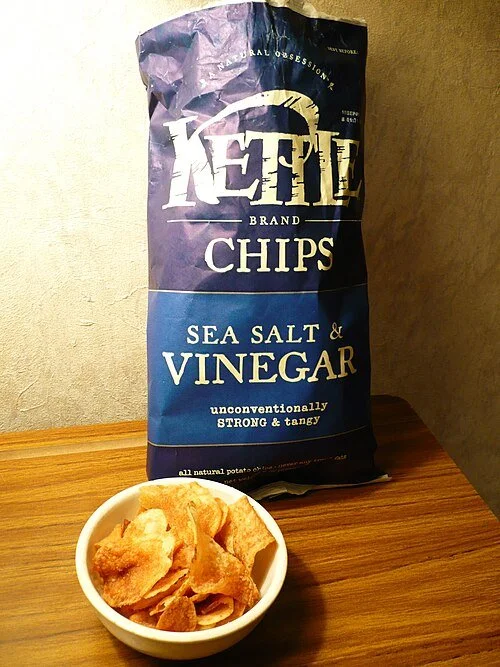
Photo of a bag and bowl of Kettle Foods-brand sea salt & vinegar potato chips/crisps

3 June 2026

One of the differences between North American and British English is the use of chip and crisp. Thin slices of potato fried until hard and brittle are chips in North America and crisps in Britain and the rest of the Commonwealth. And French-fried potatoes are chips in Britain and fries in North America. About the only place one will see this sense of chip in North America is in the phrase fish and chips, a usage and dish imported to America relatively recently from Britain.

But this difference was not always the case. For instance, the potato sense of crisp got its start in North America and didn’t make its way across the Atlantic to Britain until the twentieth century.

Crisp has a straightforward origin. The noun comes from the adjective, which in turn descends from the Old English cirps or crisp. But instead of a Germanic root, the Old English word was borrowed from the Latin crispus, meaning curled. In early use, the English word also had the sense of curled or curly. But in the sixteenth century it acquired the additional sense of brittle or stiff.

The origin of chip is more murky. The noun chip, meaning a small piece or shard of a larger object, probably comes from the verb meaning to cut or break into pieces, although the noun is attested about a century earlier. The noun appears in the mid fourteenth century and the verb in the mid fifteenth. There is an Old English word that is likely related, for-cippod, which appears four times in the extant corpus glossing the Latin praecisus, meaning to cut off or cut short. For-cippod is the past participle of the otherwise unattested verb *for-cippian, which hints that the verb *cippian also existed. There is also the Old English noun cipp which probably comes from the same root but which means rod, stick, or beam. These Old English words hint strongly that the word ultimately comes from a Germanic root.

The use of chip to refer to a French-fried potato dates to the mid nineteenth century. We see it in an article in the Mississippi Free Trader and Natchez Daily Gazette of 29 December 1841:

“They welcomed us to every thing, and we set off with our pockets filled with biscuit, jerked venisen [sic] and potatoe chips [sic], a sort of chrystalized [sic] preserve, steeped in syrup and then dried in the sun.

A little over a decade later, this sense of chip pops up in Britain. From Robert Smith Surtees’s 1854 novel Handley Cross:

By dint of playing a good knife and fork, our friend cleared his plate just as the second course made its appearance. This consisted of a brace of partridges guarding a diminutive snipe at the top, and three links of black pudding at the bottom—stewed celery, potato chips, puffs, and tartlets forming the side-dishes.

Crisp, on the other hand, isn’t attested until the end of the nineteenth century. We see it in this advertisement for a grocer in the Windsor, Ontario Evening Record of 6 January 1896:

Something Nice
Fresh Potato Crisps
In packages At
30 CENTS
Headquarters For
PURE FOOD PRODUCTS
J. A. DOUGALL
Your Grocer

And there is banquet menu printed in Benton Harbor, Michigan’s Daily Palladium of 25 April 1896:

     Bouillon
[???]ished Tongue       Cold Ham
                 Potato Crisps
[???]Fruited Jelly        Pickles

In case there is any doubt as to what crisp refers to, the following appeared the next day in a grocer’s ad in Evansville, Indiana’s Sunday Courier:

Potato crisp [sic] in one-half pound and pound packages. These are exceedingly delicate chips. Try them.

Crisps made their way down under the following year. From the Molong Express in New South Wales on 6 November 1897:

POTATO CRISPS—Skin and scrape four large, mealy raw potatoes. Mix with a little salt, a well beaten egg, and a little milk to moisten if needed. Fry a tablespoon in lard over a brisk fire, browning on both sides until crisp. Serve very hot. A little chopped onion improves the taste.

But we don’t see crisps in England until 1917. Another advertisement, this one from Middlesborough’s  North-Eastern Daily Gazette of 3 April of that year:

Try Nuts (all varieties, shelled) Nut Meals, Nut Butters, Nut Margarine, Cooking Nutter, Nutter Suet, Vegetable Lard, Nut and Vegetable Soups, Potato Crisps, Fruitarian Cakes, Proteid [?] Foods, Breakfast Foods, Special Biscuits, Chocolate, etc. Obtainable at the

SUFFRAGE HEALTH FOOD STORES

This advertisement for a potato crisp factory that was for sale appeared in London’s Daily Telegraph on 11 May 1922:

THE CENTRAL AGENCY, 179, EUSTON-RD., offer: POTATO CRISP FAC. Rent £160. Loc. 30 mis. Ldn., Profit £1,000 p.a. Books. Price £5,000.

And the Telegraph ran this help-wanted ad on 23 October 1922:

REQUIRED, MAN, capable of working potato crisp machine and frying. State experience and wages required.

There is another term for crisps or chips that you don’t hear much anymore, but which was enormously popular in the nineteenth century America, that is Saratoga crisp/chip/potato. It comes from the name of the resort town of Saratoga Springs, New York, which evidently had a reputation for serving crisps/chips in its restaurants.

A description of restaurant fare at the resort town of Richfield Springs, New York (about 75 miles / 120 km from Saratoga Springs) printed in Rhode Island’s Newport Mercury on 22 August 1868 reads:

When summoned, you are refreshed [with]
Broiled Otsego Bass with Cream,
Chicken Partridges,
Woodcock,
Saratoga Potatoes,
Frogs’ Legs and Potatoes a L[???]
Tea, Coffee, Rolls and fresh [???]

A banquet bill of fare printed in Kingston, Ontario’s Daily British Whig of 7 December 1870 lists “Saratoga chips” as one of the items served. And we see “Saratoga chips” on a banquet menu in the Brooklyn Daily Union of 12 October 1871:

Appearances of Saratoga potatoes/chips/crisps fall off markedly after the nineteenth century, although one can still occasionally see it.

But I cannot leave without including this recipe for Saratoga potatoes that drips with purple prose like oil from chips fresh out of the deep fryer. From Lexington’s Kentucky Gazette of 22 July 1874:

Saratoga potatoes, the poetry of common life, and costly charm of Delmonico’s and Parker’s, can be made in perfection in any kitchen, by the use of a very simple apparatus  consisting of a sharp blade set slanting into a wooden trough with a narrow slit in the bottom, two wire screens or sieves and a common spider. Select eight large potatoes, pare them and slice very thin with the cutting machine, soak them in cold water for two hours, and stir common table salt into the water, one teaspoonful to a quart, and allow them to remain in the brine half an hour longer. Pour them upon the screen to drain, and put on  spider with a pound of clear lard over a brisk fire. Wipe the sliced potatoes dry on a towel, wait until the lard is smoking hot, and pour a large plateful into the spider. The result is like a small sea in a white squall, and now the cook shows the artistic soul, which every votary of that noblest of the arts must possess to be worthy of the name. Patient and calm, with steady and incessant motion of the skimmer she prevents adhesion of any too affectionate slices and watches carefully for the tender blush of brownness to appear. Slowly it creeps and deepens until it rivals the hue of the fragrant Havana. Hast then takes the place of caution, lest any martyrs burn for the perfection of others; and they must be quickly spread upon another sieve to drain until dry and greaseless enough for the fairest fingers, then served hot, to melt like a kiss on sweet lips, with a dying crackle like the falling leaves of autumn.


Sources:

“[???]ssoli’s Third Annual [R]eception and Banquet at the Hotel Benton.” Daily Palladium (Benton Harbor, Michigan), 25 April 1896, 2/1. Newspapers.com.

“Businesses, Sales by Tender” (classified ad). Daily Telegraph (London), 11 May 1922, 16/7. Gale Primary Sources: Telegraph Historical Archive.

Classified ad. Evening Record (Windsor, Ontario), 6 January 1896, 8/1. Newspapers.com.

Dictionary of Old English: A to Le, 2024, s.v. for-cippod, past. part.; cirps, crisp, adj.

“Food Economy and Better Health” (advertisement). North-Eastern Daily Gazette (Middlesborough, England), 3 April 1917, 2/1. Newspapers.com.

“H. A. Cook & Son, Grocers” (advertisement). Sunday Courier (Evansville, Indiana), 26 April 1896, 8/7. Newspapers.com.

“Home Again.” Brooklyn Daily Union, 12 October 1871, 4/4. Newspapers.com.

“The Household. Recipes.” Molong Express and Western Districts Advertiser (New South Wales), 6 November 1897, 11/2. NewspaperArchive.com.

Middle English Dictionary, 31 January 2026, s.v. chippen, v., chippe, n., chip-ax, n., crisp, adj.

Mississippi Free Trader and Natchez Daily Gazette, 29 December 1841, 2/2. Newspapers.com.

Oxford English Dictionary Online, December 2021, s.v. chip, n.2, chip, v.1, Saratoga, n.; December 2006, s.v. potato chip, n.; 1893, s.v. crisp, n., crisp, adj.

“Richfield Springs.” Newport Mercury (Rhode Island), 22 August 1868. 28. Readex: America’s Historical Newspapers.

“St. Andrew’s Anniversary at Baltimore.” Daily British Whig (Kingston, Ontario), 7 December 1870, 2/5. Newspapers.com.

“Saratoga Fried Potato Secret.” Kentucky Gazette (Lexington), 22 July 1874, 2/1. Newspapers.com.

“Situations Vacant” (classified ad). Daily Telegraph (London), 23 October 1922, 19/2. Gale Primary Sources: Telegraph Historical Archive.

Surtees, Robert Smith. Handley Cross; or, Mr. Jorrocks’s Hunt. London: Bradbury, Agnew, 1854, 317. HathiTrust Digital Archive.

Image credit: Badagnani, 2008. Wikimedia Commons. Licensed under the Creative Commons Attribution 3.0 Unported license.

salient

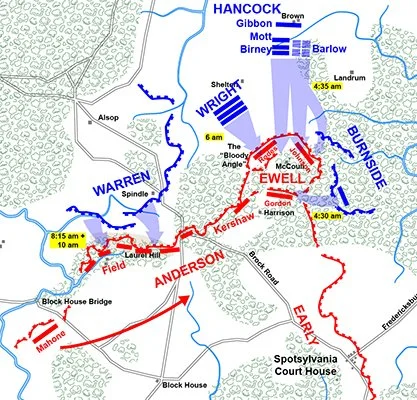
Map depicting a bulge in a defensive line under attack by enemy forces

The “Bloody Angle” salient in the Battle of Spotsylvania Courthouse, 1864

1 June 2026

Salient is a word that has traveled rather far afield semantically. Its two primary senses in Present-Day English are as an adjective meaning prominent or most important and as a noun in military jargon referring to a bulge or extension in a line of offense or defense. But one would never guess these senses from its origin.

The word comes into English from the Latin verb salire (to leap), and in particular from its present participle salientem (leaping). In addition, the verb's forms in early English use were influenced by the French saillant, which also stems from the Latin.

Salient’s earliest appearance in English was in the mid sixteenth century in the field of heraldry, where it was used to describe an animal on a coat of arms that was depicted as leaping, or rearing on its hind legs. The difference between salient and rampant in this application is rather subtle, as noted in Gerard Legh’s 1562 Accedens of Armory:

He beareth Argent, a Lion saliaunte, Geules you must note heare, the difference betwene the Lion Rampande, and this Lion. For this lifteth vp hys right pawe to the right corner of the Escocheon, and the Rampande, lifteth vp his left pawe to the same corner, and is more vpright then this.

Another heraldic book that was also, at times, titled Accedens of Armory also uses the term. This one was penned by John Bossewell in 1572:

As of beastes, the Lyon is to be commended & preferred before all others, who so euer beareth him, for that he is king of all beastes: but whether whe[n] he is borne passant, gardant, or regardant, rampant, saliant, seiante, couchant, or dormant, be moste worthiest, or auncient in Armes, I refer that to the Heraultes: yet not altogether, for I dare boldly affirme the bearing of him one way to be most of honor & souerainty: as when he is passant, gardant.

The overwhelming number of appearances of salient in the sixteenth and seventeenth centuries were in this heraldic sense. John Florio’s 1598 Italian–English dictionary, A World of Wordes, defines the Italian sagliénte as “climbing, mounting, salliant, ascendent,” where the use in heraldry was undoubtedly on Florio’s mind when he wrote this definition.

In this era we start to see writers and scholars adopting terms from Latin, so called inkhorn terms, and committing the etymological fallacy by using Latin senses and grammar to govern “correct” English. As part of this movement, by mid seventeenth century we start to see salient being used in English more generally in its original Latin sense, that of leaping. Thomas Browne, in his 1646 Pseudodoxia epidemica, uses this sense classify animals:

Lastly, the word it selfe is improper, and the tearme of Grashopper not appliable unto the Cicada; for therein the organs of motion are not contrived for saltation, nor are the hinder legges of such extension, as is observable in salient animalls, and such as move by leaping.

The sense of climbing, as in the heraldic images of animals, gave rise to the military sense, first in application to a fortified work that extended out from a defensive wall. We see this usage in Jacob Richards’s description of the 1686 siege of Buda (part of present-day Budapest) in which the Hapsburgs took the city from the Ottomans:

We pierc’d the Wall of the Lower Town looking into St. Paul's Valley, and carry’d on a 3d Angle Salliant, and rais’d a Battery of Spanish Guns on that side which regards the Round Tower, which have been well ply’d, and with so good Success, as to have ruin’d its Defence looking into the Valley.

And we see salient being used to refer to a bulge in a military line during the US Civil War, as in this 1891 account of the Battle of Spotsylvania Courthouse in Virginia on 12 May 1864 in which Union forces attacked a Confederate salient known as the Mule Shoe or, after the battle, the Bloody Angle:

Early on the morning of the 12th a general attack was made on the enemy in position. The Second Corps, Major-General Hancock commanding, carried a salient of the line, capturing most of Johnson’s division of Ewell’s corps and twenty pieces of artillery. But the resistance was so obstinate that the advantage gained did not prove decisive.

But the origin of the present-day sense of salient meaning prominent or most important stretches a bit further back. Its inspiration is a passage in Aristotle’s History of Animals about embryological development, which has a description of the first detection of what would become the animal’s heart:

Τοῦτο δὲ τὸ σημεῖον πηδᾳ̑ καὶ κινεῖται ὥσπερ ἔμψυχον.

(This leaping spot moves as though it were alive.)

Of course, Aristotle was using the Greek σημεῖον πηδᾳ̑ (simeíon pidȃ), not the Latin salientem punctum, but the association of the Latin with an embryonic heart would lead to this passage in a letter by Thomas Browne, whom we will recall from his use of salient in reference to grasshoppers. It was  written sometime before 1682, in reference to the death of a friend:

Tho, we could not have his Life, yet we missed not our desires in his soft Departure, which was scarce an Expiration; and his End not unlike his Beginning, when the salient Point scarce affords a sensible motion.

And the idea of the heart being central and most important would lead to present-day adjectival use meaning prominent. We see this sense in Thomas Carlyle’s 1840 On Heroes in this passage discussing Shakespeare’s history plays:

Marlborough, you recollect, said, he knew no English history but what he learned from Shakespeare. There are really, if we look to it, few as memorable Histories. The great salient points are admirably seized; all rounds itself off, into a kind of rhythmic coherence; it is, as Schlegel says epic;—as indeed all delineation by a great thinker will be.


Sources:

Aristotle. History of Animals. A. L. Peck, trans. Loeb Classical Library 437. Cambridge: Harvard UP, 6.3, 234–35. Loeb Classical Library Online.

Bossewell, John. Workes of Armorie Deuyded into Three Bookes, Entituled, the Concordes of Armorie, the Armorie of Honor, and of Coates and Creastes (alt. title Accendens of Armory). London: Richard Tottill, 1572,  fol. 21v. University of Michigan: Early English Books Online.

Browne, Thomas. A Letter to Friend, Upon Occasion of the Death of His Intimate Friend (before 1682). London: Charles Brome, 1690, 4. Early English Books Online (EEBO).

———. Pseudodoxia epidemica. London: T.H. for Edward Dod, 1646, 237. ProQuest: Early English Books Online (EEBO).

Carlyle, Thomas. On Heroes, Hero-Worship and the Heroic in History. London: Chapman and Hall, 1840, 101. HathiTrust Digital Library.

Florio, John. A World of Wordes. London: Arnold Hatfield for Edward Blount, 1598, sig. Ff2v. ProQuest: Early English Books Online (EEBO).

Legh, Gerard. Accedens of Armory. London: Richard Tottill, 1562, fol. 78r–v. ProQuest: Early English Books Online (EEBO).

Oxford English Dictionary Online, 1909 (modified March 2026), s.v. salient, adj. & n.

Richards, Jacob. A Journal of the Siege and Taking of Buda by the Imperial Army. London: M. Gilliflower and J. Partridge, 1687, 19. ProQuest: Early English Books Online (EEBO).

Scott, Robert N. The War of the Rebellion: A Compilation of the Official Records of the Union and Confederate Armies, series 1, vol. 36, part 1. Washington: Government Printing Office, 1891, 19. HathiTrust Digital Library.

Image credit: Hal Jesperson, 2011. Wikimedia Commons. Licensed under the Creative Commons Attribution 3.0 Unported license.
deepfake

Deepfake photo of Pope Francis wearing a white, puffy parka

“The Pope Drip,” a deepfake image of Pope Francis posted to Reddit on 24 March 2023

29 May 2026

A deepfake is a piece of artificially generated or manipulated media, especially a video, that is convincing. Deepfakes were among the first products of artificial intelligence to come to the attention of the general public. They started appearing in late 2017 when pornographic videos where a celebrity’s face had replaced that of the original performer started circulating on the internet.

The deep in deepfake comes from the phrase deep learning, which refers to the method of training machine-learning algorithms. Deep learning dates to at least 1986. But the term deepfake first appears as the screenname of a Reddit user who posted such pornographic videos on that site starting in 2017.

The Reddit user deepfakes came to the attention of the wider world on 11 December 2017 when journalist Samantha Cole wrote about him on Vice.com:

It’s not going to fool anyone who looks closely. Sometimes the face doesn’t track correctly and there’s an uncanny valley effect at play, but at a glance it seems believable. It’s especially striking considering that it’s allegedly the work of one person—a Redditor who goes by the name “deepfakes”—not a big special effects studio that can digitally recreate a young Princess Leia in Rogue One using CGI. Instead, deepfakes uses open-source machine learning tools like TensorFlow, which Google makes freely available to researchers, graduate students, and anyone with an interest in machine learning.

Two days later, the hashtag #DeepFake appeared on Twitter in a post linking to Cole’s article.

And Cole would use deepfake as a noun in a follow-up article on 24 January 2018:

In early January, shortly after Motherboard’s first deepfakes story broke, I called Peter Eckersley, chief computer scientist for the Electronic Frontier Foundation, to talk about the implications of this technology on society at large: “I think we’re on the cusp of this technology being really easy and widespread,” he told me, adding that deepfakes were pretty difficult to make at the time. “You can make fake videos with neural networks today, but people will be able to tell that you’ve done that if you look closely, and some of the techniques involved remain pretty advanced. That’s not going to stay true for more than a year or two.”

In fact, that barely stayed true for two months. We counted dozens of users who are experimenting with AI-assisted fake porn, some of which have created incredibly convincing videos.

The following month, on 21 February 2018, a post on the blog Lawfare discussed the broader implications of deepfakes beyond porn:

Belated recognition of the problem has spurred a variety of efforts to address this most recent illustration of truth decay, and at first blush there seems to be reason for optimism. Alas, the problem may soon take a significant turn for the worse thanks to deepfakes.

Get used to hearing that phrase. It refers to digital manipulation of sound, images, or video to impersonate someone or make it appear that a person did something—and to do so in a manner that is increasingly realistic, to the point that the unaided observer cannot detect the fake. Think of it as a destructive variation of the Turing test: imitation designed to mislead and deceive rather than to emulate and iterate.

And by 5 March 2018, traditional media had taken notice of the term. From the New York Times of that date:

The video, which appeared on the online forum Reddit, was what’s known as a “deepfake”—an ultrarealistic fake video made with artificial intelligence software. It was created using a program called FakeApp, which superimposed Mrs. Obama’s face onto the body of a pornographic film actress—if you didn’t know better, you might have thought it was really her.


Sources:

Chesney, Robert and Danielle Citron. “Deepfakes: A Looming Crisis for National Security, Democracy and Privacy?” Lawfare (blog), 21 February 2018.

Cole, Samantha. “AI-Assisted Fake Porn Is Here and We’re All Fucked.” Vice.com, 11 December 2017.

———. “We Are Truly Fucked: Everyone Is Making AI-Generated Fake Porn Now.” Vice.com, 24 January 2018.

Oxford English Dictionary Online, March 2023, s.v. deepfake, n.; 2020, s.v. deep learning, n.

Roose, Kevin. “It Was Only a Matter of Time: Here Comes an App for Fake Videos.” New York Times, 5 March 2018, A1/2. ProQuest.

Ruiz-Adame, Manuel (@ManuelRuizAdame), Twitter.com (now X.com), 13 December 2017.

Image credit: Unknown creator using Midjourney software, 2023. Wikimedia Commons. Reddit. Public domain image.


desi

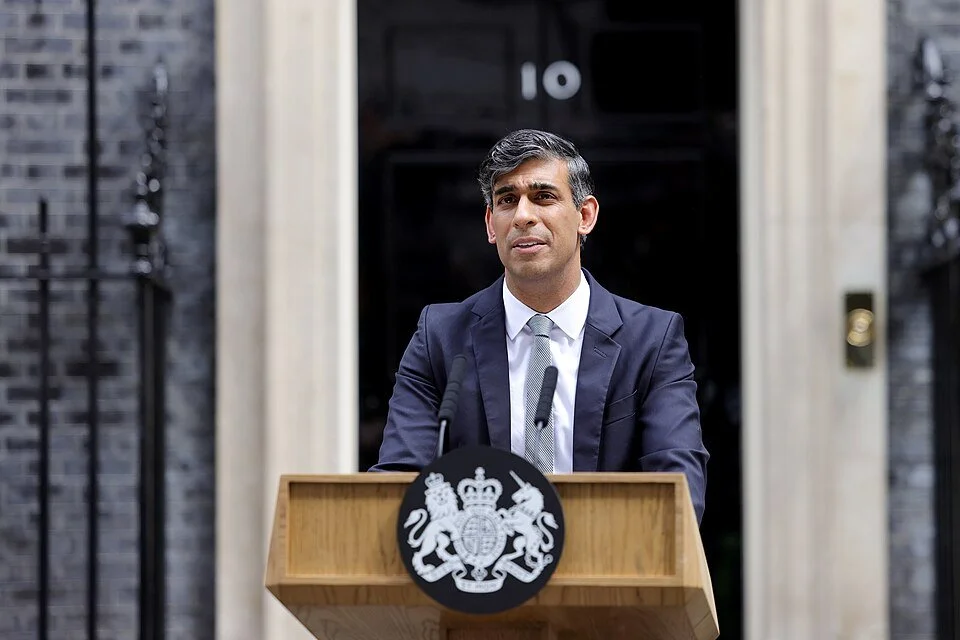
A desi man in a suit standing at a lectern in front of 10 Downing Street, London

British Prime Minister Rishi Sunak speaking upon his departure from office

27 May 2026

[Edit, 29 May 2026: clarified the etymology]

Desi is an adjective that refers to things of South Asian origin, and in recent decades has also come into use as a noun referring to people of South Asian descent outside of the region. The word comes from the Hindi desī, a noun meaning a native or inhabitant of a region and an adjective meaning native, local, or rural/rustic. The Hindi word comes from the Sanskrit deśī́ya (deśáḥ [place, region] + -iya [suffix forming adjectives]).

In appears in Anglo-Indian vocabulary, that is Indian words used in English and English words with distinctive senses in India, in the late nineteenth century. I found an 1880 use of desi in an article on Hindi etymology in Journal of the Asiatic Society of Bengal:

The commentary correctly explains it […] according to some it is a desí word meaning “blundering.”

And it can be found in two Anglo-Indian dictionaries of that decade. George Whitworth’s 1885 Anglo-Indian Dictionary has this entry, spelling it deshi:

Deshi. (Hindi deśi, from the Sanskrit deśa, country.) Native, belonging to the country, local. Often used in contradistinction to Viláyati.

Yule and Burnell’s 1886 Hobson-Jobson doesn’t have an entry for desi, but it has this in its entry for the word country:

The term, as well as the Hindustani desī, of which country is a translation, is also especially used for things grown or made in India as substitutes for certain foreign articles.

Rudyard Kipling uses desi in this sense in 1893 short story “The Finest Story in the World” in reference to Indian food:

And you’ll eat desi food, and like it all, from the smell of the courtyard to the mustard oil over you.

And there is this use in the April 1895 Calcutta Review in the context of textiles:

The Madhyama Kul and the Uttara Kul Tantuvás still adhere to weaving cotton-cloth, but their condition, on the whole, is not prosperous, as the demand for desi, or country-made, cloth is much diminishing.

In addition to referring generally to things of South Asian origin, desi is also used specifically to refer to folk and popular South Asian styles of music. There is this from the July 1888 issue of Calcutta Review:

Little is known, and much less is understood, of what is called Márga-desí or Harmonic Music, which was, no doubt cultivated at one time in this country. According to the author, Márga literally means offspring of search, enquiry, investigation &c. and Desí means local, indigenous, popular, and the compound word signifies a system of music, founded upon facts and principles determined empirically and æsthetically, as well as upon those ascertained by scientific investigations. But beyond the etymology, we have very little useful or reliable information on the subject.

In addition to the adjectival uses, by the late twentieth century desi could be used to refer to a South Asian person who is rustic or uncultured. Here is an example from John Masters’s 1972 novel The Ravi Lancers, set during the First World War:

But yesterday, Brigadier-General “Rainbow” Rogers, the senior office on board, had seen Lieutenant Mahadeo, the ex-rissaldar, eating rice with his hand, and had told Colonel Hanbury to get his officers house-trained without delay. They were taking it very well, thanks mainly to Krishna Ram’s attitude—all except Flaherty, the Anglo-Indian, who was staring with a surly mien at the empty plate before him, his head bowed.

“…Take up knife and fork, like this…Not like a dagger, Ishar Lall, more like a pencil…Try it, Flaherty.”

“I’m not a desi, sir,” the big man said sullenly. “I know how to use knives and forks.”

While this use of desi carries a negative connotation when applied to those living in South Asia, when applied to those of South Asian descent in diaspora it lacks the idea of rustic or unsophisticated, simply referring to their ethnicity. This sense appears in the closing decades of the twentieth century. From an article on slang in the 30 September 1988 issue of India Today:

In Bombay, an HMT is again no reference to a watch but to a “Hindi-medium type.” ABCD is more than a nursery lesson; it refers to “American-born confused desis” (a growing tribe).

And there is this from the Indian news website ap7am.com on 30 December 2023 with the title, “Beyond Rishi and Leo: The Political Desi’s Unstoppable Rise Around the World”:

In September this year, Singapore President Tharman Shanmugaratnam joined the growing list of Indian-origin leaders dominating the world politics, just as Rishi Sunak scripted history by becoming Britain's first desi premier in 2022.

And the article’s subhead reads, “The Political Desi in the US, UK, Canada.”

Discuss this post


Sources:

“Bengal: Its Castes and Curses. Calcutta Review, April 1895, 297. Gale Primary Sources: Nineteenth Century UK Periodicals.

“Beyond Rishi and Leo: The Political Desi’s Unstoppable Rise Around the World.” Ap7am.com, 30 December 2023.

Green’s Dictionary of Slang, accessed 1 May 2026, s.v. desi (boy), n.

Hoernle, A. F. Rudolf. “A Collection of Hindi Roots, with Remarks on Their Derivation and Classification. Journal of the Asiatic Society of Bengal, 11, 1880. 66. Gale Primary Sources: Nineteenth Century UK Periodicals.

“Hindu Music, Part I.” Calcutta Review, July 1888, xxi. Gale Primary Sources: Nineteenth Century UK Periodicals.

Kipling, Rudyard. “The Finest Story in the World.” Many Inventions. New York: D. Appleton, 1893, 106–150 at 135. HathiTrust Digital Library.

Masters, John. The Ravi Lancers. London: Book Club Associates, 1972, 80. Archive.org.

Merriam-Webster, 23 April 2026, s.v. desi, n.

Oxford English Dictionary Online, September 2004, s.v. desi, adj. & n.

Tripathi, Salil and David Devadas. “Campus Slang: Elite Students Coin an Increasingly Outlandish Vocabulary." India Today, 30 September 1988.

Whitworth, George Clifford. An Anglo-Indian Dictionary. London: Kegan Paul, Trench, 1885, s.v. Deshi, 82. HathiTrust Digital Library.

Yule, Henry and Arthur Coke Burnell. Hobson-Jobson: Being a Glossary of Anglo-Indian Colloquial Words and Phrases. London: John Murray, 1886, 206. HathiTrust Digital Library.

Photo credit: Kristy O’Connor/No 10 Downing Street, 2024. Wikimedia Commons. Flickr. Licensed under the Creative Commons Attribution-NonCommercial-NoDerivs 2.0 Generic License.

x-dimensional chess

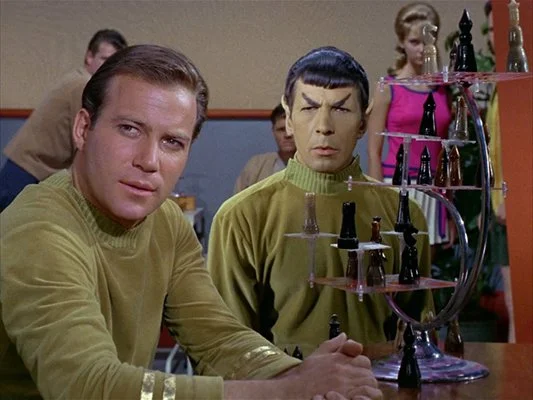
Screenshot of Capt. Kirk & Mr. Spock next to a 3-D chess board in the TV series Star Trek

Capt. Kirk (William Shatner) & Mr. Spock (Leonard Nimoy) from “Where No Man Has Gone Before,” S1.E3 of Star Trek, airdate: 22 September 1966 (Stardate 1312.4)

25 May 2026

Chess is considered by some to be the ultimate test of human intelligence, and multi-dimensional chess—three-, four-, five-, and even higher-dimensional versions—is a metaphor for even more complex tasks and strategies.

Three-dimensional chess started out as an actual variant on the game, or rather variants, as there are different versions of the game. It was invented in the early twentieth century, but within a few decades of its introduction, it had become a metaphor. And by the 1960s, notional higher-dimensional variants had entered the lexicon.

The earliest citation of three-dimensional chess in the Oxford English Dictionary is a literal one, found in H. J. R. Murray’s 1913 A History of Chess:

The latest derivative game of chess is Schachraumspiel, or Three dimensional chess (see Dr. Ferd. Maach, Das Schachraumspiel, 1908).

The German is literally chess-room-game or translated more idiomatically, spatial chess game.

But it wasn’t long before higher dimensions entered the picture. A. Merritt’s 1920 science fiction short story The Metal Monster uses fourth-dimensional chess to describe a complex, alien control panel:

The rods were movable; they formed a keyboard unimaginably complex; a keyboard whose infinite combinations were like a Fourth Dimensional chess game. I saw that only the swarms of tentacles that were the Keeper’s hands and these only could be masters of its incredible intricacies.

But the notion of three-dimensional chess really took off in the 1930s when it was erroneously associated with Albert Einstein. The idea of the famed physicist operating on a higher level undoubtedly fed the later figurative use of the term. The earliest reference to the game in connection to Einstein that I’m aware of is in Portland’s Sunday Oregonian of 26 January 1936:

When Colonel Lindbergh and his entourage left New Jersey they passed, so to speak, the door of Albert Einstein, who ponders mighty matters and plays three-dimensional chess with his colleagues for relaxation. Dr. Einstein must have deemed it curious indeed to see the colonel so hurriedly leaving a place where he, the doctor, had but recently so hurriedly arrived. It is a strange world, with some folk escaping to places which others are escaping from.

But Einstein did not actually play chess in any dimensions, as this 28 March 1936 article in New Jersey’s Asbury Park Press attests:

In answer to Smith’s questions, Prof. Einstein said yesterday he avoids playing bridge “because it affords too little relaxation.”

The scientist said also that his knowledge of three-dimensional chess, reputedly his favorite pastime, was limited to what he had read in the newspapers.

[…]

He disclosed that his chief form of diversion is walking. He is often seen taking strolls thru the country.

But the idea of Einstein playing three-dimensional chess was so compelling that the truth didn’t matter. Stories of him playing the game abound in the 1930s.

And, undoubtedly fueled by association with the physicist, figurative uses of three-dimensional chess as a metaphor for complex strategies appear in the wartime 1940s. The 28 June 1942 issue of the Miami Herald depicts complex billeting arrangements as a form of the game:

Last week was moving week for 653 TSS. Bright and early Monday morning, the whilom billetees of the Gale and Richmond hotels repaired to the Sea Isle, a 12-story barracks on the seaward side of Collins ave. at 31st st. The morning was featured by the three-dimensional chess game played by 653’s new top-kick, Sgt. George C. Barefield and Sgt. Clinton G. Gewirtz, in elevating squadron members to rooms on the top six floors.

The game is a simile for wartime logistics in Rhode Island’s Providence Journal of 11 June 1943:

The fact is that the oil transportation problem is much like a three-dimensional chess game. On the one hand, we have the crude oil-producing wells; on the other, we have the refineries; and above and below, we have the consumers—military, industrial and civilian. You can readily understand that this is on the complex side.

And the game is a metaphor for the strategy of island hopping in the Pacific theater in Alfred Vagt’s 1946 book Landing Operations:

By the beginning of December “a halt in the mud”—real, not metaphorical—had come about on Leyte. The tri-dimensional chess game of island warfare seemed to approach stalemate.

By the 1960s, three dimensions weren’t complex enough, and higher dimensions were necessary to describe the complexities of the modern age. We have avant-garde music likened to  five-dimensional chess in the Buffalo Evening News of 1 May 1967:

Involving a good deal of special talent to perform, it was something like watching some young, erudite physicists play five-dimensional chess—interesting and esoteric, but largely a matter for the performers themselves.

One wonders whether the appearance of a version of three-dimensional chess in the televsion series Star Trek, which premiered in 1966, further contributed to the popularity of the metaphor.

And by the twenty-first century, the number of dimensions was upped to six. From an article about Texas politics in the Houston Chronicle of 18 May 2014:

Back in San Antonio, the 10-member City Council would appoint a mayor until the May 2015 election.

“The process is not ideal. It’s a six-dimensional chess game with several variables,” said Councilman Rey Saldaña, who wouldn’t say yet whether he’ll seek the appointment.


Sources:

Baugh, Josh and Brian Chasnoff. “Castro Turned Down Past Obama Offer.” Houston Chronicle (Texas), 18 May 2014, A25/2. Readex: America’s Historical Newspapers.

“Dr. Einstein to Colonel Lindbergh.” Sunday Oregonian (Portland), 26 January 1936, 10/2. Readex: America’s Historical Newspapers.

Dwyer, John. “The Gallery: Color Film, Jazz Trio, Noise Are Latest Far-out Mixture.” Buffalo Evening News (New York), 1 May 1967, 13/1.Readex: America’s Historical Newspapers.

“East’s Oil Supply Called at Limit.” Providence Journal (Rhode Island), 11 June 1943, 2/2. Readex: America’s Historical Newspapers.

“Interviews Einstein.” Asbury Park Press (New Jersey), 28 March 1936, 5/2. ProQuest Newspapers.

Merritt, A. “The Metal Monster.” Argosy-Allstory Weekly, 125.2, 11 September 1920, 277. HathiTrust Digital Library.

Murray, H. J. R. A History of Chess. Oxford: Clarendon Press, 1913, 860. Archive.org.

Oxford English Dictionary Online, 2024, s.v. three-dimensional chess, n.

“653 TSS. Is Moved to Sea Isle Hotel.” Miami Herald, 28 June 1942, D-7/6. Readex: America’s Historical Newspapers.

Vagt, Alfred. Landing Operations: Strategy, Psychology, Tactics, Politics, from Antiquity to 1945. Harrisburg, Pennsylvania: Military Service Publishing Company, 1946, 792. HathiTrust Digital Library.

Photo credit: DesiLu Productions, 1966. Memory-Alpha.Fandom.com. Fair use of copyrighted image to illustrate the topic under discussion.