stump / stumper

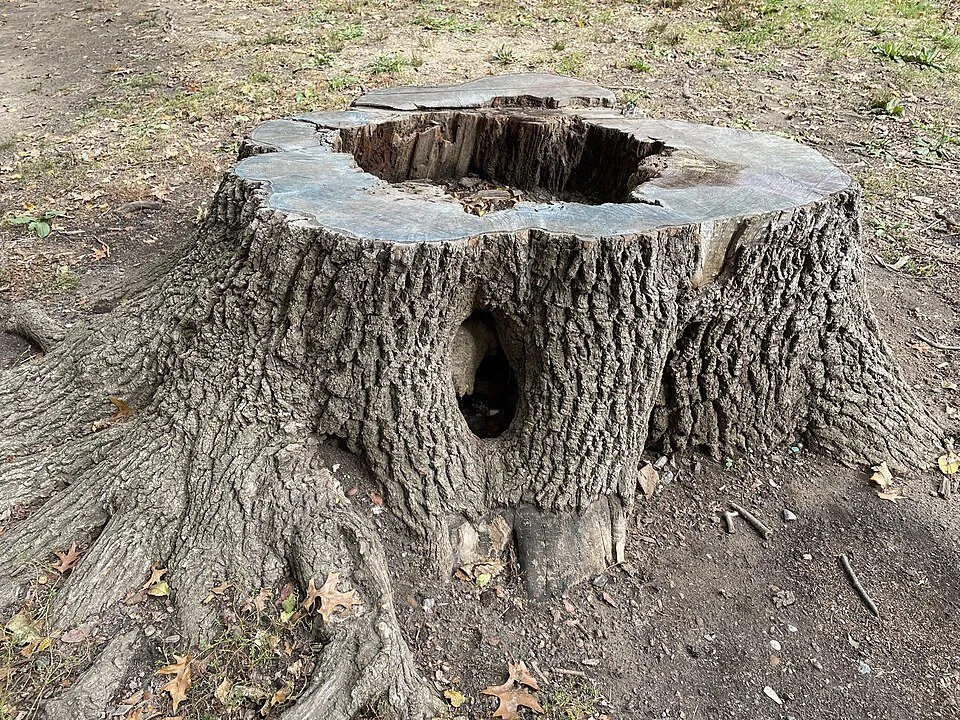
Photo of a tree stump in Prospect Park, New York City

15 June 2026

The word stump has a variety of meanings. It can be a noun referring to the what is left after a tree is cut down or a limb—of a tree or a person—is amputated. It can also refer to a place from which a political speech is delivered. And a stumper is an insolvable question or problem. It has been a verb meaning to trip or fall or to walk or tread heavily or to pose an unanswerable question. It has a number of cognates that trace back to the same Germanic root but which likely took different roots into English: stumble, stamp, and stomp.

Stump seems to be a borrowing from the Middle Low German stump or the Dutch stomp. We see it in the written record first as a verb meaning to stumble over a tree stump or obstacle. It appears in the debate poem The Owl and the Nightingale, which was composed in the first half of the thirteenth century:

For flesches lustes hi makeþ slide.
Ne beoþ heo noþt alle forlore
Þat stumpeþ at þe flesches more:
For moni wummon haueþ misdo
Þat arist op of þe slo.

(For fleshly lusts make her fall. But not all is lost if she stumps at the fleshly root: for many women who have sinned have risen up from the mud.)

The verb to stumble probably comes from the same Germanic root but likely entered English via a different route, a borrowing from Old Norse. While we don’t have a record of the sense, the appearance in this poem implies that the noun stump, meaning the remainder of a felled tree, was already in use.

We see this remainder sense about a century later, albeit in the sense of what’s left after a human limb has been amputated, in the poem Joseph of Arimathie. The poem was composed c. 1350 and a c. 1390 manuscript survives. This passage describes Joseph healing a warrior who has lost his arm in a battle:

Þenne com on fro þe fiht    þat foule was wemmed,
was striken of þat on Arm    and bar hit in þat other.
þen Ioseph asked þe kynges scheld    And bad þat mon knele,
þe arm helede a-ȝeyn    hol to þe stompe.

(Then [a man] came in from the fight who was badly wounded; one arm was stricken off and he bore it in the other. Then Joseph asked [for] the king’s shield and bade that the man kneel; the arm was healed again, whole to the stump.)

The tree sense is recorded in the Promptorium Parvulorum, an early English-Latin dictionary from the mid fifteenth century:

Stummpe of a tre hewyn done: Surcus, -ci

Surcus is a medieval Latin word referring to what remains after a tree has been cut down or a limb from a tree cut off.

In the Early Modern era, stump started to be used in extended senses referring to the remainder of other stalk- or limb-like things, such as pencils, animal tails, and ships’ masts. The use of stump to refer to the upright posts of a cricket wicket dates to the eighteenth century, as does the use of the verb to mean to knock over a cricket stump or dislodge the bail.

Also from the Early Modern era is the use of to stump meaning to walk heavily, as if with a wooden leg. Again, while it shares the same Germanic root as the semantically similar stamp and stomp, these others came into English via a different path, the Old English stempan.

In the early nineteenth century North America, stump started to be used in the sense of an insolvable question or problem. We first see it in form of the noun stumper. The satirical magazine Salmagundi, published by Washington Irving, of 20 March 1807 describes (invents?) a debate between an American and an Englishman about the meaning of a line from Shakespeare's Othello:

As ill luck would have it, they happened to run their heads full butt against a new reading. Now this was a stumper, as our friend Paddle would say, for the philadelphians are as inveterate new reading hunters as the cocknies, and for aught I know, as well skilled in finding them out.

Finally, the sense of stump to mean a platform or location from which a political speech is delivered also comes from early nineteenth century North America. The sense comes from the use, either literal or figurative, of tree stumps for such platforms. From the record of a debate in the US House of Representatives about the compensation of its members from 7 March 1816:

The gentleman (Mr. Huger) must pardon me, said Mr. R., if I think his arguments are better calculated for what is called on this side of the river stump, than for this Committee, &c.


Sources:

Bosworth, Joseph. In An Anglo-Saxon Dictionary Online, edited by Thomas Northcote Toller, Christ Sean, and Ondřej Tichy. Prague: Faculty of Arts, Charles University, 2014, s.v. stempan, v.

Cartlidge, Neil, ed. The Owl and the Nightingale, corrected edition. Exeter: University of Exeter Press, 2003, lines 1390–94, 34. London, British Library, MS Cotton Caligula A.ix.

“Compensation of Members” (7 March 1816). The Debates and Proceeding of the Congress of the United States, Fourteenth Congress—First Session. Washington, DC: Gales and Seaton, 1854, 1169. HathiTrust Digital Library.

Mayhew, A. L. The Promptorium Parvulorum (1908). Early English Text Society, Extra Series 102. Millwood, New York: Kraus Reprint, 1987, 444. Winchester, Chapter Library (olim Sylkstede). HathiTrust Digital Library.

Middle English Dictionary, 31 January 2026, s.v. stumpe, n.

Oxford English Dictionary Online, 1919, s.v. stump, n.1, stump, v.1, stumper, n., stumble, v.; 1915, stamp, v.; 1986; stomp, v.2.

Skeat, Walter W., ed. Joseph of Arimathie. Early English Text Society. London: N. Trübner, 1871, lines 678–81, 22. Oxford, Bodleian Library, MS Eng. poet. a. 1 (Vernon Manuscript). HathiTrust Digital Library.

Wizard, William (pseudonym for Washington Irving, William Irving, or James Kirke Paulding). “Theatricks.” Salmagundi; or, the Whim-Whams and Opinions of Launcelout Langstaff, Esq. No. 6, 20 March 1807, 121. HathiTrust Digital Archive.

Photo credit: CobbleHill621, 2021. Wikimedia Commons. Licensed under the Creative Commons Attribution-Share Alike 4.0 International license.

 

little green men / little people

Photo of a Coca-Cola vending machine bearing the image of a green extraterrestrial drinking a bottle of Coke

Vending machine in Roswell, New Mexico

12 June 2026

Before there were grays, reptilians, and other species of extraterrestrial beings that have visited earth in science fiction tales and in hallucinations, there were little green men. The phrase appears at the close of the nineteenth century but has its origins in older folklore about little people, a term for elves, fairies, and other mythical beings.

The shift from the supernatural and folkloric to the extraterrestrial and science fiction is a common one. As our understanding of the world changes our culture, the older beliefs are transformed into ones compatible with that understanding. Another example of this happening is demonic incubi and succubi, who allegedly visited people in their sleep, an explanation for hypnagogic hallucinations, transforming into alien visitors.

The phrase little people begins to be applied to fairies and the like in the eighteenth century. For instance, there is this published in the Delphick Oracle of 2 October 1719, although the little people here are humans of small stature whom the writer believes to be the origin of beliefs in fairies:

If then that they be Flesh and Bones, and are subject to Death, the Stories of these Fairies or little People, must proceed from those little People, about a Cubit, or 3 Spans in Height, call’d Pygmies; some of whose small Race are yet to be seen in the Island of Aruclet, one of the Molucca’s, and in the Isle of Cophi.

Poet George Waldron uses both little people and little men to denote the fairies believed by the locals to live on the Isle of Man. From his Description of the Isle of Man, written in 1726 and published posthumously in 1731:

I know not, Idolizers as they are of the Clergy, whether they would not be even refractory to them, were they to preach against the Existence of Fairies, or even against their being commonly seen: for tho’ the Priesthood are a kind of Gods among them, yet still Tradition is a greater God than they; and as they confidently assert that the first Inhabitants of their Island were Fairies, so do they maintain that these little People have still their Residence among them.

And there is this a little further on in the text:

A WOMAN who lived about two Miles distant from Ballasalli, and used to serve my Family with Butter, made me once very merry with a Story she told me of her Daughter, a Girl of about ten Years old, who being sent over the Fields to the Town, for a pennyworth of Tobacco for her Father, was on the top of a Mountain surrounded by a great Number of little Men, who would not suffer her to pass any farther.

A dispute breaks out among the little men as to whether they should abduct her or let her return home, at the end of which they rip her clothes off and beat her bloody. If there is a grain of truth to the story, it would appear to be that of a sexual assault by a gang of local men, hardly something to make one “very merry,” even in the sanitized version depicted by Waldron.

By the mid eighteenth century, such little people begin to be described as being clothed in green, and the phrase little green man starts to make its appearance. From “The Little Green Man of Smokhausen. A Legend of the Rhine,” a story printed in the Cherokee Advocate on 30 March 1853, which depicts a fairy-like, match-making spirit dressed in green:

The baron held out his hand, lifted the little green man down, and having placed a chair, by his request, on the other side of the table, his visitor seated himself on its back.

Another such depiction is F. M. Allen’s 1895 book The Little Green Man, a story about a leprechaun.

The little green people move from being earthly spirits to extraterrestrial beings at the close of the century. Charles Battell Loomis’s children’s story the Green Boy from Harrah tells of the adventures an earth boy named Sandy has with an extraterrestrial visitor, printed in the Atlanta Constitution of 8 October 1899:

“Where’d you come from? asked the little chap.

“From Harrah,” was the reply. He was just about Sandy’s size, but much slenderer, and his head was nearly twice as big. His eyes were yellow and shone like electric lights. His hair was a lighter shad of green than his body and his lipe [sic] were straw colored, uncanny looking, and yet not unhandsome, and decidedly friendly, for he rubbed Sandy’s cheeks with his long slender hands and made a cooing noise that evidently meant “I like you.”

“Where’s Harrah?” asked Sandy, but beyond pointing to the sky the green boy could not explain. Probably he had come from a star and Harrah was what he called it.

And we get the phrase little green men used in reference to ETs in the Sunday Oregonian of 29 July 1906:

And, sure enough, the man who opened the door came back in a minute and said that the president would come down at once and that he was anxious to meet Eddie of New York and then little green men from the moon.

Two years later, Ohio’s Columbus Evening Dispatch of 31 March 1908 printed this joke that shows that the phrase little green man had become widely understood as a reference to extraterrestrial beings:

The Martians were prepared to catch the first message from the earth.

“Let me see,” exclaimed the first little green man, “I wonder if the first communication will be a flash, a tick or a knock.”

“A knock, very likely,” laughed the second little green man. “You know the earth is just full of knockers.”

Which shows how wise the Martians really are.

I’ll conclude by discussing the Oxford English Dictionary’s earliest entry for little green man in a folkloric or science fiction context. It’s from an 1802 poem titled, The Little Green Man. A German Story, the opening stanzas of which read:

THE LITTLE GREEN MAN.
A German Story.

Ye warriors so bold, and ye ladies so gay,
At the Pump-room, at Ty——n’s, at K——g’s, or the play,
Oh never, oh never be seen;
For the Little Green Man will surely be there,
The Little Green Man, who delights to stare
So fierce, through his goggles of green.

The Little Green Man, in the dead of the night,
Fell in love with a maiden, all gaily bedight
In scarlet, in white, and in blue:
“Come, Lady, sweet Lady, with me come away;
Fine clothes you shall have, we will play a fine play;
Come home, I am dying for you!”

“Oh partner! oh partner! and dost thou not hear,
How the Little Green Man whispers low in mine ear
To follow him home from the ball?”
“He is joking, he’s joking—I tell you he is,
’T is only design’d as an innocent quiz,
’T is nothing, ’t is nothing at all.”

But this is not a poem about a fairy or ET. It is a about an ordinary man, whom we today might label as an incel, who accosts a woman at a ball, is subsequently beaten by the other gentlemen at the affair, and who swears revenge upon them. The green here would seem refer to jealousy. Also note the use of an archaic sense of quiz to mean an odd or eccentric person.

Discuss this post


Sources:

Allen, F. M. The Little Green Man. London: Downey, 1895. HathiTrust Digital Library.

Delphick Oracle,  2 October 1719, 3. ProQuest Historical Periodicals.

Historical Dictionary of Science Fiction, 17 November 2024, s.v. little green man, n.

“The Little Green Man. A German Story.” The Spirit of the Public Journals, vol. 5. London: James Ridgway, 1802, 348–50. HathiTrust Digital Library.

“The Little Green Man of Smokhausen. A Legend of the Rhine.” Cherokee Advocate (Tahlequah, Oklahoma), 30 March 1853, 1/4. Readex: America’s Historical Newspapers.

Loomis, Charles Battell. “Green Boy from ‘Harrah.’” Atlanta Constitution (Georgia), 8 October 1899, Constitution, Jr. 2/1. ProQuest Historical Newspapers.

Oxford English Dictionary Online, September 2014, little green man, n., little man, n., little people, n.

Palin, G. Herb. “The Little Green Men.” Sunday Oregonian (Portland), 29 July 1906, 47/3. Readex: America’s Historical Newspapers.

“Planet of Hammers.” Columbus Evening Dispatch (Ohio), 31 March 1908, 14/8.

Waldron, George. “A Description of the Isle of Man.” In Compleat Works, in Verse and Prose. Tracts, Political and Historical. London: Widows and Orphans, 1731, 93–191 at 125–26, 131. Gale Primary Sources: Eighteenth Century Collections Online.

Photo credit: mr_t_77, 2011. Wikimedia Commons. Licensed under the Creative Commons Attribution-Share Alike 2.0 Generic license.


bleach / bleachers

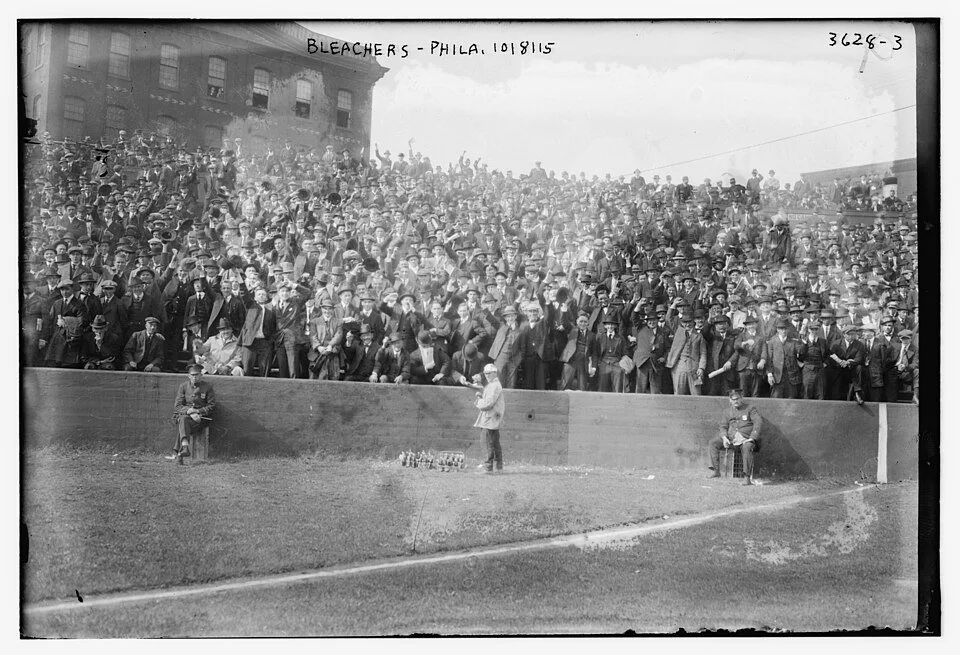
B&W photo of men occupying uncovered seats at the far end of a baseball field

Fans in the bleachers at Philadelphia’s Baker Bowl, 1915

10 June 2026

Bleachers are benches without backs or cover for spectators at sporting events, usually the most inexpensive seats in the venue. And the term is more generally used to refer to any uncovered seating at a sporting event. Bleacher can also refer to those who occupy those seats. The word, of course, is derived from bleach + -er. The word bleach has its origins in a common Germanic root, which gives us the Old English blæco (paleness) and blæcan (to whiten).

The sporting use first appears in the form bleaching boards, because of benches resemblance to frames used to whiten fabrics in the sun. And, like many English language words relating to sports, is first used in reference to baseball. The earliest use of bleaching boards to refer to ballpark seating that I’m aware of is from the Cincinnati Daily Enquirer of 9 May 1877:

The bull-pen at the Cincinnati Grounds, with its “three-for-a-quarter” crowd, has lost its usefulness. The bleaching-boards just north of the north pavilion now hold the cheap crowd which comes in at the end of the first inning on a discount.

In this passage, the bull-pen doesn’t refer to the pitchers’ warmup area, but rather to a roped off area where spectators could stand for a discounted ticket price. After the cheap seats started to be installed in parks, the bullpen area was turned over to the pitchers.

The form bleachers appears a decade later. From the Indianapolis News of 4 July 1887:

It was at first thought that the playing could be resumed, but the rain seemed pretty persistent in attending to business, and finally rain checks were issued.

The “bleachers” were quickly emptied when the flood came down, the portion of the audience located there making a break for the grand stand. The wits were there with such remarks as “Get a steamboat to run the bases.” A member of the home team facetiously cautioned one of the visitors to anchor the bats down to keep them from floating away.


Sources:

“BASE-BALL. The Battle for the League Pennant Opened.” Cincinnati Daily Enquirer (Ohio), 9 May 1877, 2/5. ProQuest Newspapers.

“Base Ball Gossip.” Indianapolis News (Indiana), 4 July 1887, 1/5. Newspapers.com.

Dickson, Paul. The Dickson Baseball Dictionary, third edition. New York: W. W. Norton, 2009, s.v. bleachers, n. & bleaching boards, n., 114–16.

Oxford English Dictionary Online, 1887, s.v. bleacher, n., bleach, v.1, bleach, n.1

Reitan, Peter. “Antedating of ‘Bleacher’ (Seating Area in Sports Arena).” ADS-L, 24 March 2025.

Photo credit: Bain News Service, 1915. Wikimedia Commons. Library of Congress. Public domain image.

birth control

Photo of a pharmacy shelf stocking contraception, pregnancy tests, and lubricants

The “day after” pill on a Portland, Oregon pharmacy shelf in 2020

8 June 2026

Birth control is a generic term for a variety of methods to promote family planning and prevent unwanted pregnancies. While various contraceptive practices have been in place for centuries (cf. condom), the term birth control in its current sense only dates to the opening decades of the twentieth century.

The Oxford English Dictionary has a citation of the term from a 13 November 1878 letter to Charles Darwin:

It is the final outcome of Human Evolution in the order of forces governing race propagation. It is necessarily evolved in the mind by the interaction of reason and sympathy, and its development proceeds on the fact of artificial birth-control, unopposed to the force of sexual passion which otherwise would, with the weaker individuals, most certainly be too powerful to permit its action.

But the context here is that of laws to prevent the “weaker” from marrying, not about methods of contraception. The “artificial” refers to legislative action, as opposed to the natural forces of sexual selection. The examples of the weaker mentioned in the letter are those suffering from tuberculosis, mental illness, and epilepsy. So while this use might fall under a capacious definition of the term, it is not a reference to modern contraception (cf. the Pill). And “race propagation” here is in the context of the survival of the human race in the face of a potential Malthusian catastrophe, not that of ethnic purity. The next use of birth control that I’m aware of is some thirty-six years later, so this one is at best an outlier and more likely simply a collocation of the two words and unrelated to our present-day use of the term.

That next use is in Montana’s Anaconda Standard of 19 August 1914:

Race suicide is virtue. At least Emma Goldman says so. In her final lecture in Butte last night, she took strong opposition to that so frequently advanced by Roosevelt. Miss Goldman is in favor of the rich raising the children for the wars and the factories, because they can best afford it. There are too many poor in the world now, and those already here should be given a chance. The strike against birth, so Miss Goldman says, is becoming one of the growing and irresistible world movements. In New York they organized a “birth control league,” and they are advocating laws that will legalize instruction, means and scientific knowledge along that line.

Goldman’s speech was delivered shortly after the outbreak of the First World War, hence the reference to war.

And there is this Associated Press piece from South Carolina’s Columbia Record of 20 October 1916 that uses birth control in reference to the efforts of Margaret Sanger, the founder of Planned Parenthood:

New York. Oct. 20.—Mrs. Margaret Sanger of this city, who was arrested and convicted but not punished while in Portland, Ore., recently for advocating birth control, announced today that clinics for the dissemination of information on the subject soon are to open in San Francisco, Cleveland and other western and inland cities. The police are searching for a clinic which is being conducted in the east New York section of Brooklyn and which has been advertised by distribution of handbills in English, Yiddish and Italian. The teaching of birth control here is a misdemeanor under the law.

I often find that the historical, literary, and social histories of a term are more interesting than the linguistics underlying it. And this is a good example. Birth control is still very much a contentious political issue, and the underlying politics of class, morality, and white supremacy that make the contraception controversial are the same today as they were a century ago.

Discuss this post


Sources:

Associated Press. “Arrested, Unpunished Woman Still Advocates Birth Control Clinics.” Columbia Record (South Carolina), 20 October 1916, 1/3. Readex: America’s Historical Newspapers. (Database metadata incorrectly identifies the date as 3 October.)

Gaskill, G. A. Letter to Charles Darwin (13 November 1878). In Jane Hume Clapperton. Scientific Meliorism and the Evolution of Happiness. London: Kegan Paul, Trench, 1885, 337–340 at 338. HathiTrust Digital Library.

“Opposed to Ideas Advanced by T. R.” Anaconda Standard (Montana), 19 August 1914, 9/2. NewspaperArchive.com.

Oxford English Dictionary Online, March 2020, s.v. birth control, n.

Photo credit: Sarahmirk, 2020. Wikimedia Commons. Licensed under the Creative Commons Attribution-Share Alike 4.0 International license.

black hole

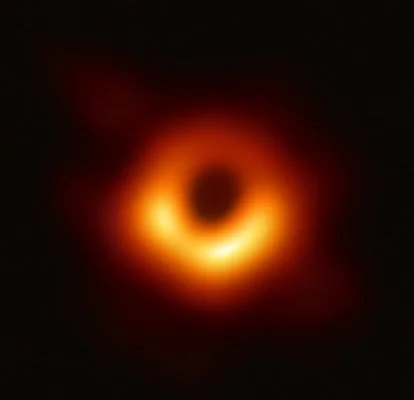
Photo of a dark circle surrounded by a bright, orange ring

The first direct visual image of a black hole in Messier 87, a supergiant elliptical galaxy in the constellation Virgo

5 June 2026

In the world of astronomy, a black hole is a cosmological object formed by the gravitational collapse of a star that is larger than about twenty solar masses. (Other mechanisms for black hole formation may exist.) The star, or remnants of the star after a supernova explosion, collapse into nothingness. Despite this collapse, the black hole retains the mass of the star, and therefore its gravity. And any matter or energy that gets close enough, that is crosses the event horizon, cannot escape its gravitational pull and will fall into it with no chance of escape.

Black holes were predicted as a consequence of Einstein’s general theory of relativity, and the modern understanding of black holes was pioneered by J. Robert Oppenheimer and Hartland Snyder in 1939. The term black hole, however, would not appear for another quarter century.

In the early 1960s, the term black hole was being batted about among physicists and astronomers and was first put into print in Science News-Letter on 18 January 1964:

Degenerate stars are not Hollywood types with low morals. They are dying stars, or white dwarfs, and make up about 10% of all stars in the sky.

[…]

Because a degenerate star is so dense, its gravitational field is very strong. According to Einstein’s general theory of relativity, as mass is added to a degenerate star a sudden collapse will take place and the intense gravitational field of the star will close in on itself.

Such a star then forms a “black hole” in the universe.

A few days later, the term was brought to the attention of the general public in an article in Life magazine on 24 January 1964:

Now Einstein’s theory predicts that if the gravitational collapse of a star did occur, the collapse would go on and the gravitational field would become stronger and stronger until it grew so powerful that it would close in upon itself; ultimately, the escape velocity would equal the speed of light, which is the speed limit of the universe. In that case nothing could get out of the star, not even light waves. Thus, instead of an intensely radiating object, sending out lavish quantities of light and radio energy, gravitational collapse would result in an invisible “black hole” in the universe. (To attain this “black hole” status, the matter comprising the earth would have to be compressed to a sphere slightly less than one inch in diameter.)

Theoretical physicist John Archibald Wheeler is often credited with coining the term black hole, but that is incorrect. He helped popularize the term, but there is no evidence that he invented it.

The phrase black hole is also used figuratively to refer to something from which there is no escape or return. While today this is often understand as metaphor for the cosmological object, the figurative use predates the astronomical use of the term. This figurative use appears in a science fiction story by P. Schuyler Miller in the February 1941 issue of Astounding Science Fiction:

To east and south and north—the road ahead was clear. There lay the great sky-reaching crags of the Mountains of the Night, blanketed in everlasting clouds, cleft by bottomless chasms, drenched by the endless rains that were slishing into the mire in which he lay, rattling on the forest roof above him. There, somewhere, was the mysterious Black Hole that had sucked a score of ether ships into oblivion since men first found this God-forsaken planet.

Instead of arising from the astronomical use, the opposite may be the case, with figurative use of black hole having played a role in astrophysicists naming the cosmological objects black holes.

And there is an even older astronomical use of black hole, referring to region of space, particularly in the Milky Way, that is seemingly devoid of stars. Edmund Beckett in the 1874 edition of his Astronomy without Mathematics uses the term:

Not only is the Milky Way composed of innumerable multitudes of stars, both large and small, but it has twice as many bright stars as are due to its space according to the average of the whole heavens. On the other hand, there are patches like black holes in it which contain no stars or scarcely any.

Such regions in the Milky Way are now understood to be dust clouds that obscure our view of the stars behind them. And seemingly starless regions outside the plane of the Milky Way have been shown, by modern telescopes and in particular the Hubble Deep Field experiment, to be filled with distant galaxies that are too faint to be seen with the unaided eye.

And there is an even older use of black hole to refer to a dungeon or prison. We see this use in a 1707 report in the Daily Courant about the actions of Richard Blondevil, the marshal of Dublin:

Resolved, That it is the Opinion of this Committee that the said Blondevil, upon very small Provocations hath Beaten, Bolted and put into a Place called the Black Hole, and kept there for several Hours, several of the said Prisoners.

While Blondevil was an Englishman imprisoning Irishmen, in the most famous use of the dungeon black hole it was the English who were thrown into the dungeon. That is the Black Hole of Calcutta, in which troops of Siraj-ud-Daulah, the nawab of Bengal, held British prisoners of war during the night of 20 June 1756. The conditions were so horrific that of the sixty-four British and Anglo-Indian soldiers and Indian civilians imprisoned that night, only some 21 survived. The phrase Black Hole of Calcutta appears in the Public Advertiser of 28 April 1761:

It appears by a Letter from Gustrow, that in the End of February the Prussians confined 2500 of the Mecklenburgers in the Cathedral of that City, where their Sufferings could be compared only to those of the English Gentlemen who were shut up in the Black-Hole of Calcutta in 1756.

As horrible as it was, at least some prisoners emerged from the Black Hole of Calcutta. That would not be the case with a stellar black hole, from which there is no escape.

Discuss this post


Sources:

Beckett, Edmund. Astronomy without Mathematics, fifth edition. London: Society for Promoting Christian Knowledge, 1874, 315. HathiTrust Digital Library.

Daily Courant, 26 August 1707, 1/2. Gale Primary Sources: Seventeenth and Eighteenth Century Burney Newspapers Collection.

Ewing, Ann. “‘Black Holes’ in Space.” Science News-Letter, 85.3, 18 January 1964, 39/1. JSTOR.

Miller, P. Schuyler. “Trouble on Tantalus.” Astounding Science Fiction, 26.6, February 1941, 48–66 at 48. Archive.org.

Oppenheimer, J. R. and H. Snyder. “On Continued Gravitational Contraction.” Physical Review, 56, 1 September 1939, 455–59. DOI: 10.1103/PhysRev.56.455.

Oxford English Dictionary Online, September 2011, s.v. black hole, n.

Public Advertiser (London), 28 April 1761, 2/2. Gale Primary Sources: Seventeenth and Eighteenth Century Burney Newspapers Collection.

Rosenfeld, Albert. “Heavens’ New Enigma.” Life, 24 January 1964, 11/4–12/2. Life Magazine Archive.

Image credit: Event Horizon Telescope (EHT)/European Southern Observatory, 2017. Wikimedia Commons. European Southern Observatory. Licensed under the Creative Commons Attribution 4.0 International license.