Grammy

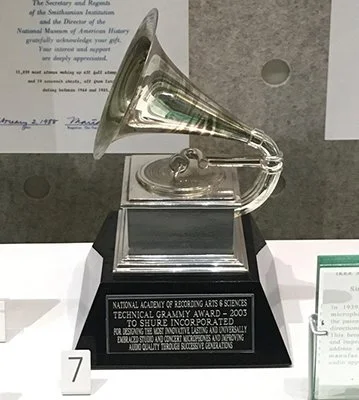
Photo of a Grammy statuette depicting a gramophone

2003 Technical Grammy award to the Shure corporation, a producer of microphones

23 September 2026

[A version of this entry originally appeared as a Words in the News segment for paying subscribers.]

The Grammys are given out by the Academy of Recording Arts & Sciences for achievement in the recording/music industry. The awards have been given annually since 1959.

The name is from gram[ophone] + -y, styled after the Emmy, the comparable award for the television industry. That award, in turn, is a variation on immy, a nickname for the image orthicon, an early type of video camera lens (cf. Emmy).

The earliest use of Grammy that I have spotted is from the Hollywood Reporter of 23 April 1959:

Newly organized Academy of Recording Arts & Sciences is previewing ITS award at the Derby—miniature gramophone called Grammy . . . Grammy, meet Oscar & Emmy

A more expansive piece, explaining the origin of the name, appeared a week later in the New Orleans Times-Picayune of 4 May 1959:

This is the week of Emmy and Grammy. I suppose quite a few people know by now that Emmy is the niece of Oscar and means the award symbol for the top television prizes for the year just ended. Grammy is the name of an award which will be given for the first time this year in the phonograph industry.

“Grammy” was selected because of its nomenclature similarity to grammophone [sic] which is what people used to call the phonograph in America and still do in England.

The Grammy awards in 28 categories of recording activity will be awarded at a banquet Monday night in Beverly Hills, Calif.

When the Academy of Recording Arts and Sciences set out to find a name for its equivalent to Oscar and Emmy, some 300 persons usggested [sic] the name Grammy, and of all those who thought this would be a good name for the statuette, a New Orleans girl one the prize for having the earliest post mark on her letter.


Sources:

Connolly, Mike. “Rambling Reporter.” Hollywood Reporter, 23 April 1959, 2/2. ProQuest: Trade Journal.

Myers, Sim. “On the Square: Now Grammy.” Times-Picayune (New Orleans), 4 May 1959, 32/2. Readex: America’s Historical Newspapers.

Oxford English Dictionary Online, 1989, s.v. Grammy, n.2.

Photo credit: Unknown photograph, 2016. Wikimedia Commons. Licensed under the Creative Commons Attribution-Share Alike 3.0 Unported license.
Emmy / image orthicon

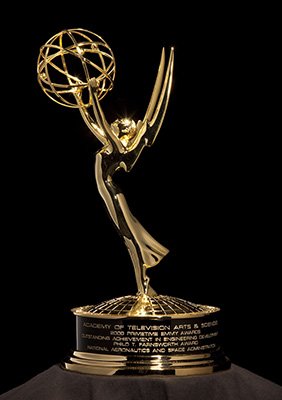
Photo of an Emmy statuette

2009 Emmy awarded to NASA for the Apollo 11 television broadcast from the moon

21 September 2026

The Emmys are a series of awards given by the Academy of Television Arts and Sciences (ATAS) for excellence in the field of television entertainment and technology. They have been given annually since 1949. The Emmy statuette depicts a winged woman holding up an atom.

The name Emmy is an alteration of Immy, an industry nickname for the image orthicon, a type of camera tube developed by RCA and first used by the U.S. military during the Second World War and made available for civilian use in 1946. Image orthicons were replaced by later technologies and phased out by 1968. According to the ATAS website, the name Immy for the award was suggested by Harry Lubke, who would become the ATAS’s third president, and changed to Emmy because that name was more appropriate for the female statuette.

The earliest reference to the Emmy awards in print that I am aware of is in Billboard magazine of 4 December 1948:

TV Emmy Award Gets ATAS Backin’

HOLLYWOOD, Nov. 27.—First video film competition to be sponsored locally will be backed by the Coast’s Academy of Television Arts and Sciences (ATAS). Winner of “the best film made for television” will be awarded an Emmy statuette, patterned after the famed Oscar, Motion Picture Academy award.

And another early appearance is this photo caption that appeared in the San Antonio Express of 26 January 1949:

It’s “EMMY” NOW—Actress Adelie Mara holds the “Emmy,” television’s version of the motion picture industry’s “Oscar,” to go to the most outstanding program.

The first public references to image orthicons are in newspaper reports dated 25 October 1945. Here is the one published the next day in the Chicago Daily Tribune:

A new television pickup “eye,” a camera tube so sensitive that at times it can see better than the human eye, emerged from war time secrecy today and was demonstrated in a studio of the National Broadcasting company.

The device, described as “image orthicon” and resembling a flashlight 15 inches long, picked up studio scenes with the aid of a small flashlight, then a couple of candles, a match, the glowing end of a cigaret [sic], and finally a scene in the dark, relying only on infra-red rays, which do not react on the eye.

The tube promises clearer television pictures under all conditions day and night, particularly outdoor night events.

Sources:

Acme Wirephoto. Photo caption. San Antonio Express (Texas), 26 January 1949, 5/4. Readex: America’s Historical Newspapers.

Merriam-Webster.com, accessed 29 August 2026, s.v. Emmy, n.

Oxford English Dictionary Online, 1972, s.v. Emmy, n.; September 2009, s.v. image orthicon, n.

Parker, Sandra. “History of the Emmy Statuette,” 12 August 2013. Televisionacademy.com.

Shapiro, Fred. “Antedating of ‘Emmy.’” ADS-L, 2 June 2020.

“Television ‘Eye’ Sees in Dark by Infra-Red Rays” (25 October 1945), Chicago Daily Tribune, 26 October 1945, 1/4. ProQuest Newspapers.

“TV Emmy Award Gets ATAS Backin’.” Billboard, 4 December 1948, 12/3. ProQuest Magazine.

Photo credit: NASA/Bill Ingalls, 2009. Wikimedia Commons. Flickr. Licensed under the Creative Commons Attribution 2.0 Generic license.

mayonnaise

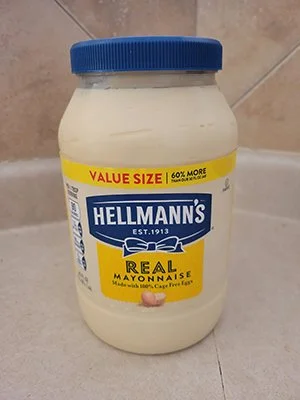
Photo of a jar of Hellman’s mayonnaise

18 September 2026

Mayonnaise is a creamy sauce made from oil, egg yolks, and vinegar, lemon juice, or other acid. It is commonly used on sandwiches and hamburgers, in salads, and on French fries. It also forms the base for other sauces like tartar sauce, ranch dressing, and some versions of aioli. The name mayonnaise first appears in French in 1804.

While many sources give a definite origin story for mayonnaise, the etymology is uncertain. It is commonly said to be named after the city of Port Mahón on the island of Minorca in the Mediterranean. French forces, under the command of Louis François Armand de Vignerot du Plessis, Duc de Richelieu, seized the island from the British in 1756 during the Seven Year’s War. Allegedly, the duke’s chef devised the sauce in celebration of the victory. Early spelling of the word is often rendered as mahonnaise. But there are chronological problems with this explanation. The word doesn’t appear in French until almost fifty years after the duke’s victory, and the original spelling is mayonnaise.

Another possibility is that mayonnaise is an alteration of bayonnaise, named for the city of Bayonne. This name appears in French in 1806. In his 1808 Manuel des Amphitryons Alexandre-Balthazar-Laurent Grimod de La Reynière wrote:

Les puristes, en cuisine, ne sont pas d’accord sur la dénomination de ces sortes de ragoûts; les uns disent mayonnaise, d’autres mahonnaise, et d’autres bayonnaise. Le premier de ces mots n’est pas français; et le second indique une ville où rien n’est renommé pour la bonne chère; c’est ce qui fait que nous nous sommes décidés pour bayonnaise, dont l’étymologie est dans le nom d’une ville qui renferme beaucoup de Gourmands inventeurs, et qui, de plus, donne naissance chaque année aux meilleurs jambons de l’Europe.

(Culinary purists disagree on the name for these types of ragouts: some call them mayonnaise, others mahonnaise, and still others bayonnaise. The first of these terms is not French, and the second refers to a city not renowned for fine dining; that is why we have opted for bayonnaise, a name derived from a city that is home to many inventive gourmets and that, moreover, produces the finest hams in Europe.)

Yet another explanation that appears in the early years of the word’s use in French is that it was originally magnonnaise, after the French verb manier, meaning to handle, a reference to the preparation of the sauce.

English language use of mayonnaise dates to 1813 when it appears in Louis Ude’s The French Cook; or The Art of Cookery:

No. 58.—Mayonnaise

Take three spoonfuls of Allemande, six ditto of aspic, and two of oil. Add a little tarragon vinegar, that has not boiled, some pepper and salt, and minced ravigotte, or merely some parsley. Then put in the members of fowl, or fillets of soles, &c. Your mayonnaise must be put to ice; neither are you to put the members into your sauce till it begins to freeze. Next dish your  meat or fish, mask with the sauce before it be quite frozen, and garnish your dish with whatever you think proper, as beet root, jelly, nasturtiums, &c.


Sources:

American Heritage Dictionary, fifth edition, 2022, s.v. mayonnaise, n.

Oxford English Dictionary Online, March 2001, s.v. mayonnaise, n.

Ude, Louis Eustache. The French Cook; or The Art of Cookery. London: Cox and Baylis, 1813, 34. Archive.org.

Photo credit: Dave Wilton, 2026. Licensable under the Creative Commons Attribution-NonCommercial-ShareAlike 4.0 International license.

marmalade

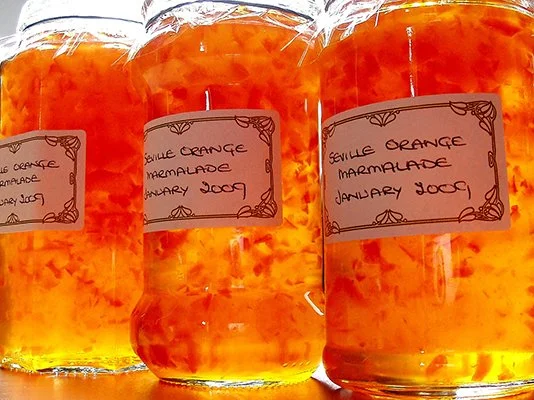
Three jars of homemade marmalade labeled “Seville Orange Marmalade January 2009”

16 September 2026

Marmalade is a jelly with pieces of fruit and rind suspended within it. It is now most commonly made primarily with oranges, but marmalade can be made with a variety of fruits; for instance, the original marmalade was made with quince. Appearances of marmalade are usually preceded by the name of the primary fruit, as in orange marmalade or apricot marmalade. But used on its own, marmalade now usually refers to orange marmalade.

The word was borrowed in the late fifteenth century from the Portuguese marmelada, a word for quince preserves, marmelo being the Portuguese for quince + -ade, being a drink or substance made from fruit. The Portuguese is from the post-classical Latin word for quince, malomellum, literally apple-honey. (Shifts from /l/ to /ɹ/, and vice versa, are common as both are alveolar approximants and easily mispronounced for one another.) The Hellenistic Greek μηλόμελι (milómeli) and classical Latin melimela referred to varieties of sweet apples. (The shift in the first vowel in the progression from classical to post-classical Latin is due to influence from the classical Latin malus, apple tree.) And the Ancient Greek μᾶλον or μῆλον (malon or milon) was the word for apple or similar fruit.

Originally, marmalade referred to a solid jelly cut into squares for eating. By the seventeenth century it had acquired the additional sense of jelly made from apples and citrus peel. Later it became the food we know today, preserves made by boiling fruit and then reboiling the liquid and fruit with sugar to create a mass with embedded rind.

The earliest known appearance of marmalade in English is in a 13 May 1480 letter written by a Richard Germyn:

Moreover, y late wrote you a letter and send him by oon John Symon, which gave you the orenges and marmelate at Exeter: which letter was delivered unto Lannos, skynner, in asmoche as ye be not at London.

It appears again in an inventory of provisions provided for the 1514 marriage of Mary, daughter of Henry VII of England, to Louis XII of France. Here we see the word in its original sense of a firm jelly for eating:

Item, a boxe of Codignac chare de qwynce marmelade.

And there is this in Thomas Elyot’s 1539 The Castel of Helth:

But yf he haue moche choler in his stomake or a heed full of vapours, it were moch better, that he dyd neyther drynke the one, nor the other, but rather eate a lyttell colyander sede prepared, or a pece of a quince rosted, or in marmelade, and after reste, to amende the lacke of nature with slepe, moderate exercise, and playsters prouyded for comfortynge of the stomake.


Sources:

Elyot, Thomas. The Castel of Helth. London: Thomas Berthelet, 1539, 46v–47r. ProQuest: Early English Books Online (EEBO).

Germyn, Richard. Letter to William Stoner (13 May 1480). The Stonor Letters and Papers, 1290–1483, vol. 2 of 2. Charles Lethbridge Kingsford, ed. Camden Third Series 30. London: Camden Society, 1919, 105. HathiTrust Digital Library.

Jerdan, William, ed. Rutland Papers. Camden Society. London: John Bowyer Nichols and Son, 1842, 27. HathiTrust Digital Library.

Oxford English Dictionary Online, December 2000, s.v. marmalade, n. & adj.

Photo Credit: Amanda Slater, 2009. Wikimedia Commons. Flickr. Licensed under the Creative Commons Attribution-Share Alike 2.0 Generic license.

tea (gossip)

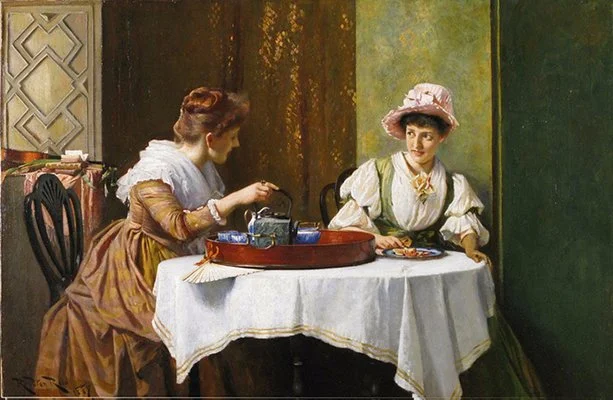
Painting of two women in 19th-century dress drinking tea and talking

“Little Tea and Gossip,” Robert Payton Reid, 1887

14 September 2026

The slang usage of tea to mean gossip is first documented in the early 1970s, although long before that the drink has been associated with gossip and the exchange of information as people would gather to socialize over the drink. In writing, the slang term is sometimes expressed as T.

As with many slang terms, the exact origins of tea as gossip are murky. Since slang is primarily oral, its use is often not documented for years, if not decades, after its coinage. Early written uses are found in both American gay and Black discourses, or perhaps it was gay-Black discourse.

The earliest documentation of the slang term that I’m aware of is in Bruce Rodgers 1972 Gay Talk (alternative title The Queen’s Vernacular). Rodgers’ lexicon has several entries relating to tea:

serve (some) tea to group together outside a restroom or bar to gossip; to gab everyone else’s tricks out the door.

scandal soup (camp) tea as a gossip’s refreshment.

have some tea engage in small talk.

A few years later, in February 1977, Joseph Chism, a dancer on the television show Soul Train, began writing a column for the Black magazine Right On! titled “And that’s the ‘T’!” Note that Chism was both Black and gay:

As I look back on the year 1976 and the Soul Train show, I have witnessed and been a part of many things. I have had some great times on the show and in this article I would like to share with you some of the “T” I have been a part of and some of the personalities I have been involved with.

So by this date (if not earlier), the term was circulating in Black discourse.

And later that year we see it in a 17 December 1977 gossip column in the Black newspaper the Racine Courier:

This week, once again, the hawk was in definite control of the streets, and the main weekend activity for most folks was running to get in out of the ice, snow, and cold, cold temperatures. But just like the mailman and the pony express, your Roving Eye was out there fighting the elements to bring you the latest hot tea…oops, I should say iced tea (gossip)!

(Hawk here is the regional term for winter winds off Lake Michigan.)

Tea often appears in the phrase spill the tea, meaning to tell or spread the gossip. This phrase was undoubtedly influenced by the older spill the beans. The first use of spill the tea in this sense that I’m aware of is from 1985, again written by a gay, Black man (see below for the quote).

We start seeing tea meaning gossip making its way into general American discourse in the 2010s. For instance there is this 5 December 2016 Business Wire article on the television show Real Housewives of Atlanta:

On today's premiere, Bravo's Real Housewives of Atlanta star, Sheree Whitfield, will join the show to “spill the tea” on her castmates, dig into the lasting impact of her iconic catchphrase “Who gon’ check me, boo,” and field questions from live video callers from the audience around the world via the VCC video calling platform.

Note that Whitfield is Black, so the use of tea here is still connected to Black culture and discourse.

But by the next year tea is shown to be firmly established in general slang, as can be seen in this article on Gen Z slang in the Philippines newspaper Business Mirror of 18 June 2017:

Tea-refers to juicy gossip, can be spilled (shared) or sipped (quietly consumed).

Time to spill the tea.

I'm just sitting here, sipping tea.

“What's the 411?” is long gone, and “tea” is now being used to refer to gossip in general. Variations like “spilling tea” or “sipping tea” show who’s sharing and who’s listening. It has found its way to mainstream online lifestyle and entertainment media, where the phrase is used in headlines and articles.

Finally, the oldest use of spill the tea that I’m aware of is in Billi Gordon’s 1985 Billi Gordon’s You’ve Had Worse Things in Your Mouth Cookbook. The etymology that Gordon relates is a tall tale and not to be taken seriously (for example, there is no reason to think the phrase has its origins in the antebellum South), but it’s worth repeating for several reasons. First, it is an early use of spill the tea. Second, it is a fun tale. Third, like many such tales there is a grain of truth in it, namely the Black and gay connections. Finally Gordon himself is a fascinating figure. He was a gay, Black actor and model, who frequently appeared in female roles. He was obese and a public advocate for social acceptance of overweight people and for public health issues. And following his entertainment career, he earned a PhD in neuroscience. Truly a renaissance man. Here is what Gordon wrote about tea:

The Final “T”

Before I go any further, let me explain the meaning of the word “T.” T has a rich heritage. It comes from the slave women. You see, when the slave women were serving the old belles of the antebellum south, they used to eavesdrop on the gossip at the tea parties. The belles would, of course, be gossiping about what Rebecca was doing with Beauregard, and what Ellie Ann had been rumored to have done with those frisky Merrill boys.

Well, sometimes the slave women would become so engrossed in the gossip that they would stop paying attention to what they were doing and spill the tea. And when they got back to the kitchen, the cooks and helpers would ask the servers, “Well, did you spill the tea, girl?” Meaning, of course, was the gossip good? Hence the expression, “spill the T.”

Then came the war, and a ravaged and ragged south turned its weak and battered eyes towards a dark and dismal sky, and a silence fell upon Atlanta, a silence more frightening than the thunder of the Yankee cannons…oops wrong story…What happened was the freeing of the slaves, and a lot of the slave women went into “domestic work” where they continued to use the expression “spill the tea” to mean “give me the juice” or the jist of it. Well most of the rich white women’s sons grew up to be gay. And the rich queens brought the expression to the gay bars. At the bars it was shortened to “T,” meaning, “pertinent facts,” “jist of,” “skinny on,” “story,” etc. Now there’s even low T and high T. High T being good news or good information, and Low T bad news or terrible facts.


Sources:

Annell. “The Roving Eye.” Racine Courier (Wisconsin), 17 December 1977, 5/1. Readex: America’s Historical Newspapers.

Chism, Joseph. “And that’s the ‘T’!” Right On!, 6.4, February 1977, 22. Archive.org.

Gordon, Billi. Billi Gordon’s You’ve Had Worse Things in Your Mouth Cookbook. San Francisco: West Graphics, 1985, 82. Archive.org.

Green’s Dictionary of Slang, accessed 19 August 2026, s.v. tea, n.

Merriam-Webster.com, s.v. tea, n.

Mullins, Bill. “Tea, and more.” ADS-L, 1 July 2024 and 2 July 2024.

Oxford English Dictionary Online, 1910, s.v. tea, n.

Preston-Kendal, Daphne. “Tea, and more.” ADS-L, 3 July 2024.

Rodgers, Bruce. Gay Talk (alt. title The Queen’s Vernacular). New York: Paragon, 1972, 177, 178, and 194.

Sirof, Evan. “Bravo's RHOA Star Sheree Whitfield Spills the Tea with Fans and Revisits ‘Who gon’ check me, boo?’ in Daily Video Call-In Gossip Show Premiere.” Business Wire (New York), 5 December 2016. ProQuest Wire Feed.

“Who Are the Gen Z and What’s the Language They Speak?” Business Mirror (Makati City, Philippines), 18 June 2017. ProQuest Newspapers.

Zimmer, Ben. “Tea, and more.” ADS-L, 1 July 2024.

Image credit: Robert Payton Reid, 1887. Wikimedia Commons. Public domain photo as a faithful reproduction of a public domain work.