
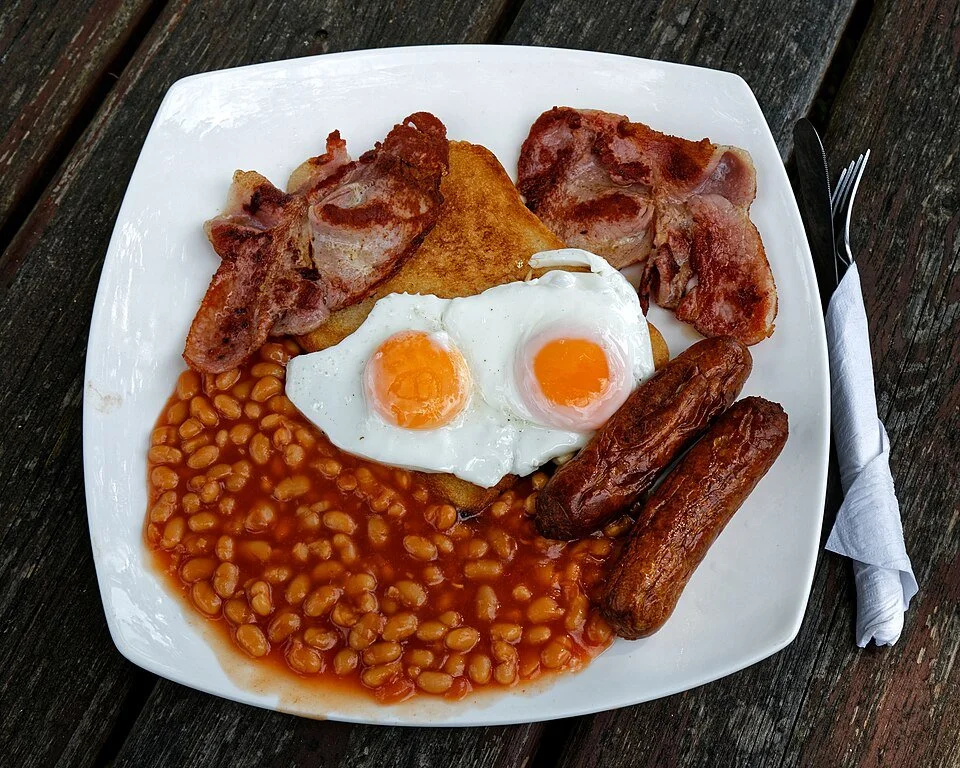
A full English breakfast
17 April 2026
Breakfast has a very straightforward etymology. It is a compound of break + fast, that is a meal eaten after period of abstention from food, usually while sleeping overnight. The word dates to at least the mid fifteenth century, but exactly what food a breakfast consists of has varied over the years and from place to place. We have Continental breakfasts and English breakfasts, not to mention, for those fans of Peter Jackson’s Lord of the Rings movies, second breakfasts.
The earliest use of breakfast that I’m aware of is in the account books of John Howard, the first duke of Norfolk. Those records contain the following entry for the year 1463:
Item, the xxij. day off Septembyr, in exspensys in breffast, xj.d.
And we see the verb to breakfast, meaning to eat a breakfast, in the 1644 pamphlet Huls Pillar of Providence Erected, an account of the siege of Hull by royalist forces during the English Civil War. It has the following description of the breaking of the siege by parliamentary forces on 12 October 1642. Note that the breakfasting here is metaphorical; the royalists are being served defeat by the parliamentary army:
How comfortably did the whole Towne almost look over the walles that whole day, and see this salvation of God?
15. Lastly, being thus breakfasted on wednesday, that night they sup with fears and curses, and hasty purposes of being gone from us. The Lord on a sudden sweeps them away, they steale away the remaining Ordnance in the night.
As traditionally conceived, a Continental breakfast is a light meal consisting of foods like toast, pastries, yogurt, and coffee, the continent in question being Europe. But I found an early example of the phrase being used to refer to a hearty meal served in the late morning. From an article in the New Sporting Magazine of April 1838 by one Nimrod, which describes such a meal served to a hunting party in Belgium:
For myself, I commenced with pig’s puddings, and finished with mutton cutlets, to say nothing of the most delightful brown bread and butter I ever tasted in my life; coffee, tea, et cetera—not forgetting a little drop of “something short,” to keep things in their places, as Mrs. Ramsbottom used to say. But speaking seriously, a continental breakfast at that hour is a most glorious meal.
But by mid century we see Continental breakfast used to describe the meal we’re familiar with today. From an 8 January 1851 letter published in the Louisville Weekly Journal:
Taking, then, Murray’s Guide Book, the faithful Friday of all English and American Crusoes, under my arm, my friend F. and I sallied forth in the direction of the Capitol, stopping on the way to take the usual continental breakfast, a cup of coffee or chocolate and bread.
In contrast to the Continental breakfast, the English breakfast is a large meal, with a full English breakfast traditionally consisting of bacon, sausages, eggs, black pudding, tomatoes, mushrooms, baked beans, and toast. And depending where you are in the islands, it can also be referred to as a full Scottish, Welsh, or Irish breakfast.
The earliest use of English breakfast that I’ve found is in an account of a visit to Holland dated 31 July 1817 that refers to a meal served aboard a British ship that has crossed the channel:
But after a little consultation, and as every one thought he could discover anguish in the countenance of his neighbour at the threatened durance, our pilot, who had speedily retired below to the comforts of a good English breakfast, was no less hastily called upon deck, when, much against his liking, he was directed to carry the ship into the Helvoet channel, where the Harwich packets go, and into which there is water at all times of tide.
But like the term Continental breakfast, what an English breakfast consisted of was not fixed in the early years. Susan Ferrier’s 1819 novel Marriage uses the term to denote a light meal, like that served on the Continent, in contrast to the fuller meal served in Scotland:
“I own I was surprised to see you cut so good a figure after the delicious meals you have been accustomed to in the north: you must find it miserable picking here. An English breakfast,” glancing with contempt at the eggs, muffins, toast, preserves, &c. &c. he had collected round him, “is really a most insipid meal: if I did not make rule of rising early and taking regular exercise, I doubt very much if I should be able to swallow a mouthful—there’s nothing to whet the appetite here; and it’s the same every where; as Yellowchops says, our breakfasts are a disgrace to England. One would think the whole nation was upon a regimen of tea and toast—from Land’s End to Berwick-on-Tweed, nothing but tea and toast.”
But by the opening years of the twentieth century the definition of an English breakfast had settled down, and we see the phrase full English breakfast. From Douglas Sladen’s 1908 Egypt and the English:
The catering, as I have said, was not done by the Sudan Government itself, but let out to a Greek contractor, who, all things considered, did his work pretty well, because he contrived to give his passengers a full English breakfast, lunch, and dinner, moderately well-cooked, and with hardly anything overhung; things must be very difficult to keep sound on a train in that temperature. Als the mineral waters were iced.
And there is this classified ad that appeared in the London Times on 4 June 1928:
A CHARMING RESIDENCE. facing gardens, two minutes Marble Arch: Bed-Sitting Room. full English breakfast. 2gns.; large double, 3gns.: optional four-course dinner, 3s.; best of food: hot and cold water.
Finally, what about the hobbits’ second breakfast in J. R. R. Tolkien’s The Lord of the Rings? The phrase does not appear in the books, existing only in Peter Jackson’s filmed version. The novels do refer to hobbits preferring to eat six meals a day, but it does not name them. But outside of Middle-Earth, second breakfast is traditionally a thing in central Europe, and there is this account of a second breakfast served in England in James Woodforde’s diary for 2 January 1775:
Dr. Wall breakfasted with me and went with me in the Bath Machine, it being a Frost so far as Burford. Mr. Fisher of University Coll: went with us in the Machine as did one Sally Kirby, a servant made of one Mrs. Horwood of Holton near Ansford who is now at Bath and bad in the gout. We stayed at Whitney and made a second breakfast, we treated the made at Whitney, I pd 0. 1. 6.
Sources:
“Accounts and Memoranda of Sir John Howard, first Duke of Norfolk, A.D. 1462 to A.D. 1471.”Manners and Household Expenses of England in the Thirteenth and Fifteenth Centuries. London: William Nicol, Shakspeare Press, 1841, 224. HathiTrust Digital Library.
Classified Ad. Times (London), 4 June 1928, 2/7. Gale Primary Sources: Times Digital Archive.
Coleman, Thomas. Huls Pillar of Providence Erected. London: Ralph Rounthwait, 1644, 13. ProQuest: Early English Books Online (EEBO). University of Michigan Early English Books Online Collection (EEBO-TCP).
Ferrier, Susan. Marriage, a Novel, vol. 2 of 3, second edition. Edinburgh: William Blackwood, 1819, 170–171. HathiTrust Digital Library.
“Journal of a Visit to Holland” (31 July 1817). Edinburgh Magazine and Literary Miscellany, vol. 3, July 1818, 36–38 at 36. ProQuest Historical Periodical.
Letter, 8 January 1851. Louisville Weekly Journal (Kentucky), 19 March 1851, 1/9. Readex: America’s Historical Newspapers.
Middle English Dictionary, 31 January 2026, s.v. breke-fast, n.
Nimrod. “The Feast of Saint Hubert—Or a Visit to Belgium.” New Sporting Magazine, 14.84, April 1838, 221. ProQuest Historical Periodical.
Oxford English Dictionary Online, March 2024, s.v. breakfast, n., breakfast, v.; 2012, s.v. all-day breakfast, n., American breakfast, n.; 2008, s.v. English breakfast, n.; 1911, s.v. second breakfast, n.; 1893, s.v. continental, adj. & n.
Sladen, Douglas. Egypt and the English. London: Hurst and Blackett, 1908, 315. Gale Primary Sources
Woodforde, James. Diary of a Country Parson, vol.1, (2 January 1775). John Beresford, ed. London: Humphrey Milford, Oxford UP, 1924, 1.144. HathiTrust Digital Library.
Photo credit: Acabashi, 2017. Wikimedia Commons. Licensed under the Creative Commons Attribution-ShareAlike 4.0 International license.