
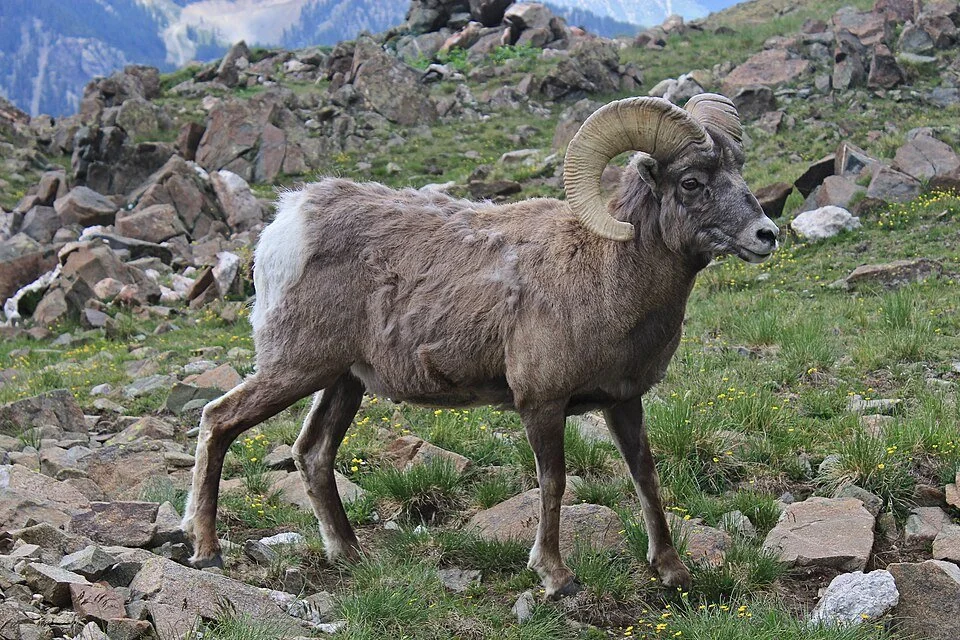
A wild and woolly bighorn sheep
20 April 2026
The phrase wild and woolly is an Americanism referring to something, or someone, who is without order or control, untamed by law or social convention. Wild is clear enough, but why woolly? This is a case of a phrase that may seem baffling at first glance, but whose underlying metaphor becomes obvious once explained.
The phrase comes out of the America’s western frontier and is a metaphorical reference to a wild or feral animal, such as a sheep or horse. The earliest use in print that I’m aware of is from the Wichita City Eagle of 12 April 1872 in a column extolling the virtues of the paper’s advertisers:
In another line we find Houghton, Mills & Co.—the Blue Store—where is kept one of the largest, most fashionable and select stocks of men’s and boys’ clothing, gents’ furnishing goods, etc., west of the Missouri river cities. They take measures at their store and show samples of goods, with the latest New York fashion plates, and thus can transfigure in two weeks the long-haired, wild-and-wooly [sic] and hard-to-handle of the frontier into the finished-appearing Broadway swell.
A year later, on 18 May 1873, we get this in another Kansas newspaper, Topeka’s Kansas Daily Commonwealth:
Here we are right from the Chisholm trail, wild and woolly and hard to curry. Wichita is booming, the long horned lantern-jawed and speckle-top booted Texan is here, not singly, but in droves. He perambulates every saloon, bagnio, dance-house, gambling shop, and clothing store in town, and swaggers through it with that nonchalance and looseness peculiar only to Texas cattle and their drivers.
The mention of curry clearly refers to cleaning the coat of an animal.
A few months later we have this from the Dallas Daily Herald of 10 August 1873 describing a fight between two drunks in Brooklyn, Texas on 7 August of that year:
Griffin was led down the street some one hundred yards to the drug store. Valentine refused to be pacified when they met and clinched, and Va[l]entine drew another Derringer, but it dropped in the scuffle. Griffin got him down, when he was pulled off. When Valentine regained his feet he threw a short piece of plank at Griffin which he dodged, and yelled in return, “Wild and woolly and hard to curry.” This was fuel to the flame.
And a few years later the same Dallas paper has this letter by “Comanche Jim” from 18 January 1877:
Now that the law is touched in the person of Mr. Jeffries, the wild and woolly cow-boys no doubt wjll [sic] be compelled to lay aside their weapons on entering the township in order that the more peaceable and respectable members of the community may have a show for their lives. The excuse that Fort Griffin is a frontier town and that Indians are dangerous is now getting “too thin” to justify men necessarily carrying weapons, which, as a matter of consequence, they use, when frontier whisky makes them feel like it.
There is an earlier and racist use of “the wild and woolly-haired Negrillo, Alfouron, or Papuan” in the July 1855 issue of the Protestant Episcopal Quarterly Review, and Church Register. But this is woolly-haired and not just woolly and appears to be a nonce usage unrelated to the phrase used two decades later to describe cowboys on the western frontier of the United States. Still, one wonders if there might be some underlying racism in the early uses of the phrase. Black cowboys were common in the American West—they have been largely erased from our present-day fictional depictions of the era—and it’s not unthinkable that the phrase originated as a racist description of them. But we would need more evidence before reaching that conclusion.
Sources:
Comanche Jim. “Frontier Racket” (18 January 1877). Dallas Daily Herald (Texas), 24 January 1877, 4/3. Portal To Texas History: Texas Digital Newspaper Program.
“Ethnology and the Scriptures.” Protestant Episcopal Quarterly Review, and Church Register, 2.3, July 1855, 373–99 at 378. Gale Primary Sources: American Historical Periodicals.
“From Wichita.” Kansas Daily Commonwealth (Topeka), 18 May 1873, 2/3. Newspapers.com.
O’Toole, Garson. “Re: [Ads-l] ‘Wild and wooly’ (1873).” ADS-L, 26 March 2026, Two emails in thread: first email; second email.
“Our Advertisers.” Wichita City Eagle (Kansas), 12 April 1872, 4/3. Newspapers.com.
Oxford English Dictionary Online, 1928, s.v. woolly, adj. & n.
Popik, Barry. “Wild and Woolly.” Barrypopik.com, 17 January 2009. https://barrypopik.com/blog/wild_and_woolly
“Wild and Woolly and Hard to Curry.” Dallas Daily Herald (Texas), 10 August 1873, 4/3. Portal To Texas History: Texas Digital Newspaper Program.
Photo credit: Jwanamaker, 2013. Wikimedia Commons. Licensed under the Creative Commons Attribution-Share Alike 3.0 Unported license.