
29 April 2026
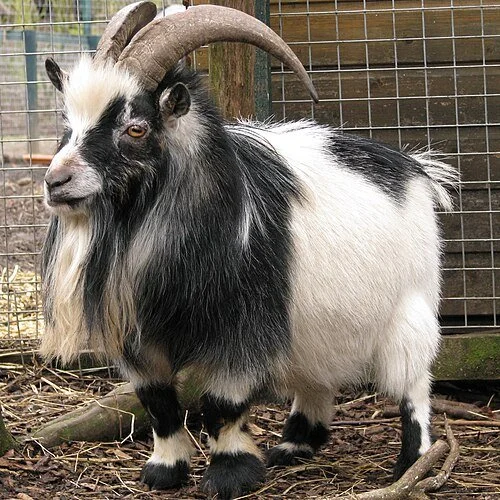
Today, buck up usually means to cheer up, to be encouraged. But in the past it was used in a wider range of meanings with the base sense of to become confident and assertive. The metaphor underlying the phrase is the behavior and attitude of a male goat or buck, especially the ram’s assertive behavior when it comes to the females in the flock.
The present-day word buck comes from the Old English bucca, a male goat. In a single late manuscript, buc glosses the Latin cervus, a stag or male deer, but the overwhelming number of uses in Old English mean goat.
The earliest use of buck up that I have found are in the writing of James Kirke Paulding. In his 1828 New Mirror for Travellers, Paulding writes:
Single gentlemen of a certain age should beware how they “buck up” to widows, unless they have previously brought themselves, as Lady Macbeth—who was undoubtedly a widow when Macbeth married her—says, “to the sticking place,” that is, to the resolution of committing matrimony at a moment’s warning. Your widows, if they mean to marry again at all, never like to linger on the funeral pyre of a bachelor’s indecision.
And a few years later, Paulding’s 1831 The Dutchman’s Fireside has this:
The noisy, but well-meaning Ariel, made matters still worse, by occasionally urging the young man to “buck up,” as he called it, to the young lady, and show his breeding.
And buck up could mean to smarten up, to dress in finer clothes, especially when courting the ladies. There is this from Ohio’s Jefferson Democrat of 29 August 1832, an article which assumes the character and dialectal spelling of a country bumpkin, which was a newspaper trope of the era (cf. okay):
I seed her at church one day fixed up kinder pretty snug; so says I to myself; I recon that aint a slow kind of bit furniture, and darn [dam?] my sealskin pumps if I don’t buck up to her next First-day; she’s a dreadful nice gal I tell you.
But early use wasn’t confined to America. The following appeared in London’s New Sporting Magazine of July 1833 in “A Trip to Paris with Mr. Jorrocks,” written by “A Yorkshireman,” where buck up is used in the cheer-up sense we’re used to today:
That’s right, Colonel, you are yourself again; I always thought you would come back to the right course; and now you are good for a glass of claret or light hermitage. Come old boy, buck up, and give a loose to pleasure for once in your life, and may you never know what it is to want, as the beggarboys say.
But buck up could also mean to pay or provide support for. An ad in the Norwich, New York’s Anti-Masonic Telegraph of 22 January 1834 uses it in a warning to those who have not paid their debts to the advertiser:
Buck Up.
All persons indebted to the subscriber, must pay up before the 20th of February, or they will be dealt with according to the revised statutes, (and a number of dull ones will get a job before that time.)
All that have promised grain, wood, or Lumber, must redeem their promise before the first of February, or cash well [sic] be required.
JAMES M. D. CARR
Norwich, Jan. 15, 1834.
The ad continued to run in the paper through June (always with the due date of 20 February), indicating that not many actually bucked up and paid Mr. Carr.
And the Pennsylvania Republican of 23 March 1842 ran a similar ad aimed at subscribers who had not paid their bill:
BUCK UP!
The Banks have resumed Specie Payments they say, and of course the HARD STUFF is plenty! We beg leave very disinterestedly of course, to advise those who owe the printer, of the fact, that the First of April is close at hand, and that therefore now is the time to “BUCK UP THE READY DOWN JOHN DAVIS,” either in specie or notes!—“we’re no ways particular which!!” Money we WANT—Money we MUST HAVE—so look out!
The support sense could be political as can be seen in this from Ohio’s Elyria Republican of 19 February 1835:
[…] and the Hon. Benjamin Tappan of Ohio. Out of this long list of candidates, the convention cannot but select a proper man. They are all “good men and true.” We have no like or dislike to express. But if urged into an expression, we should have no objection to buck up for the last named gentleman.
Or it could mean to support the downtrodden. From the Baltimore Sun of 12 August 1837:
And finally we have known men who would praise the press, and patronize the printer; but who would be among the last to signify or buck up the needful.
The earliest citation of buck up in the Oxford English Dictionary (in an old, yet-to-be revised entry) is from Joseph C. Neal’s short story “Silverton Shakes,” which was serialized in Philadelphia’s Spirit of the Times. In this appearance it returns to the sense of having confidence when courting women. From the 20 December 1843 issue of that paper:
“They’ve got free schools and high schools and universities and colleges—they learn to cypher—to read languages—to understand mathematics and all sorts of things—comparatively useless things—but who is taught confidence—that neat kind of confidence which don’t look like confidence. […] Isn’t it doleful?”
“Very,[”] said Shiverton, mournfully.
“Well, now, for my part, I don’t see the trouble,” said Mrs.Fitzgig; “why can’t a man buck up?”
“Nor I,” added Miss Jemima Fitzgig, who wanted to be Mrs something. “It is the easiest thing in the world to get along, especially among the ladies,” and she glanced tenderly at Mr. Dashoff Uptosnuff.
“You must make an effort, Shiverton—one plunge and all will be over—go to Marygold’s determined on boldness. Sooner or later, you must begin. It is impossible to dodge in this way forever.”
Sources:
“Buck Up.” Anti-Masonic Telegraph (Norwich, New York), 22 January 1834, 3/2. Readex: America’s Historical Newspapers.
“Buck Up!” Pennsylvania Republican (York), 23 March 1842, 3/1. Newspapers.com.
Dictionary of Old English: A to Le, 2024, s.v. bucca, bucc, n.
Elyria Republican (Ohio), 19 February 1835, 1/5. Readex: America’s Historical Newspapers.
Green’s Dictionary of Slang, accessed 12 April 2026, buck up, v.2, buck up, excl.
“Joe Bunker’s Story.” Jefferson Democrat (Steubenville, Ohio), 29 August 1832, 1/3. Readex: America’s Historical Newspapers.
Neal, Joseph C. “Shiverton Shakes.” Spirit of the Times (Philadelphia), 20 December 1843, 1/6. Readex: America’s Historical Newspapers.
Oxford English Dictionary, 1888, s.v. buck, v.7., buck, n.1.
Paulding, James Kirke. The Dutchman’s Fireside, vol. 1 of 2. New York: J. & J. Harper, 1831, 25. HathiTrust Digital Library.
———. New Mirror for Travellers. New York: G. & C. Carvill, 1828. HathiTrust Digital Library.
“We Have Known, and We Have Not Known.” Sun (Baltimore, Maryland), 12 August 1837, 2/1. Readex: America’s Historical Newspapers.
Yorkshireman, A. “A Trip to Paris with Mr. Jorrocks.” New Sporting Magazine (London), 5.27, July 1833, 207. ProQuest Historical Periodical.
Photo credit: Stuart Caie, 2009. Wikimedia Commons. Licensed under the Creative Commons Attribution 2.0 Generic license.