
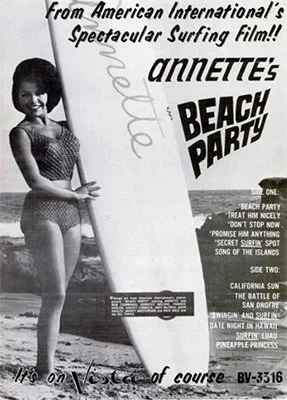
Ad for the soundtrack from the 1963 film Beach Party, starring Annette Funicello and Frankie Avalon
11 May 2026
Hodad is surfing jargon. Exactly what it means has shifted a bit. It started out as a deprecatory term for non-surfers, but it quickly shifted to become a general term of opprobrium.
The origin of the term, like that of many slang terms, is unknown. J. E. Lighter’s Historical Dictionary of American Slang offers up the possibility that it may be from the greeting Ho! Dad, or that it is a variation on hodag, an imaginary monster. This latter suggestion is rather unlikely as hodags prowl the wilds of Wisconsin, not the beaches of California where hodads make their first appearance. Another possibility is that Hodad is a surname, and the term may have originated with one particular annoying person. But the origin is probably lost in time, never to be known.
The earliest instance in print that I have found is in the Long Beach, California Independent of 9 May 1960:
At this time of the year on the beach, it is very hard to tell a mere tourist from a ho-dad or even a surfer. The sun has been away, and everyone is white and untanned. Howsoever, the surfers have crew cuts. Some of them bleach their hair with peroxide. They will be sitting on their foam boards out a ways, waiting for the big ones. The ho-dads have long hair with lots of gunk on it. They will be horsing around on the beach, trying to impress the girls. They do not like to get wet, ho-dads don’t.
The tourists? they stare at the girls just like the ho-dads do, only they let their mouths hang open. They also kick sand when they walk. They don’t mean to, but they can’t help it.
And another early use is this from Omaha’s Sunday World-Herald of 16 July 1961. Don’t let the paper’s location fool you, the article is about California surf culture:
One girl explained recently that there are three groups in high school: The surfers, the ho-dads, and the socs.
The ho-dads, also known as ho-daddies, are the hot-rod and car-club enthusiasts. They like well-oiled, Elvis Presley-type pompadours, wear boots, jeans or pegged slacks, drive cars with souped-up motors and go for rock n’ roll.
The socs (pronounced, for some tribalistic reason, as so-cees) are the “society types”—the ones who belong to campus clubs and get good grades. Surfers and ho-dads have another name for them: “Kooks.”
The Oxford English Dictionary’s earliest citation shows that surfers had quickly carried hodad around the world as it’s from Australian Women’s Weekly of 24 October 1962:
HO-DAD: Anyone who annoys board-riders while they surf.
And this one from the Dallas Morning News of 13 March 1963 uses hodad without definition or quotation marks. It’s still being hyphenated, though:
But to a true Surfer, or even a Gremmie or Ho-Dad, paradise would not be complete without Dick Dale and his Surfers’ Stomp.
And this one from the Miami Herald of 23 April 1963 expands the definition beyond that of non-surfer, encompassing dilettantes of the sport:
To give you an idea, in the future if you want to designate someone as the lowest form of pond life, just call him a hodad. Among surfers, hodads are looked on with considerable distaste because of their wild antics and lack of dedication to the sport.
And I could not leave hodad behind without including this rather unusual classified ad that appeared in the Trenton Evening Times in September 1963. It’s for a drive-in theater in neighboring Lawrenceville, New Jersey (sadly, the theater is no longer in existence) and coincides with the release of the film Beach Party, starring Annette Funicello and Frankie Avalon, which is often credited with kicking off the genre of beach party films:
ATTENTION GREMMIES AND BEACH BUNNIES—Don’t be a hodad kook, let a hotdogger show up those goofy foots and pearl divers, bring your tag-along and do some hotdogging yourself, don’t worry, you won’t bail out or bomb, the worst thing that can happen is to catch a rail, you might go over the falls or even pearl, one thing sure, you’ll shoot the curl when you finally go angling, you’ll agree with the hotdoggers that his thing called surfing is really glassy. Call the Lawrence Drive-In Theater at TU 2-9700 and find out the glassiest, the most stoke movie ever, it’s a real cowabunga.
Sources:
Classified ad. Trenton Evening Times (New Jersey), 3 September 1963, 21/5. Readex: America’s Historical Newspapers.
Dictionary of American Regional English, vol. 2. Cambridge: Harvard UP, 1991, s.v. hodag, n2.
Green’s Dictionary of Slang, accessed 19 April 2026, s.v. hodad, n.
Lighter, J. E. Historical Dictionary of American Slang, vol. 2 of 2. New York: Random House, 1997, s.v. hodad, n.
Oxford English Dictionary Online, 1976, s.v. hodad, n.
Roe, Dorothy. “STOMP: The Dance for Surf-Mad Teens.” Dallas Morning News (Texas), 13 March 1963, 2—Section 3/1. Readex: America’s Historical Newspapers.
“Surfing Lingo.” Miami Herald (Florida), 23 April 1963, 3/1. Readex: America’s Historical Newspapers.
Torgeson, Dial. “They’re Dedicated to Fun-in-the-Sun.” Sunday World-Herald (Omaha, Nebraska), 16 July 1961, G2/4. Readex: America’s Historical Newspapers.
Wells, Bob. “Eye Opener: Plus Long Weekends.” Independent (Long Beach, California), 9 May 1960, A-3/2. Newspapers.com.
Yates, Kerry. “Surf-Riders’ Dictionary.” Australian Women’s Weekly, 24 October 1962, Teenager’s Weekly 3/2. National Library of Australia: Trove.
Image credit: Buena Vista Records, 1963. Wikimedia Commons. Public domain image.