
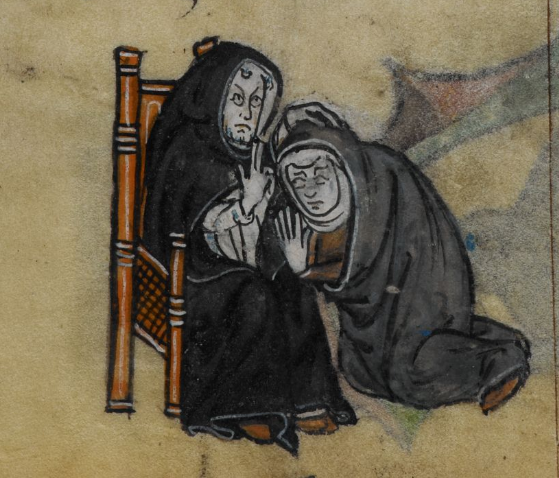
Detail from an early fourteenth-century manuscript
6 May 2026
(Update: 8 May 2026, added discussion of classical Latin root)
Religion has a straightforward etymology, but its original English meaning is rather different from how it is commonly used today. It is a late twelfth-century borrowing, partly from the Anglo-Norman religiun, and partly from the post-classical Latin religio, both referring to a system of beliefs about divine beings.
In classical Latin, religio had a range of meanings relating to the divine. It could refer to reverence for the gods; conscientiousness or scrupulousness, especially in matters of faith; or the more abstract holiness or sanctity. The root appears to be lig-, meaning to bind. The verb religo (not to be confused with the noun religio discussed above) means to fasten up or bind fast. Cicero, probably reflecting the prevalent view of his time, argued that the root was the verb relegare, meaning to read again, but modern scholarship generally discounts this explanation. (As a rule, present-day scholars have more resources and knowledge of language development than those living in earlier eras.) But either way, the noun religio was associated with the idea of adherence to divine rites..
Its original English sense was that of a monastic order, and it could also refer to a member of such an order, a monk, nun, canon, or friar or even a small community of such people.
The earliest surviving appearance of the word in English is from the Ancrene Wisse (or Ancrene Riwle), a handbook for anchoresses, women who withdrew from society, even monastic society, opting to live alone in cells attached to churches where they led a life of intense prayer and devotion. The Ancrene Riwle was probably composed in the late twelfth century, with the earliest surviving manuscript from c. 1230:
Rihten hire & smeðin hire is of euch religiun ant of euch ordre the goð & al þe strengðe. þeos riwle is imaket nawt of monnes fundles, a is of godes heaste.
(The goodness and strength of each religion and each order is to govern her & to smooth her [i.e., keep her heart free of sin]. This rule is not made of man’s invention, but it is of God’s instruction.)
We don’t see religion used in the abstract sense until the late fourteenth century. That sense appears in a Wycliffite translation of the Latin Vulgate Bible from c. 1384. Colossians 2:20–23 reads, in part:
For if ȝe ben deed with Crist from the elementis of this world, what ȝit as men lyuynge to the world deman ȝe? That ȝe touche not, nether taaste, nether trete with hoondis tho thingis, whiche alle ben in to deth bi the ilke vss, aftir the comaundementis and the techingis of men; whiche han a resoun of wisdom in veyn religioun and mekenesse.
(For if you are dead with Christ from the elements of this world, why do you, as if you were men living in the world, submit to them? That you do not touch, neither taste, nor treat with your hands those things, which all lead to death with such use, according to the commandments and the teachings of men, which have a foundation of wisdom in vain religion and humility.)
Sources:
Ancrene Wisse. Cambridge, Corpus Christi College, MS 402. Stanford University Libraries: Parker on the Web.
Ancrene Wisse. J. R. R. Tolkien, ed. Early English Text Society 249. London: Oxford UP, 1962, 7. Cambridge, Corpus Christi College, MS 402. Archive.org.
Anglo-Norman Dictionary, AND Phase 5, 2018–21, s.v. religiun, n.
Dictionary of Medieval Latin from British Sources, 2013, s.v. religio, n. Brepols: Database of Latin Dictionaries.
The Holy Bible Containing the Old and New Testaments with the Apocryphal Books in the Earliest English Versions made from the Latin Vulgate by John Wycliffe and His Followers, vol. 4. Josiah Forsall and Frederic Madden, eds. Oxford, Oxford UP, 1850, 433/2. HathiTrust Digital Library.
Lewis, Charlton T. and Charles Short. A Latin Dictionary. Oxford: Oxford UP, 1879, s.v. religio, n., religo, v. Brepols: Database of Latin Dictionaries.
Middle English Dictionary, 31 January 2026, s.v. religioun, n.
Oxford English Dictionary Online, December 2009, s.v. religion, n.
Image credit: Unknown artist, first quarter of the fourteenth century. London, British Library, Stowe MS 17, fol. 191r. Wikimedia Commons. Public domain image.