
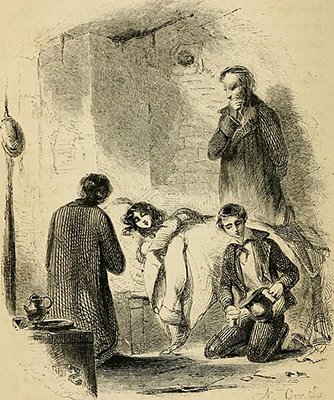
“The Death-Bed of Madalina,” 1854
6 April 2026
The phrase hot little hands was brought to my mind by Languagehat, a denizen of this site and proprietor of his own excellent blog on language. The phrase is used today in the context of eagerly possessing or receiving something. But why hot? And why little?
The answer would seem to be in the phrase’s early appearances, which were in maudlin Victorian stories about children ill and dying of fever. Mary Jane Phillips’s short story 1857 Self Control uses it thusly:
“Poor little fellow!” I murmured, and stooped to kiss his fevered cheek, but just then he threw up his hot little hands upward, exclaiming, “O do n’t, mamma, Feddy did n’t mean to!”
And two years later, Phillips uses the phrase again in her 1859 Home Pictures for the Little Ones:
Lillian was lying upon the sofa, and she reached out her hot little hands, saying, imploringly: “O brother, dear brother, please bring sister a glass of good cold water!”
By century’s end, the context of dying of fever had been lost, but the children remained, often in the context of holding or possessing flowers. Here’s an example from another piece of sentimental fiction that appeared in the San Francisco Examiner of 15 March 1899. It’s Annie Laurie’s Second Wooing of Captain De La Mar a story of an estranged couple reunited through the love of their child:
One day the little girl brought her a knot of wild flowers.
She held them tight in her hot, little hands.
“For you—mamma,” she said. “Papa sent them.”
A few decades more and the context of a child’s hands had fallen away. Here’s an example from a little piece in the Calgary Daily Herald of 14 October 1933 about the noise created when an entire newsroom of reporters munches away on apples:
Saturday morning in came the nice man with a bucket of apples. He said he’d like to give us each an apple. We said we’d like to give him something for Sunshine if he’d put it on the cuff till Tuesday, but as he was a very trusting man we gave him our shiny dimes we had been clutching in our hot little hands since payday.
And there is this wonderfully odd use of the phrase in an article about WWII-era blues music in the San Francisco Chronicle of 26 May 1940:
It is not a coincidence either that the blues are the creation of a non-Aryan people to whom the freedoms and opportunities of America have been largely denied. In a year when America is apparently going to have to come to grips with despair as never before, and perhaps become the trustee of a culture based on tolerance, that thought may be worth mulling over. Pollyanna won’t stop Hitler, even with a Garand rifle clutched in her hot little hands.
Sources:
Jive. “Pollyanna Serenade.” San Francisco Chronicle (California), 26 May 1940, This World (Sunday magazine) 25/2. Readex: America’s Historical Newspapers.
Languagehat. “Hot Little Hands.” Languagehat (blog), 8 March 2026. https://languagehat.com/hot-little-hands/
Laurie, Annie. “Second Wooing of Captain De La Mar.” Examiner (San Francisco, California), 15 March 1899, 31/5. ProQuest Newspapers.
“Music of Apple Day Brings New Sound to Disturb Newsroom.” Calgary Daily Herald (Alberta), 14 October 1933, 11/5. ProQuest Newspapers.
Phillips, Mary Jane. Home Pictures for the Little Ones. New York: Carlton & Porter, 1859, 68. Gale Primary Sources: Nineteenth Century Collections Online.
———. “Self-Control.” Ladies Repository, December 1857, 732–34 at 733/2. HathiTrust Digital Library.
Stover, Smokey. “Hot Little Hands.” Phrase Finder, 22 April 2006.
Image credit: N. Orr, 1854. Wikimedia Commons. In Solon Robinson. Hot Corn: Life Scenes in New York Illustrated. New York: De Witt and Davenport, 1854, opposite 217. Archive.org. Pubic domain image.