
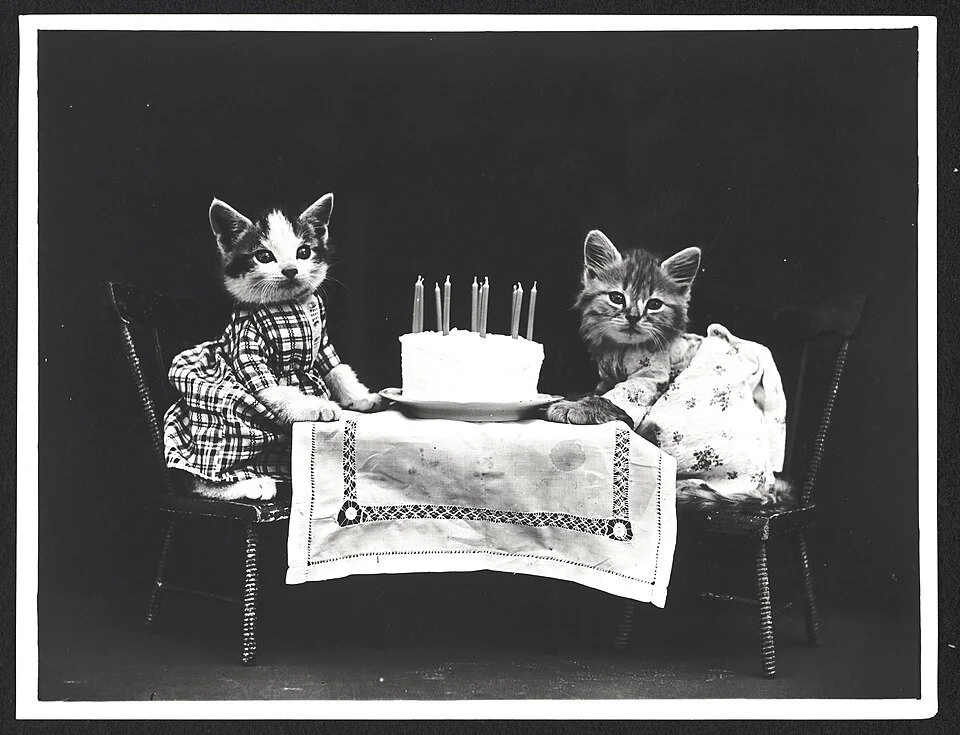
Obligatory kitten photo
8 April 2026
My practice when Facebook (yes, I’m still on Facebook; I’m old) reminds me of someone’s birthday is to send the message Many Happy Returns. I don’t remember when I first started doing it or why, but it was probably because I thought a simple Happy Birthday seemed trite and unoriginal. And occasionally someone responds with, “what the heck does Many Happy Returns mean?” The answer is rather straightforward.
It is clipping of many returns of the day, or in other words, a wish that the person may have many more. This use of return dates to the opening years of the eighteenth century. On 8 March 1704/05, the anniversary of Queen Anne’s ascension to the throne, John Hough, the bishop of Litchfield, preached a sermon that closed with:
What have we therefore to do but to rejoice in this Day, to pray that we may have many and many Returns of it, and that every one may bring fresh Blessings along with it?
And we see many happy returns used in connection to a birthday in Joseph Addison’s Free-holder of 25 May 1716:
The usual Salutation to a Man upon his Birth-day among the ancient Romans was Multos & fœlices; in which they wished him many happy Returns of it.
So my use of the phrase is a bit old fashioned, which somehow fits with someone who spends so much time with etymologies.
Sources:
Addison, Joseph. The Free-holder, 46, 25 May 1716. Dublin: George Grierson, 1716, 269. Gale Primary Sources: Eighteenth Century Collections Online (ECCO).
Hough, John. A Sermon Preach’d before the Queen (8 March 1704/5). London: Jacob Tonson, 1705, 27. Gale Primary Sources: Eighteenth Century Collections Online (ECCO).
Oxford English Dictionary Online, March 2010, s.v. return, n.
Image credit: Harry Whittier Frees, 1914. Wikimedia Commons. Library of Congress. Public domain image.