
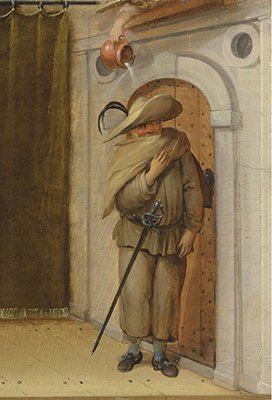
A Zanni character from 17th-century commedia dell’arte by Sebastiaen Vrancx
28 October 2026
The English adjective zany comes from a stock character in Italian commedia dell’arte named Zanni. The character is portrayed as a male servant of rustic background who is cynical, crafty, and fond of mimicry and practical jokes. The name is a hypocoristic, Venetian dialect form of the name Giovanni (cf. Gianni in other dialects). Zanni was typically depicted wearing baggy, white clothing of sackcloth, a brimmed hat with feathers, a large nose, and beard.
Over time, the name was applied to male servants in general and to anyone who acts the buffoon. But it wasn’t until the latter half of the nineteenth century that we start seeing the adjective zany as we know it today.
George Whetstone’s 1582 Heptameron of Ciuill Discourses has an early English reference to the commedia dell’arte character:
In the ende, when Supper was done, and Quéene AVRELIA, and the most Honourable of the companie had taken their places vppon a Scaffolde made for the nonce, there mounted, a Mountebanke, his necke bechayned with liue Adders, Snakes, Eau'ts, and twentie sundrie kinde of venemous vermines, whose mortall stinges were taken away by Arte, & with him a Zanni, and other Actors of pleasure: who presented themselues onelie with a single desire, to recreate Segnior Philoxenus, and his worthie companie: and not with the intent of common Mountebanckers, to deceyne the people with some vnprofitable Marchandize.
And eight years later Thomas Nash, in his 1594 Vnfortunate Traueller uses the name to refer to a servant outside the context of a stage character:
Amongst the rest the house where I lay he inuaded, where all being snatcht vp by the sicknesse but the good wife of the house, a noble and chast matrone called Heraclide and her Zanie, and I & my curtizan, he knocking at the dore late in the night, ranne unto the matrone, & left me and my loue to the mercie of his companion.
We see the sense of Zani to mean one who imitates another in Ben Jonson’s 1601 Fountaine of Selfe-loue:
The other gallant is his Zani, & doth most of these tricks after him; sweats to imitate him in euery thing (to a haire) except a Beard, which is not yet extant: he doth learne to eat Anchoues, & Caueare because he loues ’hem, speakes as he speakes; lookes, walkes, goes so in Cloathes and fashion, is in al, as he were moulded of him.
And George Chapman’s 1606 play Sir Gyles Goosecappe has the title character use Zanie to refer to someone who acts like a clown or buffoon:
Goe too you French Zanies you, you wil follow the french steps so long, till you be notable to set one Sound Steppe oth [sic] ground all the daies of your life.
So far, we have only seen nominal uses of the word, but the adjective zany appears in R. D. Blackmore’s 1869 Lorna Doone, although it’s not entirely clear what exactly is meant by the adjective in that novel, beyond redundantly denoting an attendant or servant:
Only remember my words, Jack, and when you see the man I mean, look straight at him, and tell no lie. He will make some of your zany squires shake in their shoes, I reckon.
We finally get a clear example of the adjective in the sense we know it in Hall Caine’s 1890 novel The Bondman:
A pretty thing, truly, that I should toil and moil at my age to keep house and home together ready and waiting for you, when your zany doings have shut every other door against you.
That’s how our adjective zany developed from the name of a sixteenth-century commedia dell’arte character.
Sources:
Blackmore, R. D. Lorna Doone, vol. 1. London: Sampson Low, Son, & Marston, 1869, 176. Archive.org.
Caine, Hall. The Bondman. London: William Heinemann, 1890, 37–38. Archive.org.
Chapman, George. Sir Gyles Goosecappe. London: John Windet for Edward Blunt, 1606, sig. D4v. ProQuest: Early English Books Online (EEBO).
Jonson, Ben. The Fountaine of Selfe-loue. London: R. Read for Walter Burre, 1601, sig. D4v. ProQuest: Early English Books Online (EEBO).
Nash, Thomas. The Vnfortunate Traueller. London: T. Scarlet for C. Burby, 1594, sig. K2v. ProQuest: Early English Books Online (EEBO).
Oxford English Dictionary Online, March 2024, s.v. zany, n. & adj.
Whetstone, George. An Heptameron of Ciuill Discourses. London: Richard Jones, 1582, sig. L3v. ProQuest: Early English Books Online (EEBO).
Image credit: Sebastiaen Vrancx, first half of the 17th century. Color on oak wood. Wikimedia Commons. Public domain image.
