hot little hands

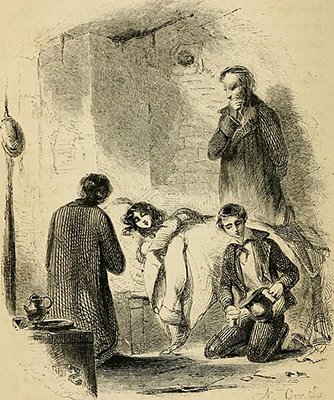
Victorian engraving of a girl lying in bed, with mother, father, and brother at the bedside looking concerned

“The Death-Bed of Madalina,” 1854

6 April 2026

The phrase hot little hands was brought to my mind by Languagehat, a denizen of this site and proprietor of his own excellent blog on language. The phrase is used today in the context of eagerly possessing or receiving something. But why hot? And why little?

The answer would seem to be in the phrase’s early appearances, which were in maudlin Victorian stories about children ill and dying of fever. Mary Jane Phillips’s short story 1857 Self Control uses it thusly:

“Poor little fellow!” I murmured, and stooped to kiss his fevered cheek, but just then he threw up his hot little hands upward, exclaiming, “O do n’t, mamma, Feddy did n’t mean to!”

And two years later, Phillips uses the phrase again in her 1859 Home Pictures for the Little Ones:

Lillian was lying upon the sofa, and she reached out her hot little hands, saying, imploringly: “O brother, dear brother, please bring sister a glass of good cold water!

By century’s end, the context of dying of fever had been lost, but the children remained, often in the context of holding or possessing flowers. Here’s an example from another piece of sentimental fiction that appeared in the San Francisco Examiner of 15 March 1899. It’s Annie Laurie’s Second Wooing of Captain De La Mar a story of an estranged couple reunited through the love of their child:

One day the little girl brought her a knot of wild flowers.

She held them tight in her hot, little hands.

“For you—mamma,” she said. “Papa sent them.”

A few decades more and the context of a child’s hands had fallen away. Here’s an example from a little piece in the Calgary Daily Herald of 14 October 1933 about the noise created when an entire newsroom of reporters munches away on apples:

Saturday morning in came the nice man with a bucket of apples. He said he’d like to give us each an apple. We said we’d like to give him something for Sunshine if he’d put it on the cuff till Tuesday, but as he was a very trusting man we gave him our shiny dimes we had been clutching in our hot little hands since payday.

And there is this wonderfully odd use of the phrase in an article about WWII-era blues music in the San Francisco Chronicle of 26 May 1940:

It is not a coincidence either that the blues are the creation of a non-Aryan people to whom the freedoms and opportunities of America have been largely denied. In a year when America is apparently going to have to come to grips with despair as never before, and perhaps become the trustee of a culture based on tolerance, that thought may be worth mulling over. Pollyanna won’t stop Hitler, even with a Garand rifle clutched in her hot little hands.


Sources:

Jive. “Pollyanna Serenade.” San Francisco Chronicle (California), 26 May 1940, This World (Sunday magazine) 25/2. Readex: America’s Historical Newspapers.

Languagehat. “Hot Little Hands.” Languagehat (blog), 8 March 2026. https://languagehat.com/hot-little-hands/

Laurie, Annie. “Second Wooing of Captain De La Mar.” Examiner (San Francisco, California), 15 March 1899, 31/5. ProQuest Newspapers.

“Music of Apple Day Brings New Sound to Disturb Newsroom.” Calgary Daily Herald (Alberta), 14 October 1933, 11/5. ProQuest Newspapers.

Phillips, Mary Jane. Home Pictures for the Little Ones. New York: Carlton & Porter, 1859, 68. Gale Primary Sources: Nineteenth Century Collections Online.

———. “Self-Control.” Ladies Repository, December 1857, 732–34 at 733/2. HathiTrust Digital Library.

Stover, Smokey. “Hot Little Hands.” Phrase Finder, 22 April 2006.

Image credit: N. Orr, 1854. Wikimedia Commons. In Solon Robinson. Hot Corn: Life Scenes in New York Illustrated. New York: De Witt and Davenport, 1854, opposite 217. Archive.org. Pubic domain image.

tidy

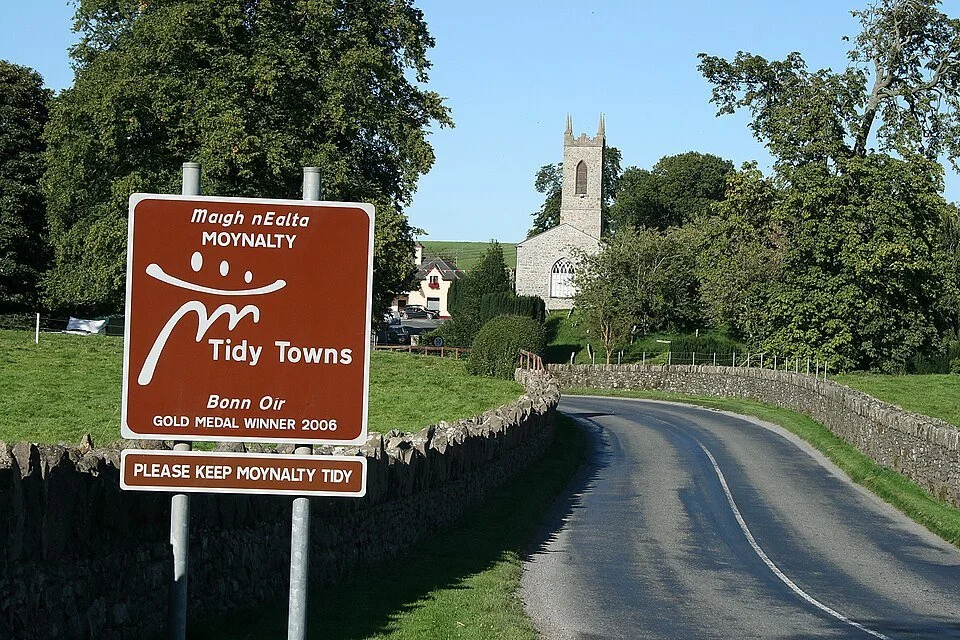
Country road leading into Moynalty with a sign saying it won the 2006 Tidy Towns competition; a church is in the background

Moynalty, County Meath, Ireland, winner of the 2006 Tidy Towns competition

3 April 2026

Tidy is one of those words whose origin seems unfathomable, but when you learn it suddenly becomes patently obvious. 

Our modern word tidy comes from the Old English tid, meaning “time, hour season,” and that word is also the origin of our modern word tide and tidings. Old English also had an adjective tidlic, meaning “temporary, opportune, in season,” but it’s unlikely that this adjective developed into our modern tidy because the -lic ending normally doesn’t develop into -y. Instead, it seems that tid developed a second adjectival form sometime in the thirteenth century.

The earliest recorded appearance of tidy is not in the sense we might expect. One would expect that the earliest sense would be that of “timely,” but the earliest sense we know of is that of “in good condition, abundant, healthy.” Tidy appears in a gloss of a thirteenth century Latin manuscript, defining the word saluber or “healthy.” The word also appears in the poem The Story of Genesis and Exodus, written around 1250 and with an extant manuscript from before 1325, describing the dream that appeared to Pharaoh and that would be interpreted by Joseph:

An oðer drem cam hi[m] be-foren,
.vii. eares wexen fette of coren,
On a busk ranc and wel tidi.

(Another dream came to him the night before, seven ears of corn grew fat on a bush strong and very tidy)

This sense was often applied to crops and livestock and grew out of the “timely, in season” sense. This sense of tidy developed into a sense applied to people meaning admirable, possessing desirable qualities. This sense can still be found today, although it has been downgraded somewhat to “satisfactory, pretty good.”

Tidy is also found in the sense meaning “considerable, big” as in a tidy sum of money. This sense is found in the Romance of William of Palerne, written c. 1350:

And al þat touched þer to a tidi erldome,
to þe kowherd & his wif þe king ȝaf þat time.

(All that was contiguous with a tidy earldom, the king gave to the cowherd and his wife at that time.)

The sense meaning “timely,” while we would expect it to be earlier, is also found in William of Palerne:

Gret merþe to þe messangeres Meliors þan made,
for þe tidy tidinges þat tiȝtly were seide.

(Melior then spoke with great ceremony to the messengers, because the tidy tidings were properly conveyed.)

An inversion of recorded senses and the logical semantic development like this is not all that unusual, and it is probably due to the fact that relatively few English-language manuscripts in early Middle English survive. Most literary and legal documents from the period are in Anglo-Norman French and most scholarly work is in Latin, so there weren’t all that many English language documents to begin with, and even fewer have survived the centuries. So, while we know quite a lot about early Middle English, we don’t have a complete record of the language from the period.

The meaning of tidy most in use today, “orderly, clean,” dates to the beginning of the eighteenth century. This also comes from the general sense of “admirable.” The verb to tidy, meaning to make orderly, to arrange neatly, dates to the early nineteenth century.

Discuss this post


Sources:

Middle English Dictionary, 31 January 2026, s.v. tidi, adj.

Morris, Richard, ed. The Story of Genesis and Exodus. Early English Text Society, O.S. 7. London: Trübner, 1865, lines 2103–05, 60. Archive.org.  

Oxford English Dictionary Online, 1912, s.v. tidy, adj., n., & adv.. tidy, v.

Skeat, Walter, W., ed. The Romance of William of Palerne. Early English Text Society, Extra Series 1. London: Kegan Paul, Trench, Trübner, 1867, lines 5384–85, 1338–39, 170, 50. Archive.org.

Photo credit: Sarah777, 2007. Wikimedia Commons. Public domain image.

terrific

Cover of the comic book Terrific #14, December 1954, featuring the terrifying face of a man

A 1954 comic book cover, Terrific #14; issues 1–13 were published under the title Horrific; subsequent titles in the series took a very different tack and became Wonder Boy

1 April 2026

From its meaning alone you would never guess where terrific comes from, but if you look at the word, the origin is rather obvious. The form, or morphology, of the word gives it away. Terrific is from the Latin terrificus, meaning frightening, causing terror. Despite it coming from classical Latin, terrific doesn’t enter English use until the early modern era.

The earliest use of the word that I’m aware of is in a 1599 edition of a poem about the Wars of the Roses, “The Civill Wars of England,” by Samuel Daniel (earlier editions of the poem do not have terrific):

Red fiery dragons in the aire doe flie,
And burning Meteors, poynted-streaming lights,
Bright starres in midst of day appeare in skie,
Prodigious monsters, gastly fearefull sights:
Straunge Ghosts, and apparitions terrific,
The wofull mother her owne birth affrights,
Seeing a wrong deformed infant borne
Grieues in her paines, deceiu'd in shame doth morn.

Daniel was no slouch of a poet, but terrific got a big boost when John Milton used it in his 1667 Paradise Lost. Milton uses it in the sense of frightening as he describes the creation and lists many of the animals that God has created:

The Serpent suttl’st Beast of all the field,
Of huge extent somtimes, with brazen Eyes
And hairie Main terrific, though to thee
Not noxious, but obedient at thy call.

A serpent with a hairy mane? One would think that Milton wasn’t a very good zoologist, but this hairie Main is probably an allusion to Virgil and the Aeneid, the epic poem about the founding of Rome, which describes the two serpents which devour the priest Laocoön and his two sons as having iubaeque sanguineae superant undas (and blood-red crests that top the waves, 2.206–07). We don’t see this “frightening” sense of terrific much anymore; the modern sense has scared it away.

In the mid-eighteenth century the word began to be used to mean large or excessive. In a 1743 translation of Horace’s odes, Matthew Tower described the giant Porphryion as “of terrific size,” which could be interpreted as meaning terrifying and awe-inspiring and also as of great size. And in his 1798 satirical poem The Literary Census, Thomas Dutton could mean only of great size when he writes of pamphleteer William Cobbett, “I am struck with admiration at the terrific sublimity of his genius.”

By the latter half of the nineteenth century, this sense of great size had come to mean simply great or excellent. An 1871 advertisement for a book in the Athenaeum magazine could say:

The last lines of the first ballad are simply terrific,—something entirely different to what any English author would dream of, much less put on paper.

And by the next century Denis Mackail’s 1930 novel The Young Livingstones could contain this exchange:

“Thanks awfully,” said Rex. “That’ll be ripping.”
“Fine!” said Derek Yardley. “Great! Terrific!”

In the space of three-hundred years, terrific had moved from a Latinate description of awe-inspiring terror with allusions to Virgil to become a rippingly informal word.

Discuss this post


Sources:

Advertisement. Athenaeum, 21 October 1871, 540/1. HathiTrust Digital Library.

Danyel, Samuel. “The Civill Wars of England.” The Poeticall Essayes of Sam. Danyel. London: P. Short for Simon Waterston, 1599, stanza 1:115, 17r. ProQuest: Early English Books Online (EEBO). (Note: the pagination in this copy is off; the pages appear to be from two different print runs bound together; the stanza number seems accurate.)

Dutton, Thomas. The Literary Census. London: 1798, 60n. Gale Primary Sources: Eighteenth Century Collections Online (ECCO).

Horace. “Ode 18.” In Matthew Tower, ed. and trans. The Lyric Pieces of Horace, vol. 2. Dublin, A. Reilly, 1743, 325. Gale Primary Sources: Eighteenth Century Collections Online (ECCO).

Milton, John. Paradise Lost. A Poem Written in Ten Books. London: Peter Parker, et al., 1667, 7.495–98. ProQuest: Early English Books Online (EEBO).

Oxford English Dictionary Online, September 2011, terrific, adj. and n.

Image credit: Unknown artist, 1954. Wikimedia Commons. Public domain image.

boondocks / boonies

Photo of an isolated cove with mountains in the background

Nagsasa Cove, Luzon, the Philippines

31 March 2026

Boondocks is a relic of American colonialism. British English imported lots of words from its far-flung colonial possessions, but American colonial aspirations primarily produced words derived from Mexican Spanish or North American and Hawaiian indigenous languages. This one, however, is an exception, taking the word from Tagalog, the language of the Philippines that is spoken by more people in that country than any other.

Boondocks is from the Tagalog bundok (mountain) + -s (English plural suffix). In English, the the word refers to any remote or isolated place. It made its way into English during the U.S. occupation of the Philippines following the Spanish-American War. For several decades, the word was used almost exclusively by marines and soldiers, entering into the general discourse during the Vietnam War era.

The U.S. seized the Philippines from Spain in 1898, and from 1899–1902 fought and won an insurgency against Filipino resisters. During that war and in the occupation that followed many U.S. soldiers and marines were stationed on the islands. In 1905, as part of that occupation, a U.S. Army officer, W.E.W. MacKinlay wrote A Handbook and Grammar of the Tagalog Language, which uses bundok multiple times in various phrases and contains a glossary entry that reads, “The mountain. Ang bundok.” Of course, the uses in MacKinlay’s book are not English ones, but it is the first step in the word’s entry into English.

Within five years, Webster’s New International Dictionary of the English Language had included an entry for the word:

|| bun-docˊ (bo͞on-dok´), n. Also bondoc. [Tag.] A mountain. Also, in colloq. English (usually pl., pronounced bŭn´do͝oks), the hills and woods in general; the wilds; any place at a distance from a center of population. Phil.I.

That dictionary clearly indicates that the word is a foreign one and not yet completely Anglicized, but the dictionary notes it is used colloquially by English speakers. Presumably, that means by soldiers.

The earliest appearance of boondocks in print that I’m aware of is in an 8 February 1914 letter by a U.S. Army soldier stationed in the Philippines that was printed in his hometown newspaper, New York’s Allegany County News, some months later:

The other companies I believe had it strenuous enough for there was out post [sic] duty a plenty and maneuvers in the boondocks.

And there is this, written by a sailor or marine on 19 October 1914, that was printed in Missouri’s Walnut Grove Tribune the following December:

Tho’ I was only an innocent bystander, my heart filled with pride at the showing they made, and the progress of civilization under the direction of Uncle Sam. I am satisfied that the interest of the patrons of the public schools was aroused through the efforts of those little brown squaws and their pupils, and education is advancing with long strides on the Naval Reservation and the bondocks roundabout.

The verb to boondock, meaning to conduct a military exercise in a wild or remote region dates to the World War II era in Marine Corps use. Later, the verb would be adopted by civilians with the sense of to go camping.

Aside from the occasional civilian use, boondocks remained largely within the province of the Marine Corps until the Vietnam War, although the context was not limited to the Philippines, being used wherever the Marines were posted. But after Vietnam, the word spread out into general use.

The clipped form boonies appears in mid-century. There is a possible use in the diary of Charles Bond, who flew with the American Volunteer Group, a.k.a. the Flying Tigers, in China before US entry into World War II. But J. E. Lighter, in his Historical Dictionary of American Slang suspects that the two uses of the word in the diary are an editorial intervention in 1984 when the diary was published. We would have to see the original manuscript to be sure. But the entry for 9 February 1942 in Bond’s published diary uses boonies to refer to the vegetation at the end of an airstrip:

One Hurricane nosed up on landing to keep out of a ground loop, an John Croft overshot and tore a landing gear off in the overrun boonies.

A few weeks later, on 2 March 1942, Bond allegedly uses the word in its usual sense of a remote area in reference to a pilot who made a forced landing away from his base:

Bob and I talked over the situation this morning and I brought him up to date on what had transpired while he was in the boonies.

But we have secure use of boonies from a decade later in a 3 March 1954 Associated Press article about Saipan, ten years after the battle for that island:

Remember Garapan? That was the biggest town before the fighting. It doesn’t even exist today. The jungle—everyone here calls it the boonies—has taken over.

Finally, in the Tidewater region of Virginia, boonie has been used to refer to an outhouse. The Dictionary of American Regional English has a citation from 1944. This may come from the idea that a privy is an out-of-the-way place, in which case it lends support for the idea that the 1942 uses by American flyers in China are real. Alternatively, this boonie may have arisen in English from by a different route altogether.

Discuss this post


Sources:

Associated Press. “Bloody Battle for Saipan Recalled; Island Quiet, Peaceful Today.” Columbia Record (South Carolina), 3 March 1954, 11-B/4. Readex: America’s Historical Newspapers.

Bond, Charles R. and Terry H. Anderson. A Flying Tiger’s Diary. College Station: Texas A&M Press, 1984, 122 and 95. Archive.org.

Cooksey, Ben. “From the Philippines” (19 October 1914). Walnut Grove Tribune (Missouri), 9 December 1914, 1/4. Newspapers.com.

Dictionary of American Regional English, vol. 1. Cambridge, Massachusetts: Belknap, 1985, s.v. boonie, n.1.

Green’s Dictionary of Slang, accessed 30 March 2026, s.v. boondocks, n., boonies, n.

Keenan, John. “Participated in Mock War in the Philippine Islands” (8 February 1914). Allegany County News (Whitesville, New York), 2 April 1914, 2/2. NYS Historic Newspapers.  

Lighter, Jonathan, ed. Historical Dictionary of American Slang, vol.1, 1994, s.v. boondock n., boonie, n.2. Archive.org.

MacKinlay, William Edbert Wheeler. A Handbook and Grammar of the Tagalog Language. Washington: Government Printing Office, 1905, 44. Archive.org.

Oxford English Dictionary Online, September 2025, s.v. boondocks, n., boondock, v.; 2010, s.v. boonies, n.

Webster’s New International Dictionary of the English Language (1910). Springfield, Mass.: G. and C. Merriam Company, 1920, s.v. bun-doc. HathiTrust Digital Library.

Photo credit: Ronronpalma, 2018. Wikimedia Commons. Licensed under the Creative Commons Attribution-Share Alike 4.0 International license.

synergy

Automobile logo reading “Hybrid Synergy Drive”

Logo for the Toyota Prius automobile

27 March 2026

Words come into and go out of fashion. Sometimes, a particular word will catch a wave of popularity and become overused to the point where it becomes essentially meaningless and nothing more than a buzzword used to show that the speaker is fashionable and up on the latest trends. You often see such words in business writing, as firms indicate through their language that they are leaders in their field by using cutting-edge language. A good example of such a buzzword is synergy.

Synergy is the cumulative effect of coordinated action by a number of independent factors. Anytime you have the whole being greater than the sum of the parts, you have synergy. It is a seventeenth century coinage from the post-classical Latin synergia.

By 1554, the Latin word had been coined, referring to how human will and divine grace together allowed for the forgiveness of sins. English use of the word first appears in this theological sense by 1632. From Edwin Reynolds’s An Explication of the Hundreth and Tenth Psalm:

In the vertue of which synergie and copartnership with Christ and with God, as he saveth, so we save; as he forgiveth sinnes, so we forgive them; as he judgeth wicked men, so wee judge them; as he beseecheth, so we also beseech, saith the Apostle, that you bee reconciled, and receive not the grace of God in vaine. Wee by his Grace, and he by our ministerie.

By 1778, the French physician Paul Joseph Barthez began using synergie in the field of physiology, and by 1831 English had taken up this French sense. From a review of French medical text that appeared in the October 1820 issue of the London Medical and Physical Journal:

This consensus or synergie, (as the author calls this relation of action, after BARTHEZ; and the term is certainly, in this case, more appropriate than sympathy;) between the glottis and the abdominal muscles, is observed in many familiar actions of the human body; and its importance in respect to those actions will be obvious on a little consideration.

Synergy began appearing in in the field of psychology in the late 1950s. From Raymond Cattell’s 1957 Personality and Motivation Structure and Measurement:

Morale has often been investigated as if it were a single dimension, but these researches show that it has several distinct causal influences and manifestations. Three of the four most important morale dimensions appear to be dimensions of synergy, i.e., to be tied up with dynamic conditions within the group.

In 1963 a racehorse named Synergy began running in the United States. Slang and buzzwords often make early appearances in the names of racehorses, indicating the term in question is starting to become popular.

And by the mid 1960s synergy was established as a business buzzword. This is clear by its use by Madame Chaing Kai-shek as reported by the Omaha World-Herald of 20 March 1966:

The reporters and others who listened to her Friday might have had trouble understanding her meaning when she tossed such words as “quodilibetical” and “macroeconomics” and “feil” and “synergy” at them.

But they followed her accurately when she said that Mao had “shinnied up” to the top of the Communist “greasy pole.”


Source:

Cattell, Raymond B. Personality and Motivation Structure and Measurement. London: George G. Harrap, 1957, 791. Archive.org.

“Critical Analysis.” London Medical and Physical Journal, 44, October 1820,  336. HathiTrust Digital Library.

“Madame Chaing Talk Clear in Five Syllables or Slang.” Sunday World-Herald (Omaha, Nebraska), 20 March 1966, 27-A/2–3. Readex: America’s Historical Newspapers.

Oxford English Dictionary Online, March 2014, s.v. synergy, n., synergia, n.

“Race Results, Entries at Major Tracks.” Miami Herald (Florida), 11 June 1963, 4-C/3. Readex: America’s Historical Newspapers.

Reynolds, Edwin. An Explication of the Hundreth and Tenth Psalm. London: Felix Kyngston for Robert Bostocke, 1632, 173. ProQuest: Early English Books Online.

Image credit: Unknown photographer, 2010. Wikimedia Commons. Public domain photo, but possibly subject to trademark restrictions.