anachronym

Photo of a man in 18th-century dress smoking a cigarette and taking a photo with with a smartphone

15 April 2026

No, that’s not a typo for acronym. An anachronym is a term whose original meaning has become anachronistic but which continues to be used for a more current application. Examples of anachronyms include dialing a phone, footage (originally referring to the length of movie film), cc (carbon copy), and dashboard (a double anachronym, originally referring to a board protecting passengers in a carriage from splashes of mud, then a control panel in a car, and more recently a digital interface on a device or in software).

The term dates to at least 10 March 2012, when W. Brewer used it in a post to the American Dialect Society email list (ADS-L):

Anachronyms. My favorites are telephone expressions. Hang up your phone, it is off the hook. Phone is ringing. I dialed the wrong number. Address book. Yellow pages.

And in another post to ADS-L on 2 April 2012, Brewer claimed to have coined the term, which may very well be true:

Greek nautia ~ nausia (seasickness) < naus (ship); cf. nautik-os (seafaring), nautil-os (sailor); pIE *na:us (boat). Preservation of Latin form NAUSEA, extension of meaning (seasick, carsick, airsick, morning sickness): According to Wilson's statement, English NAUSEA has completely lost its association with the sea, and hence fits my definition of an ANACHRONYM (my coinage).

The term seems to have languished for another dozen years until Benjamin Dreyer used it in a 12 March 2024 article in the Washington Post online edition:

But if Twitter has been X'd out and tweets are no longer tweets but posts instead, what is to become of the useful coinage “subtweet”?

Given that the word now has become a generic term used on other social media platforms (hello, my friends at Bluesky), I suspect that “subtweet” will join the ranks of what are known as anachronyms: words that are used “in an anachronistic way, by referring to something in a way that is appropriate only for a former or later time.”

That's the way Wikipedia defines them, which will have to suffice for now, because the word is too new to have worked its way into dictionaries.

That article seems to have inspired a similar one on 25 March 2024 in the Atlantic which quotes linguist Ben Zimmer using anachronym:

Besides, it wasn’t a simple self-portrait but a group shot with a dozen people in it. (That’s not a “selfie,” but a “group selfie” or a “groupie,” some have suggested.)

What is happening to the selfie?

At first glance, it seems it may be turning into what linguist Ben Zimmer calls an “anachronym,” a word or phrase that remains in usage even as behaviors change.

“The accumulated cultural knowledge of past technologies ends up powerfully shaping the way we talk about new technologies,” Zimmer told me. “Think about the terms that we use for telephones, for instance. We still talk about ‘dialing.’ And we talk about ‘taping’ something even if it’s on the DVR. Sometimes what we’re left with is language that’s sort of obsolete.”

The opposite of an anachronym would be a retronym, that is a newly coined term used to refer to an older version or form of something, such as an acoustic guitar, film camera, or hardcover book.

Anachronym is a useful term, but I doubt it will catch on with the general public. It’s too easily confused with the far more common acronym and anachronism. And indeed, when I googled anachronym, the search engine returned results for acronym. (And I used the Kagi search engine, so I’m not sure if the verb to google is an anachronym; right now it’s just a generic use of a trade name, but the way Alphabet is managing its Google search engine, making it less useful with every update, it may very well become a full-blown anachronym.)

Discuss this post


Sources:

Brewer, W. “Cathartic = ‘experiencing catharsis’ PLUS free balonus!” ADS-L, 2 April 2012.

———. “Pre-Archaic Industrial Jargon.” ADS-L, 10 March 2012.

Dreyer, Benjamin. “If You’re Still Using These Dated Words, You’re Not Alone.” Washington Post (Online), 12 March 2024. ProQuest

LaFrance, Adrienne. “When Did Group Pictures Become ‘Selfies’?” Atlantic, 25 March 2024. Theatlantic.com.

Newton, Heddwen. “37 Examples of Anachronyms.” English in Progress (blog), 17 January 2025. Wikimedia Commons. Licensed under the Creative Commons Attribution 4.0 International license.

intifada

Photo of Israeli police and military confronting Palestinian protesters across a barbed-wire barrier

Intifada in Gaza, 1987

10 April 2026
[Edit: 13 April 2026, added literal Arabic meaning]

The word intifada enters English from the Arabic انتفاضة, meaning uprising or revolt; literally, an intifada is a shaking off, from nafada meaning to shake. In Arabic, it has widespread use referring to any number of insurrections or civil resistance movements across the Arab world. In English, however, it is usually found in the context of Palestinian insurrections against Israeli occupation. And, with a capital letter, Intifada is used to refer specifically to two Palestinian insurrections against Israeli occupation, the First Intifada (1987–93) and the Second Intifada (2000–05).

The earliest use of the word in English that I have found is in a January 1985 article in Current History that uses Intifada as the name of an alliance of Palestinian political groups arrayed against Yassir Arafat’s leadership of the Palestinian Liberation Organization (PLO):

Not taking part in these talks were the Fatah rebels of Abu Musa (known now as the Intifada, or “upheaval”) and other groups controlled by Syria—the Saiga guerrilla organization, the Popular Front—General Command (PFGC) of Ahmad Jibril, and the small Palestine Popular Struggle Front (PPSF); together, these groups were known as the National Alliance. It was the groups of the National Alliance that had taken up arms against Arafat’s loyal units in Lebanon; the groups in the Democratic Alliance, however, had remained neutral, even though they shared many rebel complaints about Arafat’s policies and leadership.

And in the sense of uprising or insurrection, it appears later that year in the pages of the Los Angeles Times, referring to Palestinian resistance to the government of Lebanon. From the 11 September 1985 issue:

Along with Gemayel’s declining popularity, the last six months have seen one intifada—Arabic for uprising—after another, and they have brought about the most fundamental realignment of power in the Christian community since Lebanon obtained its independence from France in 1946.


Sources:

Hudson, Michael C. “The Palestinians after Lebanon.” Current History, 84.498, January 1985. 16–20, 38–39 at 19. ProQuest Magazines. DOI: 10.1525/curh.1985.84.498.16.

Oxford English Dictionary Online, March 2023, s.v. intifada, n.

Wallace, Charles P. “Gemayel a Leader Deserted by Followers.” Los Angeles Times, 22 September 1985, 1/5. ProQuest Historical Newspapers.

Photo Credit: Eli Sharir, 1987. Wikimedia Commons. Efi Sharir / Dan Hadani collection / National Library of Israel / The Pritzker Family National Photography Collection. Licensed under the Creative Commons Attribution 4.0 International license.
French toast

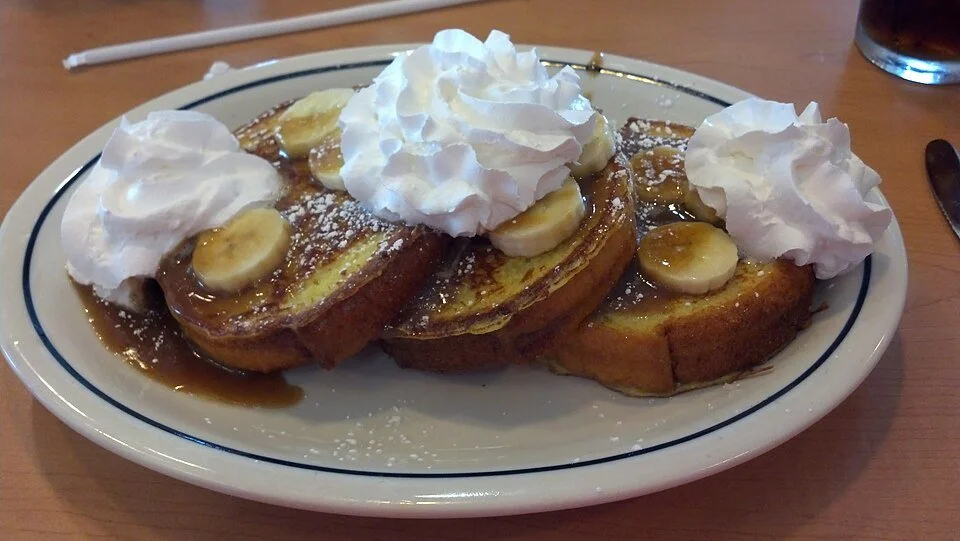
Photo of a dish of bananas Foster served over brioche French toast

13 April 2026

French toast is a dish, typically served at breakfast or brunch, of slices of bread soaked in beaten eggs and then fried. It is usually served with syrup. Why it is French is a bit of mystery. The earliest use of the present-day form of the dish that I have found ascribes it to an anonymous French cook, but the name is more likely simply from a general ascription of things culinary to the French.

But before we get to the dish as we know it today, I have found three early uses of the term French toast to refer to a different method of preparing and serving toasted bread. In these cases, the French is a reference to using French bread. Whether this is a baguette or another type of bread, I do not know. The first of these uses is from Robert May’s 1660 The Accomplisht Cook:

French Toasts.

Cut French Bread, and toast it in pretty thick toasts on a clean gridiron, and serve them steeped in claret, sack, or any wine, with sugar and juyce of orange.

A century later, Thomas Houdlston publishes a verbatim recipe in his c. 1760  A New Method of Cookery. And J. Skeat, in their 1769 The Art of Cookery and Pastery Made Easy and Familiar, includes “French Toast” as a side dish on a suggested menu for a cold supper. Exactly what this dish consists of cannot be determined, but it seems likely to be this same type of wine-soaked toast.

These early uses are probably unrelated to the dish we know today, which seems to have been independently created and coined in the mid nineteenth century. We have this recipe that appears in the magazine Southern Planter in August 1844:

FRENCH TOAST

From a French gentleman, of this city, we obtained the following recipe:—Take a loaf of light baker’s bread and cut it into thin slices—mix three eggs—three table-spoonfuls of sugar, and a tea-cup of milk, taking care to beat the eggs until they are very light. Soak the bread in this custard. Have some lard boiling hot, enough to cover the bread, and fry it until it is brown—then serve it up hot.

This is a very convenient and very pleasant dessert. The children, who are very fond of it, have dignified it with the name of French toast.


Sources:

“French Toast.” Southern Planter, August 1844, 192/2. ProQuest Magazine.

Houdlston, Thomas. A New Method of Cookery. Dumfries, Scotland: c. 1760, 57. Gale Primary Sources: Eighteenth Century Collections Online (ECCO).

May, Robert. The Accomplisht Cook, or the Art and Mystery of Cookery. London: R.W. for Nathaniel Brooke, 1660, 162. ProQuest: Early English Books Online.

Oxford English Dictionary Online, September 2009, s.v. French toast, n.

Skeat, J. The Art of Cookery and Pastery Made Easy and Familiar. London: 1769.

Photo credit: tengrrl, 2013. Wikimedia Commons. Flickr. Licensed under the Creative Commons Attribution-Share Alike 2.0 Generic license.

many happy returns

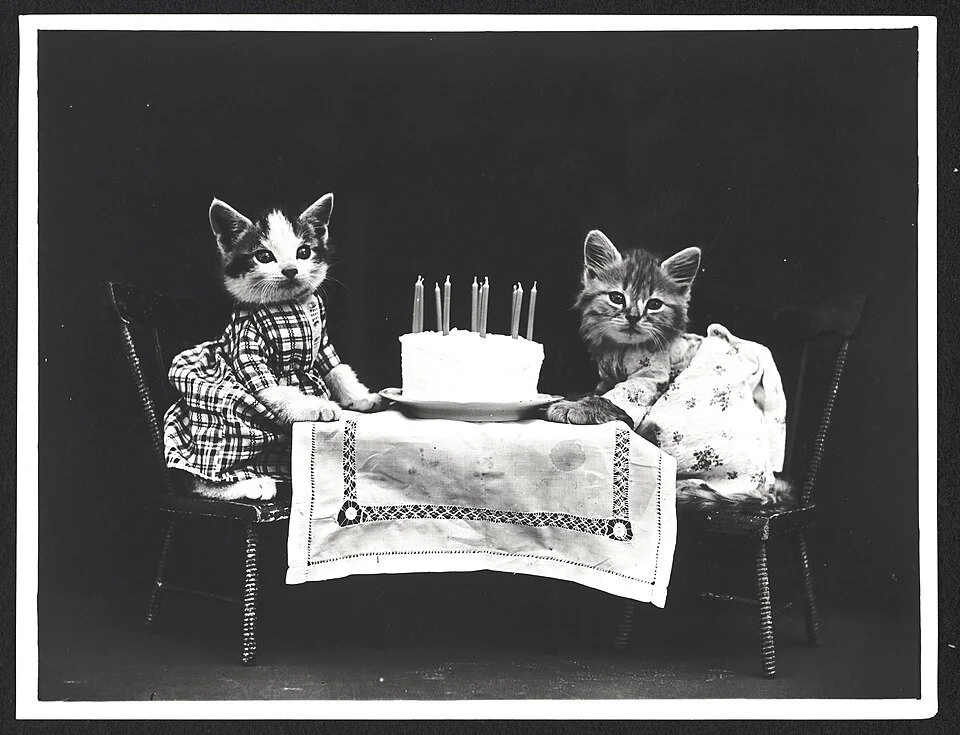
B&W photo of two kittens in dresses sitting at a table with a birthday cake

Obligatory kitten photo

8 April 2026

My practice when Facebook (yes, I’m still on Facebook; I’m old) reminds me of someone’s birthday is to send the message Many Happy Returns. I don’t remember when I first started doing it or why, but it was probably because I thought a simple Happy Birthday seemed trite and unoriginal. And occasionally someone responds with, “what the heck does Many Happy Returns mean?” The answer is rather straightforward.

It is clipping of many returns of the day, or in other words, a wish that the person may have many more. This use of return dates to the opening years of the eighteenth century. On 8 March 1704/05, the anniversary of Queen Anne’s ascension to the throne, John Hough, the bishop of Litchfield, preached a sermon that closed with:

What have we therefore to do but to rejoice in this Day, to pray that we may have many and many Returns of it, and that every one may bring fresh Blessings along with it?

And we see many happy returns used in connection to a birthday in Joseph Addison’s Free-holder of 25 May 1716:

The usual Salutation to a Man upon his Birth-day among the ancient Romans was Multos & fœlices; in which they wished him many happy Returns of it.

So my use of the phrase is a bit old fashioned, which somehow fits with someone who spends so much time with etymologies.

Discuss this post


Sources:

Addison, Joseph. The Free-holder, 46, 25 May 1716. Dublin: George Grierson, 1716, 269. Gale Primary Sources: Eighteenth Century Collections Online (ECCO).

Hough, John. A Sermon Preach’d before the Queen (8 March 1704/5). London: Jacob Tonson, 1705, 27. Gale Primary Sources: Eighteenth Century Collections Online (ECCO).

Oxford English Dictionary Online, March 2010, s.v. return, n.

Image credit: Harry Whittier Frees, 1914. Wikimedia Commons. Library of Congress. Public domain image.


hot little hands

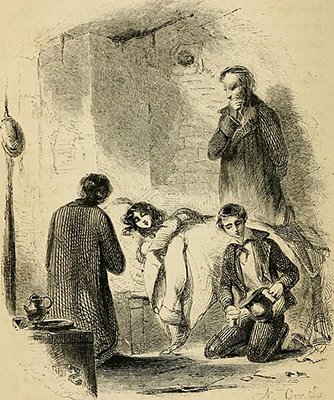
Victorian engraving of a girl lying in bed, with mother, father, and brother at the bedside looking concerned

“The Death-Bed of Madalina,” 1854

6 April 2026

The phrase hot little hands was brought to my mind by Languagehat, a denizen of this site and proprietor of his own excellent blog on language. The phrase is used today in the context of eagerly possessing or receiving something. But why hot? And why little?

The answer would seem to be in the phrase’s early appearances, which were in maudlin Victorian stories about children ill and dying of fever. Mary Jane Phillips’s short story 1857 Self Control uses it thusly:

“Poor little fellow!” I murmured, and stooped to kiss his fevered cheek, but just then he threw up his hot little hands upward, exclaiming, “O do n’t, mamma, Feddy did n’t mean to!”

And two years later, Phillips uses the phrase again in her 1859 Home Pictures for the Little Ones:

Lillian was lying upon the sofa, and she reached out her hot little hands, saying, imploringly: “O brother, dear brother, please bring sister a glass of good cold water!

By century’s end, the context of dying of fever had been lost, but the children remained, often in the context of holding or possessing flowers. Here’s an example from another piece of sentimental fiction that appeared in the San Francisco Examiner of 15 March 1899. It’s Annie Laurie’s Second Wooing of Captain De La Mar a story of an estranged couple reunited through the love of their child:

One day the little girl brought her a knot of wild flowers.

She held them tight in her hot, little hands.

“For you—mamma,” she said. “Papa sent them.”

A few decades more and the context of a child’s hands had fallen away. Here’s an example from a little piece in the Calgary Daily Herald of 14 October 1933 about the noise created when an entire newsroom of reporters munches away on apples:

Saturday morning in came the nice man with a bucket of apples. He said he’d like to give us each an apple. We said we’d like to give him something for Sunshine if he’d put it on the cuff till Tuesday, but as he was a very trusting man we gave him our shiny dimes we had been clutching in our hot little hands since payday.

And there is this wonderfully odd use of the phrase in an article about WWII-era blues music in the San Francisco Chronicle of 26 May 1940:

It is not a coincidence either that the blues are the creation of a non-Aryan people to whom the freedoms and opportunities of America have been largely denied. In a year when America is apparently going to have to come to grips with despair as never before, and perhaps become the trustee of a culture based on tolerance, that thought may be worth mulling over. Pollyanna won’t stop Hitler, even with a Garand rifle clutched in her hot little hands.


Sources:

Jive. “Pollyanna Serenade.” San Francisco Chronicle (California), 26 May 1940, This World (Sunday magazine) 25/2. Readex: America’s Historical Newspapers.

Languagehat. “Hot Little Hands.” Languagehat (blog), 8 March 2026. https://languagehat.com/hot-little-hands/

Laurie, Annie. “Second Wooing of Captain De La Mar.” Examiner (San Francisco, California), 15 March 1899, 31/5. ProQuest Newspapers.

“Music of Apple Day Brings New Sound to Disturb Newsroom.” Calgary Daily Herald (Alberta), 14 October 1933, 11/5. ProQuest Newspapers.

Phillips, Mary Jane. Home Pictures for the Little Ones. New York: Carlton & Porter, 1859, 68. Gale Primary Sources: Nineteenth Century Collections Online.

———. “Self-Control.” Ladies Repository, December 1857, 732–34 at 733/2. HathiTrust Digital Library.

Stover, Smokey. “Hot Little Hands.” Phrase Finder, 22 April 2006.

Image credit: N. Orr, 1854. Wikimedia Commons. In Solon Robinson. Hot Corn: Life Scenes in New York Illustrated. New York: De Witt and Davenport, 1854, opposite 217. Archive.org. Pubic domain image.