wild and woolly

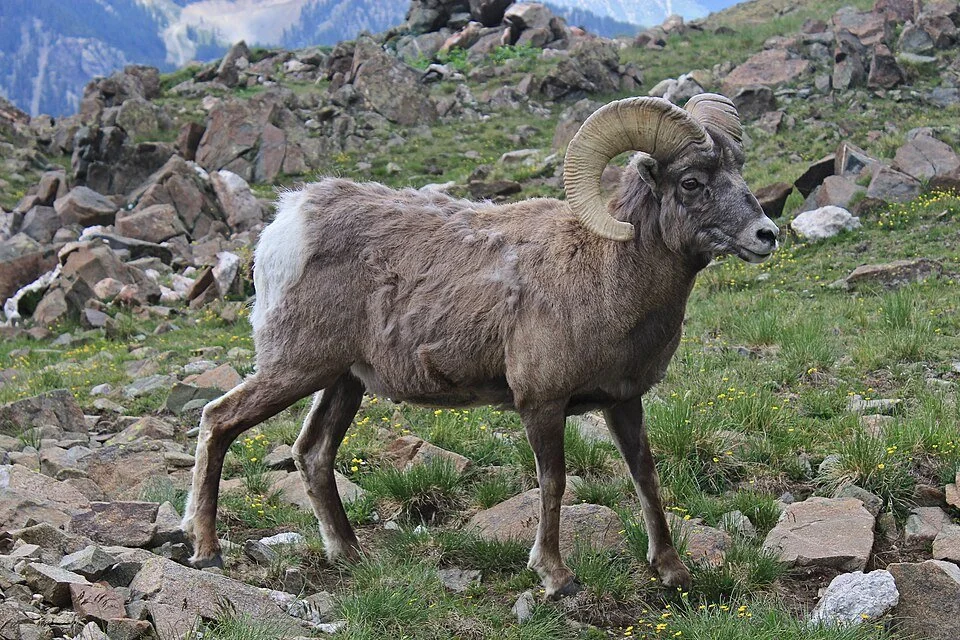
Photo of a bighorn sheep with unkempt wool on a rocky hillside

 A wild and woolly bighorn sheep

20 April 2026

The phrase wild and woolly is an Americanism referring to something, or someone, who is without order or control, untamed by law or social convention. Wild is clear enough, but why woolly? This is a case of a phrase that may seem baffling at first glance, but whose underlying metaphor becomes obvious once explained.

The phrase comes out of the America’s western frontier and is a metaphorical reference to a wild or feral animal, such as a sheep or horse. The earliest use in print that I’m aware of is from the Wichita City Eagle of 12 April 1872 in a column extolling the virtues of the paper’s advertisers:

In another line we find Houghton, Mills & Co.—the Blue Store—where is kept one of the largest, most fashionable and select stocks of men’s and boys’ clothing, gents’ furnishing goods, etc., west of the Missouri river cities. They take measures at their store and show samples of goods, with the latest New York fashion plates, and thus can transfigure in two weeks the long-haired, wild-and-wooly [sic] and hard-to-handle of the frontier into the finished-appearing Broadway swell.

A year later, on 18 May 1873, we get this in another Kansas newspaper, Topeka’s Kansas Daily Commonwealth:

Here we are right from the Chisholm trail, wild and woolly and hard to curry. Wichita is booming, the long horned lantern-jawed and speckle-top booted Texan is here, not singly, but in droves. He perambulates every saloon, bagnio, dance-house, gambling shop, and clothing store in town, and swaggers through it with that nonchalance and looseness peculiar only to Texas cattle and their drivers.

The mention of curry clearly refers to cleaning the coat of an animal.

A few months later we have this from the Dallas Daily Herald of 10 August 1873 describing a fight between two drunks in Brooklyn, Texas on 7 August of that year:

Griffin was led down the street some one hundred yards to the drug store. Valentine refused to be pacified when they met and clinched, and Va[l]entine drew another Derringer, but it dropped in the scuffle. Griffin got him down, when he was pulled off. When Valentine regained his feet he threw a short piece of plank at Griffin which he dodged, and yelled in return, “Wild and woolly and hard to curry.” This was fuel to the flame.

And a few years later the same Dallas paper has this letter by “Comanche Jim” from 18 January 1877:

Now that the law is touched in the person of Mr. Jeffries, the wild and woolly cow-boys no doubt wjll [sic] be compelled to lay aside their weapons on entering the township in order that the more peaceable and respectable members of the community may have a show for their lives. The excuse that Fort Griffin is a frontier town and that Indians are dangerous is now getting “too thin” to justify men necessarily carrying weapons, which, as a matter of consequence, they use, when frontier whisky makes them feel like it.

There is an earlier and racist use of “the wild and woolly-haired Negrillo, Alfouron, or Papuan” in the July 1855 issue of the Protestant Episcopal Quarterly Review, and Church Register. But this is woolly-haired and not just woolly and appears to be a nonce usage unrelated to the phrase used two decades later to describe cowboys on the western frontier of the United States. Still, one wonders if there might be some underlying racism in the early uses of the phrase. Black cowboys were common in the American West—they have been largely erased from our present-day fictional depictions of the era—and it’s not unthinkable that the phrase originated as a racist description of them. But we would need more evidence before reaching that conclusion.

Discuss this post


Sources:

Comanche Jim. “Frontier Racket” (18 January 1877). Dallas Daily Herald (Texas), 24 January 1877, 4/3. Portal To Texas History: Texas Digital Newspaper Program.

“Ethnology and the Scriptures.” Protestant Episcopal Quarterly Review, and Church Register, 2.3, July 1855, 373–99 at 378. Gale Primary Sources: American Historical Periodicals.

“From Wichita.” Kansas Daily Commonwealth (Topeka), 18 May 1873, 2/3. Newspapers.com.

O’Toole, Garson. “Re: [Ads-l] ‘Wild and wooly’ (1873).” ADS-L, 26 March 2026, Two emails in thread: first email; second email.

“Our Advertisers.” Wichita City Eagle (Kansas), 12 April 1872, 4/3. Newspapers.com.

Oxford English Dictionary Online, 1928, s.v. woolly, adj. & n.

Popik, Barry. “Wild and Woolly.” Barrypopik.com, 17 January 2009. https://barrypopik.com/blog/wild_and_woolly

“Wild and Woolly and Hard to Curry.” Dallas Daily Herald (Texas), 10 August 1873, 4/3. Portal To Texas History: Texas Digital Newspaper Program.

Photo credit: Jwanamaker, 2013. Wikimedia Commons. Licensed under the Creative Commons Attribution-Share Alike 3.0 Unported license.

breakfast / Continental breakfast / English breakfast / second breakfast

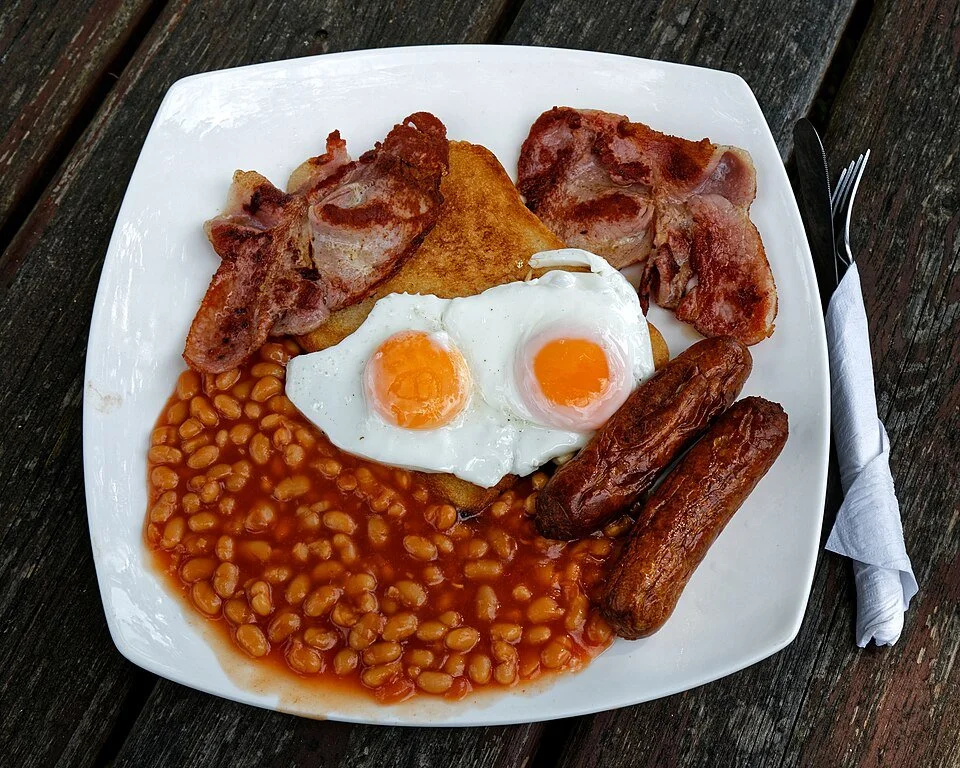
A breakfast plate containing two eggs, sausages, bacon, baked beans, and fried bread

A full English breakfast

17 April 2026

Breakfast has a very straightforward etymology. It is a compound of break + fast, that is a meal eaten after period of abstention from food, usually while sleeping overnight. The word dates to at least the mid fifteenth century, but exactly what food a breakfast consists of has varied over the years and from place to place. We have Continental breakfasts and English breakfasts, not to mention, for those fans of Peter Jackson’s Lord of the Rings movies, second breakfasts.

The earliest use of breakfast that I’m aware of is in the account books of John Howard, the first duke of Norfolk. Those records contain the following entry for the year 1463:

Item, the xxij. day off Septembyr, in exspensys in breffast,      xj.d.

And we see the verb to breakfast, meaning to eat a breakfast, in the 1644 pamphlet Huls Pillar of Providence Erected, an account of the siege of Hull by royalist forces during the English Civil War. It has the following description of the breaking of the siege by parliamentary forces on 12 October 1642. Note that the breakfasting here is metaphorical; the royalists are being served defeat by the parliamentary army:

How comfortably did the whole Towne almost look over the walles that whole day, and see this salvation of God?

15. Lastly, being thus breakfasted on wednesday, that night they sup with fears and curses, and hasty purposes of being gone from us. The Lord on a sudden sweeps them away, they steale away the remaining Ordnance in the night.

As traditionally conceived, a Continental breakfast is a light meal consisting of foods like toast, pastries, yogurt, and coffee, the continent in question being Europe. But I found an early example of the phrase being used to refer to a hearty meal served in the late morning. From an article in the New Sporting Magazine of April 1838 by one Nimrod, which describes such a meal served to a hunting party in Belgium:

For myself, I commenced with pig’s puddings, and finished with mutton cutlets, to say nothing of the most delightful brown bread and butter I ever tasted in my life; coffee, tea, et cetera—not forgetting a little drop of “something short,” to keep things in their places, as Mrs. Ramsbottom used to say. But speaking seriously, a continental breakfast at that hour is a most glorious meal.

But by mid century we see Continental breakfast used to describe the meal we’re familiar with today. From an 8 January 1851 letter published in the Louisville Weekly Journal:

Taking, then, Murray’s Guide Book, the faithful Friday of all English and American Crusoes, under my arm, my friend F. and I sallied forth in the direction of the Capitol, stopping on the way to take the usual continental breakfast, a cup of coffee or chocolate and bread.

In contrast to the Continental breakfast, the English breakfast is a large meal, with a full English breakfast traditionally consisting of bacon, sausages, eggs, black pudding, tomatoes, mushrooms, baked beans, and toast. And depending where you are in the islands, it can also be referred to as a full Scottish, Welsh, or Irish breakfast.

The earliest use of English breakfast that I’ve found is in an account of a visit to Holland dated 31 July 1817 that refers to a meal served aboard a British ship that has crossed the channel:

But after a little consultation, and as every one thought he could discover anguish in the countenance of his neighbour at the threatened durance, our pilot, who had speedily retired below to the comforts of a good English breakfast, was no less hastily called upon deck, when, much against his liking, he was directed to carry the ship into the Helvoet channel, where the Harwich packets go, and into which there is water at all times of tide.

But like the term Continental breakfast, what an English breakfast consisted of was not fixed in the early years. Susan Ferrier’s 1819 novel Marriage uses the term to denote a light meal, like that served on the Continent, in contrast to the fuller meal served in Scotland:

“I own I was surprised to see you cut so good a figure after the delicious meals you have been accustomed to in the north: you must find it miserable picking here. An English breakfast,” glancing with contempt at the eggs, muffins, toast, preserves, &c. &c. he had collected round him, “is really a most insipid meal: if I did not make rule of rising early and taking regular exercise, I doubt very much if I should be able to swallow a mouthful—there’s nothing to whet the appetite here; and it’s the same every where; as Yellowchops says, our breakfasts are a disgrace to England. One would think the whole nation was upon a regimen of tea and toast—from Land’s End to Berwick-on-Tweed, nothing but tea and toast.”

But by the opening years of the twentieth century the definition of an English breakfast had settled down, and we see the phrase full English breakfast. From Douglas Sladen’s 1908 Egypt and the English:

The catering, as I have said, was not done by the Sudan Government itself, but let out to a Greek contractor, who, all things considered, did his work pretty well, because he contrived to give his passengers a full English breakfast, lunch, and dinner, moderately well-cooked, and with hardly anything overhung; things must be very difficult to keep sound on a train in that temperature. Als the mineral waters were iced.

And there is this classified ad that appeared in the London Times on 4 June 1928:

A CHARMING RESIDENCE. facing gardens, two minutes Marble Arch: Bed-Sitting Room. full English breakfast. 2gns.; large double, 3gns.: optional four-course dinner, 3s.; best of food: hot and cold water.

Finally, what about the hobbits’ second breakfast in J. R. R. Tolkien’s The Lord of the Rings? The phrase does not appear in the books, existing only in Peter Jackson’s filmed version. The novels do refer to hobbits preferring to eat six meals a day, but it does not name them. But outside of Middle-Earth, second breakfast is traditionally a thing in central Europe, and there is this account of a second breakfast served in England in James Woodforde’s diary for 2 January 1775:

Dr. Wall breakfasted with me and went with me in the Bath Machine, it being a Frost so far as Burford. Mr. Fisher of University Coll: went with us in the Machine as did one Sally Kirby, a servant made of one Mrs. Horwood of Holton near Ansford who is now at Bath and bad in the gout. We stayed at Whitney and made a second breakfast, we treated the made at Whitney, I pd 0. 1. 6.


Sources:

“Accounts and Memoranda of Sir John Howard, first Duke of Norfolk, A.D. 1462 to A.D. 1471.”Manners and Household Expenses of England in the Thirteenth and Fifteenth Centuries. London: William Nicol, Shakspeare Press, 1841, 224. HathiTrust Digital Library.

Classified Ad. Times (London), 4 June 1928, 2/7. Gale Primary Sources: Times Digital Archive.

Coleman, Thomas. Huls Pillar of Providence Erected. London: Ralph Rounthwait, 1644, 13. ProQuest: Early English Books Online (EEBO). University of Michigan Early English Books Online Collection (EEBO-TCP).

Ferrier, Susan. Marriage, a Novel, vol. 2 of 3, second edition. Edinburgh: William Blackwood, 1819, 170–171. HathiTrust Digital Library.

“Journal of a Visit to Holland” (31 July 1817). Edinburgh Magazine and Literary Miscellany, vol. 3, July 1818, 36–38 at 36. ProQuest Historical Periodical.

Letter, 8 January 1851. Louisville Weekly Journal (Kentucky), 19 March 1851, 1/9. Readex: America’s Historical Newspapers.

Middle English Dictionary, 31 January 2026, s.v. breke-fast, n.

Nimrod. “The Feast of Saint Hubert—Or a Visit to Belgium.” New Sporting Magazine, 14.84, April 1838, 221. ProQuest Historical Periodical.

Oxford English Dictionary Online, March 2024, s.v. breakfast, n., breakfast, v.; 2012, s.v. all-day breakfast, n., American breakfast, n.; 2008, s.v. English breakfast, n.; 1911, s.v. second breakfast, n.; 1893, s.v. continental, adj. & n.

Sladen, Douglas. Egypt and the English. London: Hurst and Blackett, 1908, 315. Gale Primary Sources

Woodforde, James. Diary of a Country Parson, vol.1, (2 January 1775). John Beresford, ed. London: Humphrey Milford, Oxford UP, 1924, 1.144. HathiTrust Digital Library.

Photo credit: Acabashi, 2017. Wikimedia Commons. Licensed under the Creative Commons Attribution-ShareAlike 4.0 International license.

anachronym

Photo of a man in 18th-century dress smoking a cigarette and taking a photo with with a smartphone

15 April 2026

No, that’s not a typo for acronym. An anachronym is a term whose original meaning has become anachronistic but which continues to be used for a more current application. Examples of anachronyms include dialing a phone, footage (originally referring to the length of movie film), cc (carbon copy), and dashboard (a double anachronym, originally referring to a board protecting passengers in a carriage from splashes of mud, then a control panel in a car, and more recently a digital interface on a device or in software).

The term dates to at least 10 March 2012, when W. Brewer used it in a post to the American Dialect Society email list (ADS-L):

Anachronyms. My favorites are telephone expressions. Hang up your phone, it is off the hook. Phone is ringing. I dialed the wrong number. Address book. Yellow pages.

And in another post to ADS-L on 2 April 2012, Brewer claimed to have coined the term, which may very well be true:

Greek nautia ~ nausia (seasickness) < naus (ship); cf. nautik-os (seafaring), nautil-os (sailor); pIE *na:us (boat). Preservation of Latin form NAUSEA, extension of meaning (seasick, carsick, airsick, morning sickness): According to Wilson's statement, English NAUSEA has completely lost its association with the sea, and hence fits my definition of an ANACHRONYM (my coinage).

The term seems to have languished for another dozen years until Benjamin Dreyer used it in a 12 March 2024 article in the Washington Post online edition:

But if Twitter has been X'd out and tweets are no longer tweets but posts instead, what is to become of the useful coinage “subtweet”?

Given that the word now has become a generic term used on other social media platforms (hello, my friends at Bluesky), I suspect that “subtweet” will join the ranks of what are known as anachronyms: words that are used “in an anachronistic way, by referring to something in a way that is appropriate only for a former or later time.”

That's the way Wikipedia defines them, which will have to suffice for now, because the word is too new to have worked its way into dictionaries.

That article seems to have inspired a similar one on 25 March 2024 in the Atlantic which quotes linguist Ben Zimmer using anachronym:

Besides, it wasn’t a simple self-portrait but a group shot with a dozen people in it. (That’s not a “selfie,” but a “group selfie” or a “groupie,” some have suggested.)

What is happening to the selfie?

At first glance, it seems it may be turning into what linguist Ben Zimmer calls an “anachronym,” a word or phrase that remains in usage even as behaviors change.

“The accumulated cultural knowledge of past technologies ends up powerfully shaping the way we talk about new technologies,” Zimmer told me. “Think about the terms that we use for telephones, for instance. We still talk about ‘dialing.’ And we talk about ‘taping’ something even if it’s on the DVR. Sometimes what we’re left with is language that’s sort of obsolete.”

The opposite of an anachronym would be a retronym, that is a newly coined term used to refer to an older version or form of something, such as an acoustic guitar, film camera, or hardcover book.

Anachronym is a useful term, but I doubt it will catch on with the general public. It’s too easily confused with the far more common acronym and anachronism. And indeed, when I googled anachronym, the search engine returned results for acronym. (And I used the Kagi search engine, so I’m not sure if the verb to google is an anachronym; right now it’s just a generic use of a trade name, but the way Alphabet is managing its Google search engine, making it less useful with every update, it may very well become a full-blown anachronym.)

Discuss this post


Sources:

Brewer, W. “Cathartic = ‘experiencing catharsis’ PLUS free balonus!” ADS-L, 2 April 2012.

———. “Pre-Archaic Industrial Jargon.” ADS-L, 10 March 2012.

Dreyer, Benjamin. “If You’re Still Using These Dated Words, You’re Not Alone.” Washington Post (Online), 12 March 2024. ProQuest

LaFrance, Adrienne. “When Did Group Pictures Become ‘Selfies’?” Atlantic, 25 March 2024. Theatlantic.com.

Newton, Heddwen. “37 Examples of Anachronyms.” English in Progress (blog), 17 January 2025. Wikimedia Commons. Licensed under the Creative Commons Attribution 4.0 International license.

intifada

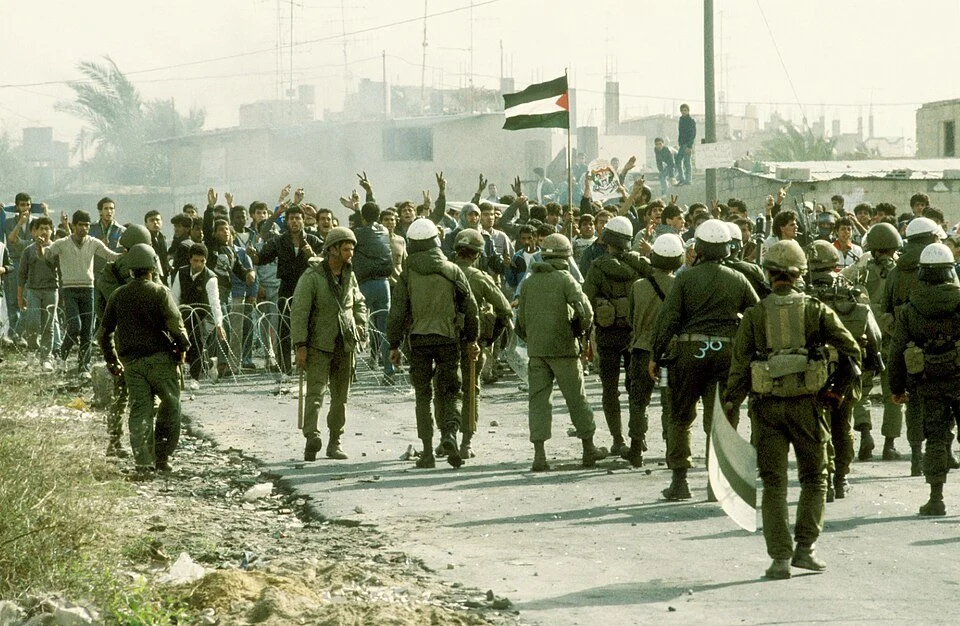
Photo of Israeli police and military confronting Palestinian protesters across a barbed-wire barrier

Intifada in Gaza, 1987

10 April 2026
[Edit: 13 April 2026, added literal Arabic meaning]

The word intifada enters English from the Arabic انتفاضة, meaning uprising or revolt; literally, an intifada is a shaking off, from nafada meaning to shake. In Arabic, it has widespread use referring to any number of insurrections or civil resistance movements across the Arab world. In English, however, it is usually found in the context of Palestinian insurrections against Israeli occupation. And, with a capital letter, Intifada is used to refer specifically to two Palestinian insurrections against Israeli occupation, the First Intifada (1987–93) and the Second Intifada (2000–05).

The earliest use of the word in English that I have found is in a January 1985 article in Current History that uses Intifada as the name of an alliance of Palestinian political groups arrayed against Yassir Arafat’s leadership of the Palestinian Liberation Organization (PLO):

Not taking part in these talks were the Fatah rebels of Abu Musa (known now as the Intifada, or “upheaval”) and other groups controlled by Syria—the Saiga guerrilla organization, the Popular Front—General Command (PFGC) of Ahmad Jibril, and the small Palestine Popular Struggle Front (PPSF); together, these groups were known as the National Alliance. It was the groups of the National Alliance that had taken up arms against Arafat’s loyal units in Lebanon; the groups in the Democratic Alliance, however, had remained neutral, even though they shared many rebel complaints about Arafat’s policies and leadership.

And in the sense of uprising or insurrection, it appears later that year in the pages of the Los Angeles Times, referring to Palestinian resistance to the government of Lebanon. From the 11 September 1985 issue:

Along with Gemayel’s declining popularity, the last six months have seen one intifada—Arabic for uprising—after another, and they have brought about the most fundamental realignment of power in the Christian community since Lebanon obtained its independence from France in 1946.


Sources:

Hudson, Michael C. “The Palestinians after Lebanon.” Current History, 84.498, January 1985. 16–20, 38–39 at 19. ProQuest Magazines. DOI: 10.1525/curh.1985.84.498.16.

Oxford English Dictionary Online, March 2023, s.v. intifada, n.

Wallace, Charles P. “Gemayel a Leader Deserted by Followers.” Los Angeles Times, 22 September 1985, 1/5. ProQuest Historical Newspapers.

Photo Credit: Eli Sharir, 1987. Wikimedia Commons. Efi Sharir / Dan Hadani collection / National Library of Israel / The Pritzker Family National Photography Collection. Licensed under the Creative Commons Attribution 4.0 International license.

French toast

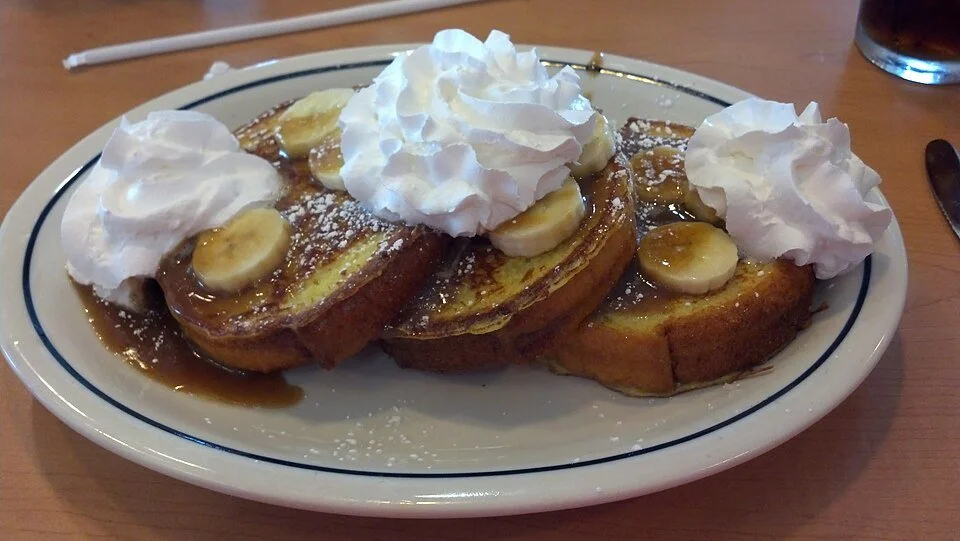
Photo of a dish of bananas Foster served over brioche French toast

13 April 2026

French toast is a dish, typically served at breakfast or brunch, of slices of bread soaked in beaten eggs and then fried. It is usually served with syrup. Why it is French is a bit of mystery. The earliest use of the present-day form of the dish that I have found ascribes it to an anonymous French cook, but the name is more likely simply from a general ascription of things culinary to the French.

But before we get to the dish as we know it today, I have found three early uses of the term French toast to refer to a different method of preparing and serving toasted bread. In these cases, the French is a reference to using French bread. Whether this is a baguette or another type of bread, I do not know. The first of these uses is from Robert May’s 1660 The Accomplisht Cook:

French Toasts.

Cut French Bread, and toast it in pretty thick toasts on a clean gridiron, and serve them steeped in claret, sack, or any wine, with sugar and juyce of orange.

A century later, Thomas Houdlston publishes a verbatim recipe in his c. 1760  A New Method of Cookery. And J. Skeat, in their 1769 The Art of Cookery and Pastery Made Easy and Familiar, includes “French Toast” as a side dish on a suggested menu for a cold supper. Exactly what this dish consists of cannot be determined, but it seems likely to be this same type of wine-soaked toast.

These early uses are probably unrelated to the dish we know today, which seems to have been independently created and coined in the mid nineteenth century. We have this recipe that appears in the magazine Southern Planter in August 1844:

FRENCH TOAST

From a French gentleman, of this city, we obtained the following recipe:—Take a loaf of light baker’s bread and cut it into thin slices—mix three eggs—three table-spoonfuls of sugar, and a tea-cup of milk, taking care to beat the eggs until they are very light. Soak the bread in this custard. Have some lard boiling hot, enough to cover the bread, and fry it until it is brown—then serve it up hot.

This is a very convenient and very pleasant dessert. The children, who are very fond of it, have dignified it with the name of French toast.


Sources:

“French Toast.” Southern Planter, August 1844, 192/2. ProQuest Magazine.

Houdlston, Thomas. A New Method of Cookery. Dumfries, Scotland: c. 1760, 57. Gale Primary Sources: Eighteenth Century Collections Online (ECCO).

May, Robert. The Accomplisht Cook, or the Art and Mystery of Cookery. London: R.W. for Nathaniel Brooke, 1660, 162. ProQuest: Early English Books Online.

Oxford English Dictionary Online, September 2009, s.v. French toast, n.

Skeat, J. The Art of Cookery and Pastery Made Easy and Familiar. London: 1769.

Photo credit: tengrrl, 2013. Wikimedia Commons. Flickr. Licensed under the Creative Commons Attribution-Share Alike 2.0 Generic license.