religion

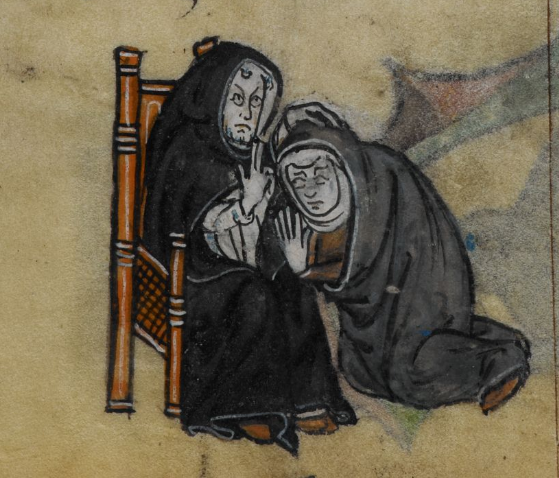
Medieval illustration of a seated monk blessing a woman kneeling before him in prayer

Detail from an early fourteenth-century manuscript

6 May 2026
(Update: 8 May 2026, added discussion of classical Latin root)

Religion has a straightforward etymology, but its original English meaning is rather different from how it is commonly used today. It is a late twelfth-century borrowing, partly from the Anglo-Norman religiun, and partly from the post-classical Latin religio, both referring to a system of beliefs about divine beings.

In classical Latin, religio had a range of meanings relating to the divine. It could refer to reverence for the gods; conscientiousness or scrupulousness, especially in matters of faith; or the more abstract holiness or sanctity. The root appears to be lig-, meaning to bind. The verb religo (not to be confused with the noun religio discussed above) means to fasten up or bind fast. Cicero, probably reflecting the prevalent view of his time, argued that the root was the verb relegare, meaning to read again, but modern scholarship generally discounts this explanation. (As a rule, present-day scholars have more resources and knowledge of language development than those living in earlier eras.) But either way, the noun religio was associated with the idea of adherence to divine rites..

Its original English sense was that of a monastic order, and it could also refer to a member of such an order, a monk, nun, canon, or friar or even a small community of such people.

The earliest surviving appearance of the word in English is from the Ancrene Wisse (or Ancrene Riwle), a handbook for anchoresses, women who withdrew from society, even monastic society, opting to live alone in cells attached to churches where they led a life of intense prayer and devotion. The Ancrene Riwle was probably composed in the late twelfth century, with the earliest surviving manuscript from c. 1230:

Rihten hire & smeðin hire is of euch religiun ant of euch ordre the goð & al þe strengðe. þeos riwle is imaket nawt of monnes fundles, a is of godes heaste.

(The goodness and strength of each religion and each order is to govern her & to smooth her [i.e., keep her heart free of sin]. This rule is not made of man’s invention, but it is of God’s instruction.)

We don’t see religion used in the abstract sense until the late fourteenth century. That sense appears in a Wycliffite translation of the Latin Vulgate Bible from c. 1384. Colossians 2:20–23 reads, in part:

For if ȝe ben deed with Crist from the elementis of this world, what ȝit as men lyuynge to the world deman ȝe? That ȝe touche not, nether taaste, nether trete with hoondis tho thingis, whiche alle ben in to deth bi the ilke vss, aftir the comaundementis and the techingis of men; whiche han a resoun of wisdom in veyn religioun and mekenesse.

(For if you are dead with Christ from the elements of this world, why do you, as if you were men living in the world, submit to them? That you do not touch, neither taste, nor treat with your hands those things, which all lead to death with such use, according to the commandments and the teachings of men, which have a foundation of wisdom in vain religion and humility.)


Sources:

Ancrene Wisse. Cambridge, Corpus Christi College, MS 402. Stanford University Libraries: Parker on the Web.

Ancrene Wisse. J. R. R. Tolkien, ed.  Early English Text Society 249. London: Oxford UP, 1962, 7. Cambridge, Corpus Christi College, MS 402. Archive.org.

Anglo-Norman Dictionary, AND Phase 5, 2018–21, s.v. religiun, n.

Dictionary of Medieval Latin from British Sources, 2013, s.v. religio, n. Brepols: Database of Latin Dictionaries.

The Holy Bible Containing the Old and New Testaments with the Apocryphal Books in the Earliest English Versions made from the Latin Vulgate by John Wycliffe and His Followers, vol. 4. Josiah Forsall and Frederic Madden, eds. Oxford, Oxford UP, 1850, 433/2. HathiTrust Digital Library.

Lewis, Charlton T. and Charles Short. A Latin Dictionary. Oxford: Oxford UP, 1879, s.v. religio, n., religo, v. Brepols: Database of Latin Dictionaries.

Middle English Dictionary, 31 January 2026, s.v. religioun, n.

Oxford English Dictionary Online, December 2009, s.v. religion, n.

Image credit: Unknown artist, first quarter of the fourteenth century. London, British Library, Stowe MS 17, fol. 191r. Wikimedia Commons. Public domain image.
English (spin)

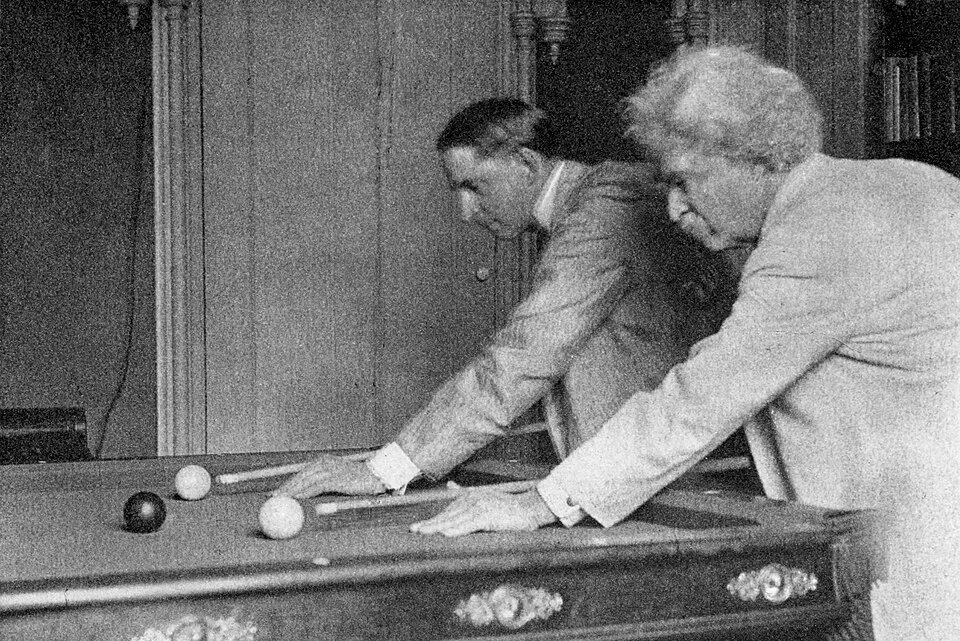
Grainy B&W photo of two men playing billiards

Mark Twain and his biographer Albert Bigelow Paine playing billiards, 1907

4 May 2026

In billiards, and in other sports, to put English on a ball is to cause it to spin so that it’s course changes. In billiards, this is done by striking the ball on one side, and the course change often occurs after it caroms off the cushion. The term arose in the United States in the mid nineteenth century.

Why this is referred to as English is not known. The most likely explanation is that billiard players from England introduced the technique to those in the United States, but there is no firm evidence of this. The Oxford English Dictionary has a quotation from a 1959 letter written to London’s Sunday Times in claiming that it was a man named English who introduced the technique to the Americas, but this is almost certainly an after-the-fact invention to explain the term.

The earliest use of English in this sense that I’m aware of is in the Cleveland Daily Plain Dealer of 14 October 1861:

The following are tricks most frequently practiced at billiards by a cunning adversary, of which I desire to warn you:

[…]

3. Immediately after shooting using his cue as a magic wand and flourishing it in the air above the table to give an increased “English” to his ball.

And Mark Twain used the term in his 1869 Innocents Abroad in a description of Parisian pool halls:

The cushions were hard and inelastic, and the cues were so crooked that in making a shot you had to allow for the curve or you would infallibly put the “English” on the wrong side of the ball.

And English as a verb appears in the Atlanta Constitution of 31 January 1875 in an article about King Kalakaua of Hawaii playing billiards in Omaha, Nebraska:

His royal highness again scored several, and to make up for his miscue he “jawed” the balls, and would and would [sic] have made a big run had not the balls “shewed” round so that it was impossible to make the shot without going to cushion first, and “Englishing.” The king failed on his “English,” not putting enough of it on.

The Constitution credits this article to the Omaha Bee, but that paper’s digitization is spotty, with only two issues of the Omaha paper from January 1875 available. In those, I see coverage of the king’s visit to the city, but not of this particular event.

Discuss this post


Sources:

“Kalakaua as a Billiard Player. Atlanta Constitution (Georgia), 31 January 1875, 2/5. ProQuest Historical Newspapers.

Oxford English Dictionary Online, December 2008, s.v. English, adj. (& adv.) & n., English, v.

Smith, Norman. “Giving It English.” Sunday Times (London), 5 April 1959, 4/3. Gale Primary Sources: The Sunday Times.

“Tricks at Billiards.” Cleveland Daily Plain Dealer (Ohio), 14 October 1861, 4/3. Readex: America’s Historical Newspapers.

Twain, Mark. The Innocents Abroad. San Francisco: H. H. Bancroft, 1869, 116. HathiTrust Digital Library.

Photo credit: Unknown photographer, 1907. Wikimedia Commons. From Paine, Albert Bigelow. Mark Twain: A Biography, vol. 4 of 4. New York: Gabriel Wells, 1923, facing page 1326. Archive.org. Public domain image.

eighty-six

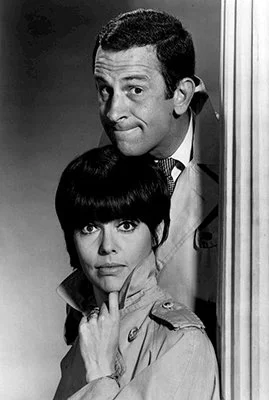
B&W photo of a man and a woman in trench coats

Publicity still of Don Adams as Agent 86 and Barbara Feldon as Agent 99 in the TV series Get Smart

2 May 2026

Eighty-six or 86 originated in restaurant slang with the meaning that an item was out of stock. It also came into use as a verb meaning to cancel an order and to eject or not serve a customer. It then passed into general slang to mean to cancel something or kill someone. Why the number eighty-six was chosen is not known. There are number of explanations floating about, but only two are plausible: that it is rhyming slang or that it is simply an arbitrary assignment of a number in a larger numbering scheme.

Use of eighty-six in diner slang meaning out of stock is recorded as early as 1920 in a 22 October article in the Topeka Daily State Journal:

They were breaking in a new waiter at one of the avenue restaurants. He turned in an order for a small steak, to be met with a curt “eighty-six.” The waiter stared at the cook and repeated the order. “Eighty-six, I toldcha,” roared the cook in so belligerent a tone that the waiter wilted. A brother hash-slinger broke it gently to him that in the argot of the restaurant “Eighty-six” means just what “Thirty” does to a printer—“That’s all. No more to come.”

Several years later, George Manker Watters and Arthur Hopkins’s 1927 play Burlesque contains an exchange where a waiter uses eighty-six, but it seems to be in the opposite sense, that of possessing something in short supply, specifically during Prohibition:

WAITER (opening bottles)—If you need any Scotch or gin, sir.
SKID—Yeah, I know.
WAITER—My number is Eighty-six.
SKID—That’s just Lefty’s age.
LEFTY (stirring in his doze—Ah, you big bum, why don’t you go to bed?
SKID (pays WAITER)—Keep the change.
WAITER—Thank you, sir. Thank you very much, and my number is…
SKID (up at table)—Yeah. Eighty-six. I know (WAITER exits. SKID draws enormous flask from pocket.) Do you want yours straight or highball, Mazie?

Researcher Barry Popik has found two other early uses. The first is in a 10 June 1929 Pittsburgh Post-Gazette article:

The Soda Jerkers’ Code

The young bartenders in one of those big soda emporiums downtown have a secret code. They use it in relaying orders behind the bar. It works much like the waitress’ “Two on a raft!” when she means poached eggs on toast.

When “Burn one!” for instance, is hollered fore and aft, it means the customer’s tongue is hanging out for a chocolate malted milk. Other signals we learned to identify at the rist of indigestion and strawberry rash are:

“Shake one!” (Chocolate milk shake.)
“Shoot one!” (Small coca cola.)
“Stretch one!” (Large coca cola.)
“Ten!” (Root beer.)
“Twenty-one!” (Limeade.)
“Thirty-one!” (Lemonade.)
“Forty-one!” (Orangeade.)
“Fifty-one! (Hot chocolate.)
“Eighty-six! (All out.)
“Eighty-nine!” (Look at the legs under the table.)

The second is in a Walter Winchell newspaper column from 23 May 1933 with a nationwide audience:

A Hollywood soda-jerker forwards this glossary of soda-fountain lingo out there... “Shoot one” and Draw one” is one coke and one coffee... “Shoot one in the red!” means a cherry coke... An “echo” is a repeat order... “Eighty-six” means all out of it... “Eighty-one” is a glass of water... “Thirteen” means one of the big bosses is drifting around... A “red ball” is an orangeade.

By 1947 eighty-six had become a verb meaning to cancel, as can be seen by this item in the 5 February 1947 issue of Variety—a publication famed for its use of slangy headlines—which also shows the term had moved beyond the food service industry:

Jeffries Eighty-Sixed?

Hollywood, Feb. 4.

Disk jockeys test their weight tonight when vocalist, Herb Jeffries, is named initial candidate for jockey’s nix list. He failed to show as promised to substitute for Bob McLaughlin, ill, on pilot’s daily show over KLAC, here. McLaughlin will ask his fellows to play no more Jeffries platters, and has had it indicated by organization sparkers, Bill Anson and Peter Potter that they’ll press the measure at regular meeting tonight.

And by 1978, the meaning of the verb had was also in use to mean to kill a person, as can be seen in this 15 March 1978 Los Angeles Times article about a left-wing activist who had been believed dead turning up alive and well and married to an undercover policewoman:

When later informed by a reporter that official records showed Dial and Miss Milazzo were married, Wells, one of his closest friends’ [sic] expressed mild surprise.

“At least it suggests that the police haven’t 86ed (disposed of) him,” Wells said. “But it still doesn’t resolve the question of whether he was a cop. We’d all like to know.

Various explanations have been put forward for the term. The most plausible is that it is rhyming slang for nix. The only issue with this explanation is the existence of a more comprehensive numbering scheme, as evidenced by the 1929 and 1933 citations. The larger scheme suggests the assignment of this meaning to eighty-six is arbitrary.

Most of the other proffered explanations aren’t worth discussing as there is no evidence to support them, but there is one that comes up so frequently that it needs to be mentioned. This explanation holds that eighty-six comes from Chumley’s Bar at 86 Bedford Street in Manhattan. Chumley’s opened as a Prohibition-era speakeasy in 1922—two years after eighty-six is recorded in print—and closed its doors for the last time in 2020, a victim of the Covid-19 pandemic. The explanation is clearly an after-the-fact attempt to make sense of an arcane term.

Discuss this post


Sources:

Danver, Charles F. “Pittsburghesque.” Pittsburgh Post-Gazette,” 10 June 1929, 8/6. Newspapers.com.

Green’s Dictionary of Slang, accessed 2 May 2026, s.v. eighty-six, adj., eighty-six, v.

“Jeffries Eighty-Sixed?” Variety, 5 February 1947, 46. ProQuest.

Lighter, J. E. Historical Dictionary of American Slang, vol. 1 of 2. New York: Random House: 1994, s.v. eighty-six.

Oxford English Dictionary Online, 1989 (modified June 2025), s.v. eighty-six, n.

Popik, Barry (@barrypopik.bsky.social), Bluesky, 1 May 2026.

Rosenzweig, Dave. “Vanished Leftist Believed Allive, Wed.” Los Angeles Times, 15 March 1978, 1, 26/3. ProQuest Historical Newspapers.

“Snap Shots.” Topeka Daily State Journal (Kansas), 22 October 1920, 6/4. Library of Congress: Chronicling America.

Watters, George Manker and Arthur Hopkins. Burlesque (1927). In Burns Mantle, ed. The Best Plays of 1927–28. New York: Dodd, Mead, 1928, Act 2, 122–45 at 135. Archive.org.

Winchell, Walter. “On Broadway” (syndicated column). Times-Union (Albany, New York), 23 May 1933, 8. NewsBank: America’s Historical Newspapers.

Image credit: NBC Television, 1965. Wikimedia Commons. Public domain image.
hokum

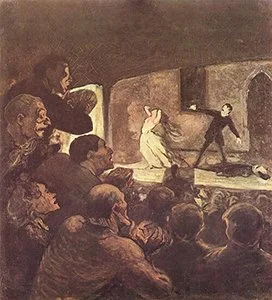
Painting of an enraptured audience watching a play where a body lies on the stage, a woman weeps, and a man points accusingly

“The Melodrama,” Honoré Daumier, c. 1858, oil on canvas

1 May 2026

Hokum is a slang term with two main senses. One is something that is overly sentimental or melodramatic; the other is nonsense, something that is false. Like most slang terms, its origin is a bit mysterious, but the most likely explanation is that it is a blend of hocus pocus and bunkum.

Hokum arises in American theater slang in the opening years of the twentieth century. We see the sentimental sense in the pages of New York’s Evening World of 3 March 1906:

No, I ain’t going out in a musical show. Musical shows are dead cards and you have to carry too many people. I’ve been studying plays that make hits and I’m going to write one myself that won’t be nothing but sure-fire hokum from start to finish.

And we see the false sense of hokum a couple of years later. From Kenneth McGaffey’s 1908 The Sorrows of a Show Girl:

Honest, to hear him spring that sure-fire hokum you would have thought he believed it. I know he passed the same line of dope out to me, and I fell for it.

Since the appearances in print are so close to one another and that the term was undoubtedly in oral use for some time before this, we can’t say which sense came first. They probably arose in tandem, as overly sentimental and nonsense aren’t all that much different from one another.

The adjective hokey and the term hokey-pokey, which has a plethora of meanings, probably influenced the development and use of hokum, but an exploration of those terms will be explored in a forthcoming entry. Hokey is too much work to take on all at once.

Discuss this post


Sources:

Green’s Dictionary of Slang, accessed 13 April 2026, s.v. hokum, n., hokum, adj., hokey, adj.

McCardell, Roy L. “The Chorus Girl.” Evening World (New York), 3 March 1906, 9/4. Library of Congress: Chronicling America.

McGaffey, Kenneth. The Sorrows of a Show Girl. Chicago: J. I. Austen, 1908, 214. Archive.org.

Oxford English Dictionary Online, 1933, s.v. hokum, n.; 1976, s.v. hokey, adj.

Image credit: Honoré Daumier, c. 1858. Wikimedia Commons. Public domain image.

docket / shadow docket

The US Supreme Court as it was composed in 2020–21. Chief Justice John Roberts is seated in the center. The associate justices are, left to right, Samuel Alito, Brett Kavanaugh, Clarence Thomas, Elena Kagan, Neil Gorsuch, Stephen Breyer, Amy Coney Barrett, and Sonia Sotomayor. Nine people in black robes arrayed in front of a red curtained background.

The US Supreme Court as it was composed in 2020–21. Chief Justice John Roberts is seated in the center. The associate justices are, left to right, Samuel Alito, Brett Kavanaugh, Clarence Thomas, Elena Kagan, Neil Gorsuch, Stephen Breyer, Amy Coney Barrett, and Sonia Sotomayor. Nine people in black robes arrayed in front of a red curtained background.

9 September 2021
[Edit: 29 April 2026; 1982 citation added]

The US Supreme Court under Chief Justice John Roberts has taken to deciding a number of highly consequential, and sometimes high-profile, cases via what is called the shadow docket. But what is the shadow docket? And for that matter, what is a docket and where does that word come from?

To answer that last question first, a docket is the filings in a particular legal case or the register of cases in front of a judge or a court.

There is an appearance of the phrase shadow docket in 1982, but it is used in a different, more general sense than how the term is used today. That sense is of a docket of filings of questionable legal merit, such as those that might be filed by a pro se defendant without the advice of legal counsel. It appears in a 29 October 1982 opinion of the Superior Court of Pennsylvania in the case Commonwealth v. Almeida:

On reargument, the Commonwealth has persuaded me that I was wrong, and that “[t]his Court should announce that it will not consider pro se pleadings until these are reviewed by counsel.” Brief for Commonwealth at 16. On reflection, I've concluded that the distinction between pro se arguments that “benefit[ ]” an appellant and those that “pose [a] danger” to him is unsound. Whatever the nature of the argument, by considering it we may, as the Commonwealth suggests, encourage other appellants to submit pro se briefs, which the Commonwealth “will have to decipher and respond to,” thereby “creat[ing] a shadow docket of hundreds of appeals.” Id.

The phrase shadow docket starts being used more widely in the early 2000s but in a slightly different sense and context than it was used in the 1982 Pennsylvania case or as it is currently being used in reference to the Supreme Court. But all these senses refer to items on a court’s agenda that hidden from plain view.

The earliest use that I have found is from the practice of county courts in Florida to not publish or publicize cases that involved those who were influential, rich, or famous. From an editorial in the Tampa Tribune of 21 June 2006:

The local scrutiny comes in response to an investigation by Attorney General Charlie Crist of whether Broward County has a shadow docket featuring prominent people. The existence of the hidden list creates the appearance that some people have received special treatment.

And around 2012, shadow docket was used in New York City courts to denote the list of real estate foreclosures that languished without action on the courts’ dockets because the lenders had stopped filing paperwork. From the New York Post of 15 July 2012:

According to attorneys at the non-profit MFY Legal Services based in Manhattan, plaintiffs by and large could not verify the documents and stopped filing RJIs [Requests for Judicial Interventions], leaving borrowers in limbo in the court system.

A study by MFY in April 2012 found that almost 75 percent of cases filed in Queens and Brooklyn in October 2011—one year after the rule was implemented—were held up in courts in what is known as the “shadow docket.”

Use of the phrase shadow docket in reference to the Supreme Court was first made by law professor William Baude in a New York Times op-ed column on 3 February 2015. Baude uses shadow docket as a synonym for what is more conventionally known as the orders docket. Baude explains:

Mr. Warner’s execution illustrates the high stakes in a crucial part of the court’s work that most people don’t know anything about: its orders docket.

Work at the Supreme Court is divided into two main categories. One is deciding the cases it hears on the merits: the 70-some cases each year that the court selects for extensive briefing, oral argument and a substantial written opinion, sometimes with dissents. These are the cases we hear about in the news.

The orders docket includes nearly everything else the court must decide—which cases to hear, procedural matters in pending cases, and whether to grant a stay or injunction that pauses legal proceedings temporarily. There are no oral arguments in these cases and, as in Mr. Warner’s situation, they are often decided with no explanation.

This docket operates in such obscurity that I call it the “shadow docket.” (I was a law clerk for Chief Justice John G. Roberts Jr. in 2008–9, but these views are solely mine.)

Despite their obscurity, these orders—there are thousands each year, if you count decisions not to hear cases—are significant. Consider the flurry of orders issued in the month before the 2014 election. The court stopped Wisconsin from implementing a strict voter identification law while it allowed a similar law to be implemented in Texas, and it also stopped lower courts from expanding early voting in Ohio or voter registration in North Carolina.

The orders docket exists for good reason. Many procedural decisions are routine, even pro forma, and need no lengthy consideration. Others, such as a decision as to whether executing someone is constitutional, cannot wait for a full hearing, so the court may grant a stay on the orders docket to give themselves time to decide whether it should consider the case on the merits. But when substantive decisions are made in secrecy and with little or no explanation, justice can be short-circuited, lower courts are left in limbo as to what to do with similar cases, and faith in the court is eroded.

Baude claimed coinage in this op-ed, and it is likely that, those being localized uses, he had never seen the term shadow docket before, or at most he was not conscious of having seen them. In any case, he deserves credit for applying the term to the Supreme Court. It is not at all unusual for a term to have multiple related, but slightly different, senses in early usage—different groups will independently coin a term or interpret and apply a term in slightly different ways, before the term settles down into a single, widely accepted meaning.

That explains where the shadow part comes from, but what about docket?

The origin of docket is a bit more uncertain, but it probably comes from the word dock, meaning the fleshly part of an animal’s tail, as opposed to the hair—think of a horse’s tale. The origin of dock is obscure, but the word has cognates in other Germanic languages. The word is first recorded c.1390 in the anonymous poem Sir Gawain and the Green Knight in a passage describing the Green Knight’s horse:

Þe tayl and his toppyng twynnen of a sute
And bounden boþe wyth a bande of a bryʒt grene
Dubbed wyth ful dere stonez, as þe dok lasted,
Syþen þrawen wyth a þwong.

(The tail and his mane were twins of a set, and both were bound with a band of bright green, arrayed with very precious stones, extending to the dock, then drawn up with a thong.)

At around the same time the verb to dock, meaning to cut something short, also appears. From the description of the Reeve in the General Prologue to Geoffrey Chaucer’s The Canterbury Tales:

The REVE was a sclendre colerik man.
His berd was shave as ny as ever he kan;
His heer was by his erys ful round yshorn;
His top was dokked lyk a preest biforn.

(The Reeve was a slender, choleric man. His beard was shaved as close as could be; his hair was shorn all around by his ears; the top of his head was docked in front like a priest’s.)

This verb is still used in reference to cutting animals’ tails. But the verb to dock is also used in reference to cutting or curtailing other things, as in the phrase to dock someone’s pay. This use is also quite old, recorded only a decade or so after Sir Gawain and the Canterbury Tales. It appears in an anonymous, anti-clerical poem titled Jack Upland, set down in 1402. The poem, which draws upon William Langland’s Piers Plowman for inspiration, details exchanges between a man, Jack Upland, and a friar, exposing the corruption in the friar’s order:

And so þou mysse takist Ierom, & lyest on Bernarde,
For Alrede his clerke wrote þis reson
Þat þou mysse layst & dokkist it as þe likiþ.

(And so, you mistake Jerome and lie about Bernard, for Alrede, his clerk, wrote this argument, that you sinfully beat and dock it as you like.)

The word docket appears within a century, meaning a summary or abstract of official proceedings—an abridgement, after all, is a form of cutting. From the Liber niger domus regis Angliae (Black Book of the King of England), which isn’t a list of the those with whom the king has had dalliances, but which sets forth regulations for the governing of the household of King Edward IV. We don’t know exactly when it was written, but it must date to sometime before 1483, the year of Edward’s death:

For the resorte of the comers, as it is before sayde, yf her noble presence be in this courte, then the doggettes in the countyng house bere witnesse bothe of her venit et recessit ad curiam, vel a curia, post prandium sive ante, tociens queeins.

(For the benefit of the arrivals, as has been said before, if her noble presence is in this court, then the dockets in the counting house should bear witness both of her coming and departure to the court, or from the court, before or after dinner, as often the queen likes.)

By the mid seventeenth century, docket had come to mean a registry of legal judgments. We see this sense in the Diary of Samuel Pepys for 12 March 1669. The passage here is longer than it need be, but I couldn’t bear to dock it for reasons that will be clear upon reading:

And here I did set a clerk to look out for some things for me in their books, while W Hewers and I to the Crowne Office, where we met with several good things that I wanted and did take short notes of the Dockets; as so back to the Patent Office and did the like there, and by candle-light ended; and so to home, where thinking to meet my wife with content, after my pains all this day, I find her in her closet, alone in the dark, in a hot fit of railing against me, upon some news she hath this day heard of Deb's living very fine, and with black spots, and speaking ill words of her mistress; which with good reason might vex her, and the baggage is to blame; but God knows, I know nothing of her nor what she doth nor what becomes of her; though God knows, my devil that is within me doth wish that I could.

And on the other side of the Atlantic, docket took on a related, but slightly different, sense, that of a register of pending cases before a court of law. From the minutes of the Pennsylvania General Assembly for 23 March 1790:

Whereas a respectable number of the inhabitants of the western part of York county have, by their petition to this Assembly, set forth, that they labour under very considerable difficulties and inconveniences, in consequence of their being obliged to attend at York-Town as their seat of justice, owing to the great distance many of them are from it, and the crouded situation of the docquet, whereby they are much difficulted to obtain justice.

So, that’s how docket went from an animal’s tail to the agenda before a court of law.

Discuss this post


Sources:

Andrew, Malcolm and Ronald Waldron. “Sir Gawain and the Green Knight.” The Poems of the Pearl Manuscript. Exeter: U of Exeter Press, 2002, lines 191–94, 214. London, British Library, Cotton Nero A.10.

Baude, William. “The Supreme Court’s Secret Decisions.” New York Times, 3 February 2015, A23. ProQuest Historical Newspapers.

Bockmann, Rick. “SE Queens Leads City with 42% of Foreclosures.” New York Post, 15 July 2012, Queens Weekly 16. Readex: America’s Historical Newspapers.

Chaucer, Geoffrey. “General Prologue.” The Canterbury Tales, lines 1.587–90. Harvard’s Geoffrey Chaucer Website.

Com. v. Almeida, 306 Pa. Super. 197, 215–16, 452 A.2d 512, 521 (1982). Westlaw.

“Court Dockets Should Not Be Kept Secret.” Tampa Tribune, 21 June 2006, 12. ProQuest Historical Newspapers.

Heyworth, P.L., ed. “Upland’s Rejoinder.” Jack Upland, Friar Daw’s Reply and Upland’s Rejoinder. Oxford: Oxford UP, 1968, lines 342–44, 112. HathiTrust Digital Archive. Oxford, Bodleian Library, Digby 41.

Liber niger domus regis Angliae; id est, Domus regiae sive aulae Angliae Regis Edw. IV.  (The Black Book of the King of England; that is, the Royal House or Court of the King of England Edward IV.) In A Collection of Ordinances and Regulations for the Government of the Royal Household. London: Jon Nichols for the Society of Antiquaries, 1790, 24. Gale Primary Sources: Eighteenth Century Collections Online (ECCO).

Middle English Dictionary, 2019, s.v. dok, n., dokken, v.  

Minutes of the Second Session of the Fourteenth General Assembly of the Commonwealth of Pennsylvania (23 March 1790). Philadelphia: Hall and Sellers, 1790, 207. Gale Primary Sources: Eighteenth Century Collections Online (ECCO).

Oxford English Dictionary, second edition, 1989, s.v. docket, n.1, dock, n.2, dock, v.1.

Pepys, Samuel. The Diary of Samuel Pepys (12 March 1669), vol. 9 of 10. Robert Latham and William Matthews, eds. Berkeley: U of California Press, 1976, 480–1. HathiTrust Digital Archive.

Shapiro, Fred. “More on ‘Shadow Docket.’” ADS-L, 24 April 2026.

Photo credit: Fred Schilling, 2020, Collection of the Supreme Court of the United States. Public domain image.