buttload

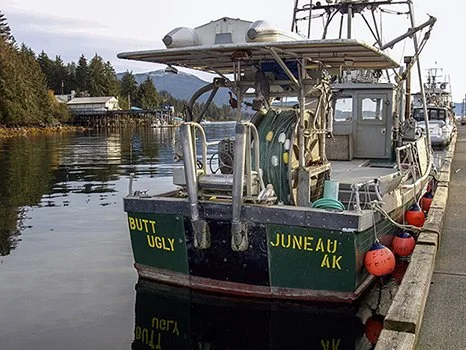
Photo of a fishing boat with the name Butt Ugly moored at a quay in Juneau, Alaska

6 July 2026

Buttload is a slang term meaning a great quantity of something. It’s a relatively recent term; it starts to appear in the late 1980s. The -load is self-explanatory, But why butt?

The butt comes from a slang use of that word as an intensifier. University of North Carolina Linguist Connie Eble’s files on campus slang record this sense, with the example of butt ugly, from 1988. And Pamela Munro’s 1989 dictionary of college slang, Slang U., has this entry:

butt very, truly, extremely, very much so, incredibly | I had to get up butt early this morning for my eight o’clock class!

And it also has this entry for a duplicative form of the intensifier:

butt-ass very | It’s butt-ass cold.

Butt ugly is used as a nickname for a character as early as 1983 in an episode of the television series Hill Street Blues. So it seems likely that this adverbial use of butt started with this term, meaning looking unattractive as a person's ass (although since many think asses are quite attractive, perhaps donkey?), and then the butt was applied in other contexts where the anatomical (or equine) context did not apply.

It is possible, albeit rather unlikely, that the adverbial butt comes from the sense of the noun referring to a large cask of wine or other liquids. This butt was used as an adverb meaning a large amount in the early nineteenth century. But it is not very plausible that college students in the 1980s would resurrect this archaic usage and incorporate into their slang.

Anyway, we see buttload in Richard Raynor’s 1988 novel Los Angeles Without a Map:

I’d never sell any of this stuff. But the Stetson that Dean wore in Giant, I guess that must be worth a buttload of money, $10,000 I guess.

And there is this Usenet post from 28 June 1989 critiquing the Alan Parsons Project album Tales of Mystery and Imagination, which used the stories of Edgar Allan Poe as a theme:

I do not like the fact that the symphonic material was broken up (the intro at the beginning of the disc, the remainder in the usual place. Everything's got buttloads of reverb and (hold your breath, here comes the big one) Ambience. Fuck ambience.


Sources:

Flander, Judy. “Tune in Tonight” (syndicated column). El Paso Herald-Post (Texas), 8 December 1983, B-10/2. Readex: America’s Historical Newspapers.

Green’s Dictionary of Slang, accessed 14 June 2026, s.v. butt, n.1, butt, adv., shitload, n.

Munro, Pamela. Slang U. New York: Harmony, 1989, s.v., butt, butt-ass, 51. Archive.org.

Oxford English Dictionary Online, September 2018, s.v. buttload, n., butt, n.6, butt, n.4; September 2011, s.v. shitload, n.

Raynor, Richard. Los Angeles Without a Map (1988). New York: Plume, 1990, 56. Archive.org.

Relph, John M. “Parsons’ Poe (was Re^2: CSN/ELP/YES).” Usenet: rec.music.cd, 28 June 1989.

Photo credit: Gillfoto, 2010. Wikimedia Commons. Licensed under the Creative Commons Attribution-Share Alike 4.0 International license.
podcast

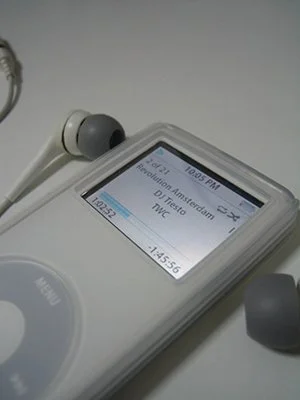
Photo of an iPod and headphones

An iPod Nano, 2005

3 July 2026

A podcast is an audiovisual file—originally and most commonly audio only—or series of files that are made available for download to a portable media player. The audio format is usually MP3, and the files are distributed by an RSS feed or similar technology. It is also a verb meaning to create and distribute such files, and a podcaster is one who creates them.

The term is a blend or portmanteau of the Apple iPod audio player and broadcast, [i]Pod + [broad]cast. The first iPod was released on 10 November 2001, and the product line was discontinued in 2022.

The earliest use of the word that I’m aware of is in form podcasting in the Guardian newspaper of 12 February 2004:

With the benefit of hindsight, it all seems quite obvious. MP3 players, like Apple’s iPod, in many pockets, audio production software cheap or free, and weblogging an established part of the internet; all the ingredients are there for a new boom in amateur radio.

But what to call it? Audioblogging? Podcasting? GuerillaMedia?

But use of the term only started to take off months later. On 15 September 2004, Dannie J. Gregoire posted the following to the Yahoo Group iPodder.dev:

I can see there being the desire of users in some instances to be able to easily subscribe and get older posts/episodes/shows (what are we calling these things anyway? How about pode or sode for short?) that no longer appear on the rss feed. […]

I guess one could argue that this is simply an rss/server side issue, and that the "podcaster" (yes, I like making up new words) should be responsible enough to offer a page of seperate feeds of old sodes by month/year/season/etc.

A month later, on 14 October 2004, the Los Angeles Times published an article on the nascent podcast industry titled: “Pirate Radio’s Next Generation: Podcasting, an audio version of the blog made for MP3 players, may be the biggest thing you haven’t heard of.” The article reads, in part:

If you’ve never heard of a podcast, don’t worry. Neither has Google. Type “podcast” into the search engine and it yields results but also asks, “Did you mean broadcast?”

Well, yes, Sort of. Podcasts are broadcasts in only the loosest sense. They don’t use megawatt transmitters to send signals tens or hundreds of miles like terrestrial radio. Listeners can’t hear them live because they are prerecorded sound files; they don’t stream in real time like Internet radio.

[…]

A month ago, the only podcast was “Trade Secrets,” a daily news and technology talk show co-hosted by podcasting’s pioneers: former MTV VJ Adam Curry and software developer Dave Winer.

[…]

Podcasting will also, most likely, branch out to include more music—a prospect that has some podcast enthusiasts excited and others worried.

Curry and Winer claim to have coined the term podcast, but as the Guardian article shows, the term was in the discourse months before they started their podcast in September 2004. And the Gregoire post was made the day before their first podcast. It is probable that Curry and Winer had heard the term but were not conscious that they had when they started using it, but the possibility that they independently coined it cannot be dismissed. In any case, they were not the first to use it.

Podcasting has long since moved out of its “pirate radio” phase. While there is still a plethora of amateur podcasts out there, the professionals have moved into the space, and many radio programs are also available via podcast. While the medium chiefly remains an audio one, many podcasts are now available with video feeds as well. And podcasting has already outlived its namesake, the iPod, and shows no signs of going away soon.

Discuss this post


Sources:

Carpenter, Susan. “Pirate Radio’s Next Generation.” Los Angeles Times, 14 October 2004, E4–E5. ProQuest: Newspapers.

Gregoire, Dannie J. Yahoo Groups: iPodder.dev, 15 September 2004. Archive.org.

Hammersley, Ben. “Audible Revolution.” Guardian (London), 12 February 2004, Life 28/1. ProQuest Newspapers.

Oxford English Dictionary Online, December 2008, s.v. podcast, n., podcast, v., podcasting, n., podcaster, n.

Photo credit: Jeremy Foo, 2005. Flickr. Wikimedia Commons. Licensed under the Creative Commons Attribution 2.0 Generic license.

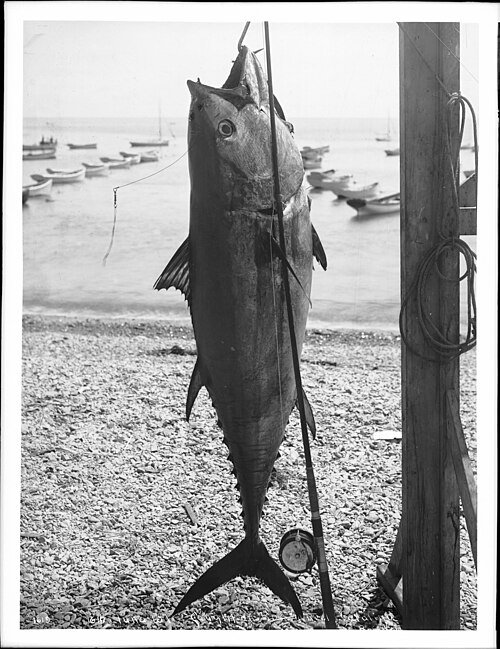
tuna / tuna fish / tunny

B&W photo of a large fish hanging from a hook, a rod and reel leaning against it; fishing boats are in the background

Tuna caught off Santa Catalina Island, California, c. 1910

1 July 2026

Tuna are a variety of fishes of the family Scombridae which are widely fished both for food and for sport. They range widely in size, with the Atlantic bluefin tuna reaching weights as high as 1,500 pounds (680 kb).

The name tuna is a relatively recent addition to English. It dates to the late nineteenth century, with the older and now rare name tunny dating to the sixteenth century. The fish is also sometimes referred to by the redundant tuna fish, although that open compound is most commonly used to refer to the meat of the fish, particularly when it is canned. One would generally not refer to a tuna steak as tuna fish.

The older name tunny is a borrowing from the French, thon + y (English diminutive suffix). The French comes from the Latin thunnus, which in turn comes from the Greek θύννος (thunnos). The form tuna is originally an American alteration of the Spanish atún. The Spanish word does not come directly via the usual Romance path, but rather from the Andalusian Arabic at-tūn, which only then circles back to the Latin.

Tunny appears as an entry in John Palsgrave’s 1530 textbook on the French language, a somewhat odd entry for that text as it contains no French:

Tunny     fysshe

Tuna is recorded in an 1881 academic article on fishes found along the Pacific coast of the United States, although this article says the term is restricted to specific species, the skipjack and another the authors were unable to catch. According to this article, the albacore is not a tuna:

88. Orcynus alalonga (Gmelin) Risso.—Albicore.
(Orcynus pacificus Cooper; Thynnus pacificus C. & V.)

From San Francisco southward; abundant in summer south of Point Concepcion and taken by trolling. It is found in deeper water than the bonito, being rarely taken within 6 miles of the shore. It feeds on anchovy and squid, and occasionally rare deep-water fishes are found in its stomach. It is shorter and deeper than the bonito, weighing 12 to 15 pounds. It is little valued as a food-fish, selling at about 25 cents. It is caught chiefly for sport, as it is a very gamy fish.

Another Orcynus, known as the “tuna”, exists about Santa Cruz Island, but we failed to obtain it.

89. Sarda chilensis (Cuvier & Valenciennes) J. & G.—Bonito; Spanish Mackerel; Skipjack; Tuna.

From Monterey southward; very abundant everywhere in summer, when it is taken in great numbers, by trolling, at a distance of 2 or 3 miles from shore. It is extensively salted and dried, but the flesh is rather coarse, and it brings a lower price than the yellow-tail and barracuda. It reaches a weight of about 12 pounds and sells at about 25 cents. After the spawning season the young are very abundant in the kelp.

We see tuna fish being used to refer to the fish a few years later. A headline in the Cincinnati Enquirer of 24 September 1898 reads, “Catching: A Monster Tuna Fish. Exciting Sport Along the Pacific Coast.”

And we find canned tuna fish two years later in a grocer’s advertisement in Kansas’s Hutchinson News of 5 October 1900:

Maggi Bouillon Liquid Extract of Beef, per bottle……….55c
Tuna Fish, per can………………………………….......... 25c
Monarch Codfish Steaks (fresh and very fine) 1 lb can.....15c


Sources:

American Heritage Dictionary, fifth edition, 2022, s.v. tuna1, n.

“Among the Delicacies” (advertisement). Hutchinson News (Kansas), 5 October 1900, 5/5. Newspapers.com.

“Catching: A Monster Tuna Fish. Exciting Sport Along the Pacific Coast.” Cincinnati Enquirer (Ohio), 24 September 1898, 12/8. ProQuest Newspapers.

Jordan, David S. and Charles H. Gilbert. “Notes on the Fishes of the Pacific Coast of the United States.” Proceedings of the United States National Museum, vol. 4, 1881. Washington, DC: Government Printing Office, 1882, 45. HathiTrust Digital Library.

Merriam-Webster, accessed 11 June 2026, s.v. tuna, n.

Oxford English Dictionary Online, 1915, s.v. tuna, n.2, tunny, n.; 1986, tuna fish, n.

Palsgrave, John. Lesclarcissement de la langue Francoyse. London: Richard Pynson, 1530, fol. 70v. ProQuest: Early English Books Online (EEBO).

Photo credit: Brickey, c. 1910. Wikimedia Commons. Public domain photo.

hush puppy

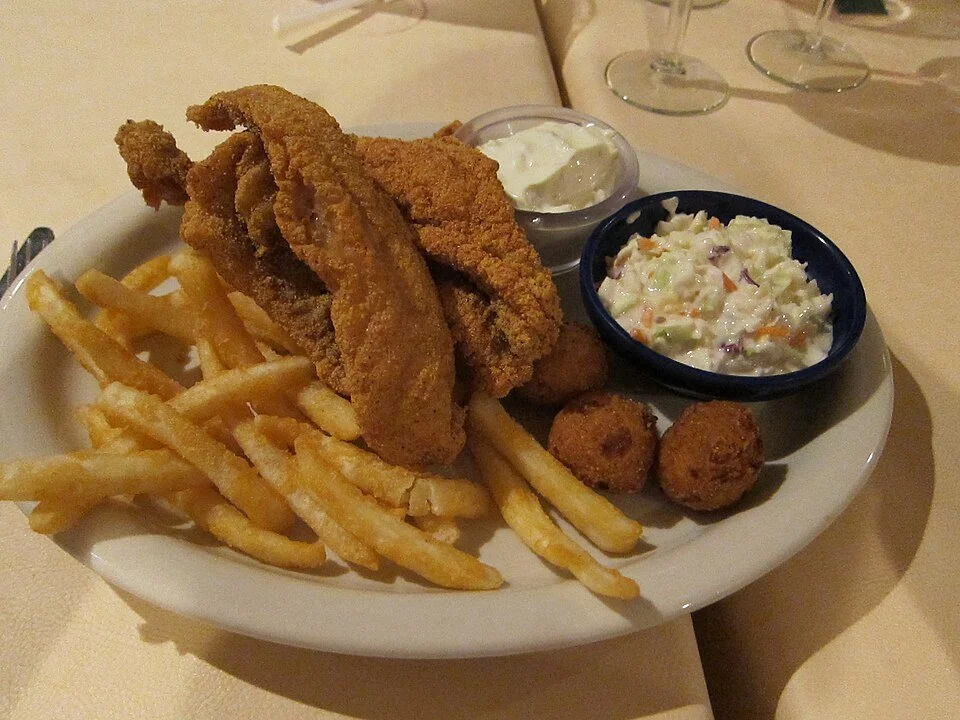
Photo of a plate with hush puppies, fried catfish, french fries, cole slaw, and tartar sauce

Fried catfish with hush puppies and French fries in a Hope, Arkansas restaurant

29 June 2026

Hush puppy has a number of meanings ranging from various types of food to a brand of casual shoes, but its most common meaning is that of a small, fried ball of corn meal. The dish is a common throughout the American South and is often served alongside fish. The name probably comes from the idea that hush puppies can be fed to a dog to keep it quiet.

The use in reference to the balls of fried corn meal is attested to in the early twentieth century, but we see hush puppy gravy being used to refer to white or cream gravy from several decades earlier. The following is a passage from an article in the 23 October 1879 issue of Louisville, Kentucky’s Courier-Journal that describes the aftermath of a deadly skirmish with Native Americans that had occurred on 9 January 1876:

Jim Gillet, of Lampasas Springs, who took one of the scalps, covered his revolver holster with it, but afterward, in bending over a frying pan at breakfast, he trailed the long hair into the “hush puppy” gravy, whereupon Lieut. N. O. Reynolds applied a torch to the greasy locks, and in an instant nothing was left but the bald skin. “Wah!” said a wooly ranger as he sniffed the burnt hair, “you have spoilt my appetite.”

We see the term used in reference to some unspecified type of food in Kirk Monroe’s 1899 novel of the Spanish-American war. This is the earliest citation in the Oxford English Dictionary. The scene is that of an army camp in San Antonio, Texas:

Had breakfast hours ago, you know, and a prime one it was. Scouse, slumgullion, hushpuppy, dope without milk, and all sorts of things.

Hushpuppy here may refer to the balls of corn meal, but since scouse and slumgullion are a type of stew, and since, as we shall see, hush puppy can also refer to a stew, it may be reference to the latter. And indeed, there is this from Alabama’s Montgomery Advertiser of 10 October 1907 that uses hush-puppy as the name for a stew:

The Voice of the People—we heard much of it even in these days when there is scant enough belief in any god to stand sponsor as joint owner. Yet is it not but today’s well-cooked hash of the scraps from yesterday’s feast of words? A camp stew? What streetwise cooks call a Hush-puppy or a Duke’s Mixture?

We finally get a clear use of hush puppy to refer to the balls of corn meal in the New York Tribune of 8 September 1912:

I’m tellin’ you all this in excuse for Frosty bein’ a cook. Seems like he was just fitted for that callin’ and no other. He could cook frijoles and hush-puppy, and make sinkers, or moss agates, or death balls, or whatever you call biscuits, as good as the best.

And hush puppy is given as the name for a type of soup in the Arkansas Gazette of 14 August 1917. Whether or not this soup is more of a stew cannot be determined from the context:

If you want good soup that’s good and made in wash post and made in “hush puppy” style, visit this little country city and ask for the same. We are the originals of “hush puppy” soup.—Spring Hill Correspondent of the Hope Gazette.

And there is a solid description of corn meal hush puppies in the Atlanta Journal of 21 December 1919:

They had no fancy bill-of-fare and only old Bill for a cook, but how they did feast out there beneath those big trees. They would awaken in the morning from a refreshing sleep in the open air to a breakfast that is enough to make any man envious in these days of high prices. There was hominy and butter, venison, friend [sic] fish and coffee, the real article, “slap-jacks” and “hush-puppies” with syrup and wild honey. For the benefit of the novice I had better state that “slap-jacks” are thin cakes of corn bread friend [sic] where the venison was cooked and “hush-puppies” are small pones of corn bread cooked in the grease in which the fish had been fried.

The idea that the name comes from a food fed to a dog in order to keep it quiet has some evidentiary support. There is this from Oklahoma’s Henryetta Free-Lance of 25 September 1914. Here the term is used to refer to a pork barrel appropriation enacted by politicians to silence critics and appease voters:

Those Republicans who engineered the successful filibuster in Congres [sic] against the fifty-three million dollar “hush-puppy” appropriations deserve the thanks of the entire public.

And there is this casually racist use of the stew sense of hush puppy that opines on the origin in Jackson, Mississippi’s The Issue of 13 May 1915:

“Pot-licker” or “hush-puppy,” a concoction of utilitarian value so comprehensive as to be employed both in silencing the growls of “houn’ dawgs” and keeping colored babies from becoming bow-legged, was celebrated in speech and story yesterday afternoon at the Mississippi dedication exercises.

[…]

Known as “Hush Puppy.”

State Senator H. H. Casteel of Mississippi said that “pot-liquor” in his section was known as “hush-puppy,” because it kept the “houn’ dawgs” from growling.

So that is probably how the foodstuffs got their name.

As for the brand of shoes, they went on the market in 1958 and feature a basset hound as the brand’s mascot. According to the company’s website, the name comes from the idea that the shoes are “solutions for sore feet, aka ‘barking dogs.’”

Discuss this post


Sources:

“About Us.” Hushpuppies.com, accessed 6 June 2026.

“All Over Arkansas.” Arkansas Gazette (Little Rock), 14 August 1917, 6/8. Readex: America’s Historical Newspapers.

Bealer, Alex W. “Hunting Trip Down on Pin Hook River.” Atlanta Journal (Georgia), 21 December 1919, SM 2/3. Readex: America’s Historical Newspapers.

“Bow, Shield, Quiver and Arrows.” Courier-Journal (Louisville, Kentucky), 23 October 1879, 3/6. ProQuest Newspapers.

Dictionary of American Regional English (DARE), vol. 2, 1991, s.v., hush puppy, n.

Henryetta Free-Lance (Oklahoma), 25 September 1914, 2/2. Newspapers.com.

Munroe, Kirk. Forward, March: A Tale of the Spanish-American War. New York: Harper & Brothers, 1899, 28. HathiTrust Digital Library.

Oxford English Dictionary Online, 1976, s.v. hush puppy, n.

Popik, Barry. “Hush Puppies,” 17 August 2006. Barrypopik.com.

“Pot Liquor” The Dedication Pass Word.” The Issue (Jackson, Mississippi), 13 May 1915, 4/1. Newspapers.com.

Speed, Ida. “The Double Cross Outfit.” New York Tribune, 8 September 1912, SM 13/1. ProQuest Newspapers.

“What the Crowd Had to Say Enroute to the Wild West.” Montgomery Advertiser (Alabama), 10 October 1907, 7/4. ProQuest Newspapers.

Photo credit: Jay Cross, 2009. Wikimedia Commons. Flicker.com. Licensed under the Creative Commons Attribution 2.0 Generic license.

scallywag

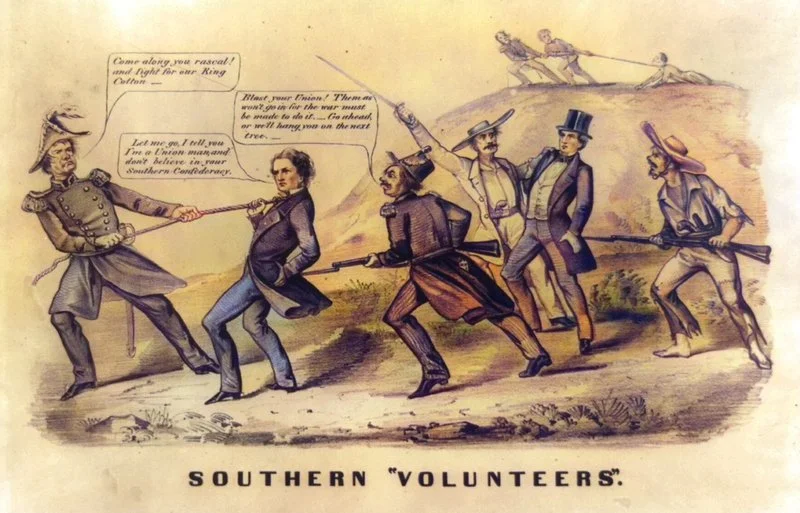
Cartoon depicting 2 well-dressed men being led away by gunpoint with the caption “Southern ‘Volunteers’”

1862 cartoon depicting southerners loyal to the Union, men who would later be labeled as “scallywags,” being drafted into the Confederate army

26 June 2026

A scallywag is a disreputable person. The term is often associated with the post-Civil War South, where it was applied to white southerners who supported the Reconstruction policies of the Republican party, but the term is at least a generation older. It appears in a wide variety of spellings.

Like many slang terms, the origin is unknown. There are, however, a couple of plausible possibilities, albeit ones that lack strong evidence. One is that it is from the Scots scurryvaig (vagabond, lout), attested in Scotland as early as 1804, and which in turn could be from the Latin scurra vagas (wandering buffoon). The second is also from Scots, scallag (farm laborer) This one came into Scots from the Gaelic sgalag, which is attested in the earlier form scoloc from the early thirteenth century.

Researcher Nathaniel Sharpe has discovered a cluster of early uses of the American scallywag in western New York of the 1830s. The earliest is from the Ithaca Chronicle of 11 April 1832:

Cambria, Royalton, Lewiston, Newfane, and Porter, are antimasonic.—Hartland, Wilson and Lockport, masonic, the latter by an average majority of 4 votes, under the designation of the scalliwag ticket, in support of which the Jackson and Clay men with some disaffected antimasons, united.

I have not been able to independently verify this one, but there is no reason to doubt its validity.

Scallywag can be found outside western New York a few years later. From Vermont’s Burlington Sentinel of 5 April 1838:

The readers of the Vermonter, would undoubtedly infer from this, that the democrats of Vergennes were a pack of “scalliwags,” fit to be numbered with swine, but not the right sort of characters to consort with gentlemen of property and standing.

A month later, there is this story of dissension in a church congregation in the Daily Buffalonian of 14 May 1838:

This church is divided into two factions, the Cole party and the opposition. Mr. Cole’s party say he is a saint, the others content that he is a wolf in sheep’s clothing. Bettis, Bond, Moony, Chester & Co. are the leaders of the opposition.

While the sexton was busily engaged in sweeping the house, and dusting the seats, meditating on heaven and divine things, these scalawags, as Mr. Cole calls them, came and knocked, saying, “open unto us.” The sexton kept about his business. They went to banging away at the door, and he dropped the broom and seized his musket. They broke through and demanded the keys; he told them if they attempted to touch him he would blow them through. More valorous than Tigers, they rushed upon him, threw him down, took away the keys, kicked him out doors, locked them up, and went home swearing Mr. Cole should not preach there another Sunday.

And this from New York’s Mayville Sentinel of 28 September 1843:

This is probably the same “hopeful” who imposed upon us by getting us to print a quantity of handbills—and the same who stayed a couple of days with neighbor Gifford, of the Temperance House, and then “sloped” without paying his bill. He was a middling sized, slim built scalawag, with black eyes, and was dressed in a suit of black bombazine, and had holes in his socks. Printers will doubtless do the community a service by publishing this swindler.


Sources:

Dictionary of the Older Scottish Tongue, 2000, s.v. scallag, n. Dictionaries of the Scots Language | Dictionars o the Scots Leid.

“From the Middlebury Argus: Vergennes Charter Election.” Burlington Sentinel (Vermont), 5 April 1838, 3/2. Newspapers.com.

Green’s Dictionary of Slang, accessed 2 June 2026, s.v. scallywag, n.

Mayville Sentinel (New York), 28 September 1843, 2/1. Readex: America’s Historical Newspapers.

Oxford English Dictionary Online, 1910, s.v. scallywag, n.

“Scenes at the Stone Chapel.” Daily Buffalonian (New York), 14 May 1838, 2/1. Newspapers.com.

Scottish National Dictionary, 1971, s.v. scurryvaig, n. Dictionaries of the Scots Language | Dictionars o the Scots Leid.

Sharpe, Nathaniel. “That Damned Elusive Skallewagg.” ADS-L, 7 January 2013.

Zimmer, Ben. “The Original Scalawag.” Boston Globe (Massachusetts), 10 March 2013. ProQuest Newspapers.

Image credit: Currier & Ives, 1862. Wikimedia Commons. Library of Congress. Public domain image.