biscuit / cookie

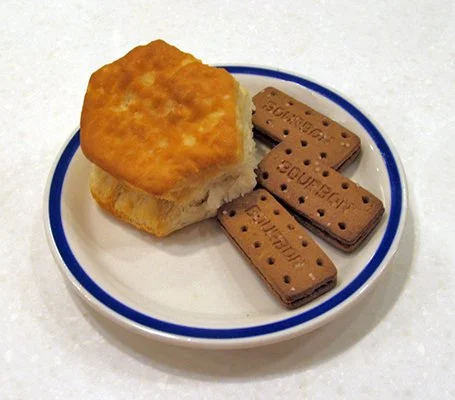
Photo of a plate holding an American savory biscuit and three Indian, British-style chocolate biscuits (i.e., cookies)

American and British biscuits

24 June 2026

One distinction between the British and North American lexicons is the usage of biscuit and cookie. What North Americans call a cookie, the British call a biscuit. And what Americans call a biscuit has no exact counterpart in British cuisine. American biscuits are savory and resemble a scone in some respects, but a scone is denser and less salty.

The word biscuit comes from the Anglo-Norman bescuit, bis/bes- (twice) + cuit (cooked). It is attested in that language in the late twelfth century in the sense of dry, unleavened bread. We also see the Anglo-Latin panis biscoctus (twice-baked bread), attested in the early thirteenth century, which would probably make the Latin a borrowing from the French, a reversal of the usual direction.

Cookie, on the other hand is from the Dutch koekje (little cake). It was borrowed independently into both Scots and American English.

An early use of biscuit in Middle English can be found Robert Mannyng’s Chronicle, which is a translation of an Anglo-Norman work by Peter Langtoft. Mannyng’s translation was composed sometime before 1338. The passage in question is about the sinking of ship that was resupplying the Muslim army besieging the Crusader-held city of Acre during the Third Crusade:

þe schip þat was so grete, it dronkled in þe flode.
þei teld fiueten hundred Sarazins, þat drenkled were,
Fourti & sex wer sundred, & alle þo were saued þere.
þe summe couth no man telle of gold þat was þer in
& oþer riches to selle, bot alle mot þei not wyn.
þe venom alle þei hent, in þe se cast it away,
þe folk it mot haf schent, þat about Acres lay.
Armour þei had plente, & god besquite to mete,
It sanke son in þe se, half myght þei not gete.

(The ship was so large that it drowned in the flood. It held fifteen hundred Saracens that were drowned; forty-six were separated [from the others], and all those were saved. The amount of gold and other riches it held for the taking, no one could say, but all was not good. All the deadly things it held, they cast into the sea, the army that besieged Acre it might have ruined. Armor it had plenty and good biscuit for food; it soon sank in the sea; they could not get half of it.)

The sweet biscuit, the counterpart to the North American cookie, comes along some two centuries later. We see it in a 1566 poem titled The Banquett of Dainties:

As Marchpaine, Chéese & Ginger gréene,
with sucket pleasaunt swéete,
Blauncht Almondes, as in court is séene,
for princely Ladyes, méete.
Stewde Proynes, conserue of Cherries red,
Peares, Biskets, Suger fine,
With nectar dulce, since I am wedde,
by voyce of Muses nine.

And the North American style of biscuit is recorded in the early nineteenth century. From John Palmer’s 1818 Journal of Travels in the United States of North America, and in Lower Canada:

Our living consisted almost invariably of coffee, hot short cakes, called biscuits, corn-bread, cucumbers, honey, eggs, bacon, and chicken.

Cookie, on the other hand, appears in Scotland by the beginning of the eighteenth century. But in Scottish usage, a cookie was an unsweetened, plain bun. Here is an example from the household accounts of John Foulis. The entry is from 3 December 1701:

for seck and a cuckie wt ye tuo alexr Gibsones    0 14 6

Here seck is sack, the fortified white wine.

And the North American style of cookie is attested by the close of that century, in Amelia Simmons’s 1796 cookbook American Cookery:

Cookies.
One pound sugar boiled slowly in half pint water, scum well and cool, add two teaspoons pearl ash dissolved in milk, then two and half pounds flour, rub in 4 ounces butter, and two large spoons of finely powdered coriander seed, wet with above; make rolls half an inch thick and cut to the shape you please; bake fifteen or twenty minutes in a slack oven—good three weeks.

Another Christmas Cookey.
To three pound flour, sprinkle a tea cup of fine powdered coriander seed, rub in one pound butter, and one and half pound sugar, dissolve three tea spoonfuls of pearl ash in a tea cup of milk, knead all together well, roll three quarters of an inch thick, and cut or stamp into shape and size you please, bake slowly fifteen or twenty minutes; tho’ hard and dry at first, if put into an earthern [sic] pot, and dry cellar, or damp room, they will be finer, softer and better when six months old.


Sources:

Anglo-Norman Dictionary, AND2 Phase 1, 2000–06, s.v. biscuit, n.

The Banquett of Dainties. London: Thomas Hacket, 1566, sig. A.6.v. ProQuest: Early English Books Online.

Dictionary of Medieval Latin from British Sources, 2013, s.v. biscoctus, n. Brepols: Database of Latin Dictionaries.

Hallen, A. W. Cornelius, ed. The Account Book of Sir John Foulis of Ravelston. Edinburgh, Edinburgh UP, 1894, 299. HathiTrust Digital Library.

Hearne, Thomas, ed. Mannying’s Chronicle (before 1338). Peter Langtoft’s Chronicle in The Works of Thomas Hearne, vol. 3. London: 1725, 170–71. Corpus of Middle English Prose and Verse

Middle English Dictionary, 31 January 2026, s.v. bisquit(e, n.

Oxford English Dictionary Online, September 2020, s.v. biscuit, n. & adj., cookie, n.

Palmer, John. Journal of Travels in the United States of North America, and in Lower Canada. London: Sherwood, Neely, and Jones, 1818, 125. HathiTrust Digital Library.

Scottish National Dictionary, 2005, s.v. cookie, n. Dictionary of the Scots Language | Dictionars o the Scots Leid.

Simmons, Amelia. American Cookery. Hartford, Connecticut: Hudson & Goodwin, 1796, 35. Archive.org.

Photo credit: Lou Sander, 2009. Wikimedia Commons. Public domain image.
atone / atonement

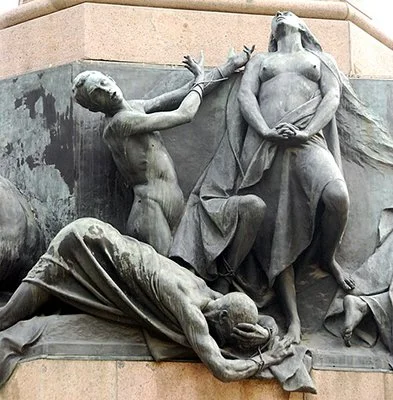
Statue detail of 3 figures: a woman looking up; a man with bound hands raised & looking away; & a prone man, head in hands

Detail of the 19th-century Monument to Dante in Trento, Italy by Florentine artist Cesare Zocchi

22 June 2026

As the word is generally used today, to atone is to offer propitiation to an injured party, to make amends for a wrong one has committed, and atonement is the product of that verb. But the word did not always mean this, and it has an etymology that may seem surprising at first, but which once you have learned is glaringly obvious every time you read the word.

The original sense of atone was to reconcile, to unite. And the word is a compound of at + one. The verb appears in the written record c. 1300 in the romance Sir Beues of Hamtoun:

“Fet me,” a seide “me ȝerde of golde.
Gii, is fader, was me marchal
Also Beues, is sone, schal.”
His ȝerd he gan him þer take;
So þai atonede wiþoute sake.

(Fetch me,” he said, “my staff of gold.
Gii, his father, was my marshal
Bevis, his son shall be also.”
His staff he went to take to him;
So they atoned without strife.)

The noun, in the form of the phrase in to onement, appears in an early fifteenth-century Wycliffite Bible, in a translation of Ezekiel 37:16–17:

And thou, sone of man, take thou an other tree, and write on it, Joseph, the tree of Effraym, and of al the hous of Israel, and of hise felowis. And ioyne thou tho trees oon to the tother in to o tree to thee; and tho schulen be in to onement in thin hond.

(And you, son of man, take another stick and write on it, “For Joseph, the stick of Ephraim, and all the house of Israel and its fellows.” And join these sticks one to the other so they are one stick to you; and they shall become a onement in your hand.)

The shift to the present meaning occurs by the early seventeenth century. It’s a straightforward shift from a state of unity to one of being reconciled with God. The 1611 King James Version of Leviticus 1:4 uses the noun:

And he shall put his hand upon the head of the burnt offering; and it shall be accepted for him to make atonement for him.

The Hebrew is לְכַפֵּר (lechaper); the Vulgate reads expiationem.

And we see the verb in the present-day sense in Joseph Glanvill’s 1665 Scepsis Scientifica:

I might reasonably expect a pardon from the ingenious, for faults committed in an immaturity of Age and Judgment that would exclude them; and perhaps I may have still need to plead it to attone for the imperfections of this Adress.


Sources:

American Heritage Dictionary, fifth edition, 2022, s.v., atone, v.

Ezekiel 37:16–17. The Holy Bible Containing the Old and New Testaments with the Apocryphal Books, in the Earliest English Versions Made from the Latin Vulgate by John Wycliffe and His Followers, vol. 3 of 4. Josiah Forshall and Frederic Madden, eds. Oxford: Oxford UP, 1851, 588–89. HathiTrust Digital Library.

Glanvill, Joseph. Scepsis Scientifica: or, Confest Ignorance, the Way to Science. London: E. Cotes for Henry Eversden, 1665, sig. C4r–v. HathiTrust Digital Archive.

Leviticus 1:4. The Bible, Authorized King James Version with Apocrypha (1611). Oxford: Oxford UP, 2008, 119.

Merriam-Webster.com, accessed 30 May 2026, s.v. atone, v.

Middle English Dictionary, 31 January 2026, s.v. at-onen, v., onement(e, n.

Oxford English Dictionary Online, June 2004, onement, n.: 1885, s.v. atonement, n., atone, v., at one, adv.

“Sir Beues of Hamtoun.” The Auchinleck Manuscript, Edinburgh, National Library of Scotland, Advocates’ MS 19.2.1, lines 1330–34. National Library of Scotland.

Photo credit: Niccolò Caranti, 2009. Wikimedia Commons. Licensed under the Creative Commons Attribution-Share Alike 3.0 Unported license.

pond / pound

Photo of a pond surrounded by reeds and other greenery

Institute Pond, Institute for Advanced Study, Princeton, New Jersey

19 June 2026

A pond is a small body of water. The word is actually a spelling and pronunciation variant of the noun pound, meaning of a pen or enclosure. The word probably comes from an unattested Old English *pund. We also find cognates in the Anglo-Norman ponde, punde, attested to as a family name in the twelfth century and as a noun in the fourteenth, and in the Anglo-Latin pundum and pundfalda starting in the thirteenth century.

Both the Anglo-Norman and the Anglo-Latin cognates are likely borrowings from English, although it’s possible the Anglo-Norman comes from a shared Germanic root. (Norman French has a considerable number of words from Germanic, in addition to the usual Latin roots.)

The original pounds were enclosures for animals, but in later use the meaning was extended to include prisons—that is enclosures for people—and more recently enclosures for vehicles.

We have a record of the word from a twelfth century charter that outlines the boundaries of the land owned by Abingdon Abbey, in what is now Oxfordshire, England. It appears in the compound pund fald, that is the present-day pinfold:

Of þam pytte on haccan pund fald, of haccan pund falde oþ eft on þæt efer fearn

(From that pit to the pinfold fence, from the pinfold fence to once again the efer-ferns.)

The shift to the pond spelling occurred in Middle English. The letter <o> appears to have been added because the back-to-back <u> and <n> invited confusion in the number of minims required to write the letters. In later Middle English the spelling either represented or engendered a pronunciation change, the shortening of the vowel sound.

In the thirteenth century the word is recorded in the sense of  a pool or other small body of water, that is an enclosure that holds water. An early attestation of this sense is in thirteenth-century romance King Horn:

My net hys ney honde
In a wel fayr ponde
Hyt hat hy be here
Al þis seue ȝere

(My net lies near to hand
In a very fair pond
It has lain here
All these seven years.)

While ponds are usually small, there is also the jocular use of pond to refer to the ocean, particularly the Atlantic Ocean. This usage dates to the early seventeenth century. Here is an early example from Joseph Hall’s 1612 Contemplations vpon the Principall Passages of the Holy Storie:

From thence, if wee goe downe to the great deepe, the wombe of moisture, the well of fountaines, the great pond of the world; wee know not whether to wonder at the Element it selfe, or the guests which it containes.

The use in this passage is not so much for humorous effect as it is an example of litotes or understatement. We see a more directly humorous application, and one referring specifically to the Atlantic, in the poem Mary Cay, published in a Tory newspaper, New York’s Royal Gazette of 22 January 1780, during the American Revolution:

IV. For Molly counted full thirteen,
   And bundled now with Sammy,
Who said she ought to be a Queen,
   And never mind her Mammy.
V. So Sam an[d] Moll together plot,
   To make a stout resistance,
And from the school, in short, they got
   Some truants for assistants.
VI. Then mother call’d for Dick and Will
   To teach the wench her duty,
They drubb’d her now and then, but still
   They coax’d her as a beauty.
Then Jack was sent across the Pond,
   To take her in the rear, Sir,
But Dick and Will did both abscond—
   We thought it mighty queer, Sir!

In the poem, Molly represents the thirteen states, née colonies; the mother is, of course, England; Dick and Will are the British military commanders, brothers Admiral Richard Howe and General William Howe; and Jack is the prototypical Royal Navy sailor. One is tempted to assign Sam the identity of Uncle Sam, but it is more likely a reference to the revolutionary leader Sam Adams.

Discuss this post


Sources:

Anglo-Norman Dictionary, AND2 Phase 4, 2013–17, s.v. ponde, n.

Hall, Joseph. Contemplations vpon the Principall Passages of the Holy Storie. London: M Bradwood for Sa. Macham, 1612, 20. ProQuest: Early English Books Online (EEBO).

Hall, Joseph, ed. King Horn. Oxford: Clarendon Press, 1901, lines 1172–75. Corpus of Middle English Prose and Verse. (Not the same Joseph Hall)

“Mary Cay.” Royal Gazette (New York), 22 January 1780, 3/3–4. Readex: America’s Historical Newspapers.

Middle English Dictionary, 31 January 2026, s.v. pound(e, n.2.

Oxford English Dictionary Online, December 2006, s.v. pond, n., pound n.2.; June 2006, s.v. pinfold, n.

Photo credit: Dave Wilton, 2021. Licensable under the Creative Commons Attribution-NonCommercial-ShareAlike 4.0 International License.

pudding

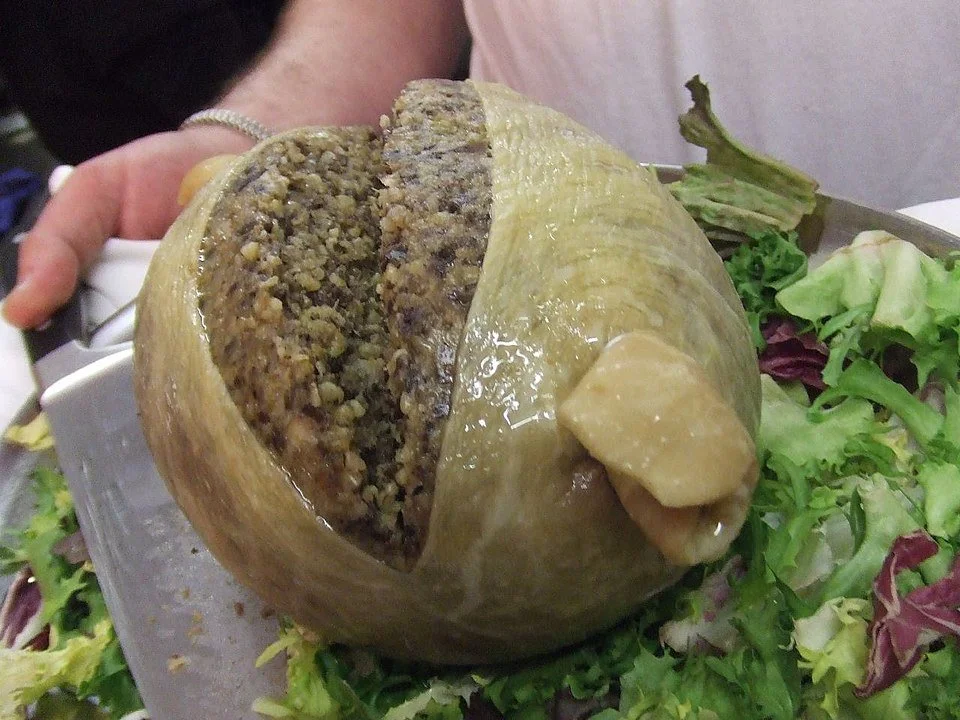
Photo of a haggis on a dish surrounded by greens

A haggis, the “Great Chieftain o’ the Puddin-race”

17 June 2026

Pudding is a word that means different things on either side of the Atlantic, and it is also a word that has acquired additional senses over of the centuries. Pudding dates to the late thirteenth century, and its original meaning is that of a sausage, a mix of meat, suet, oats or other grains, seasonings, etc. stuffed into the intestine or stomach of a sheep, pig, or other animal. Over time, it has also come to mean a boiled, steamed, or baked dish, both savory and sweet, as well as a custard-like dessert, or just a dessert course in general.

Pudding most likely comes from the Anglo-Norman bodin, referring to animal intestines generally and sausage more specifically. In the twentieth century, Canadian French borrowed pudding and changed it into a very different dish, poutine, before handing that variant of the word back to English, along with a hardening of the arteries.

But the earliest reference to pudding in the original sense of sausage that I’m aware of is in the records of the court leet for Norwich, England in 1287. A court leet was a local court that tried minor offenses. The roll for that year inserts the English word into an otherwise Latin record:

Presentant etiam quod omnes illi de Sproxton vendunt hillas et pudinges, emunt scienter porcos superseminatos et vendunt in foro Norwyci predictas hillas et pundinges, non necessarias corporibus hominum.

(They present also that all those Sprowston men sell sausages and puddings, they knowingly buy diseased/inferior pigs, and they sell the said sausages and puddings, unfit for human bodies, in Norwich market.)

The exact meaning of the Latin superseminatos (oversown) here is uncertain, but in context, it clearly refers to pigs that will produce diseased or otherwise inferior meat. The 1892 edition from which I take the quotation translates it as measly, which does not match the present-day colloquial sense of small/puny nor the technical sense of infected with cysticercosis, which is probably too specific for this passage.

A fully English use can be found in the poem The Land of Cockaygne, composed in the thirteenth century with a manuscript witness from c. 1335:

Þer is a wel fair abbei
Of white monkes and of grei.
Þer beþ bowris and halles,
Al of pasteiis beþ þe walles,
Of fleis, of fisse and rich met,
Þe likfullist þat man mai et.
Fluren cakes beþ þe schingles alle
Of cherche, cloister, boure and halle,
Þe pinnes beþ fat podinges,
Rich met to princeȝ and kinges.

(There is a very fine abbey
Of white monks and of gray,
There are bowers and halls,
All of pasties are the walls,
Of flesh, of fish, and rich meat,
The most delicious that one may eat.
Flour cakes are the shingles all
of church, cloister, house and hall,
The nails are fat puddings,
Rich food for princes and kings.)

By the early modern era, pudding had also come to mean a boiled or steamed dish, either savory or sweet. Such dishes were boiled or steamed in a bag, analogous to the intestine used to make sausage, hence the semantic change. Here we see an example from 1544, although here the recipe is for a poultice or medical dressing that resembles a pudding, not for the food itself. From Thomas Phaer’s translation of Jean Goerot’s Regiment of Lyfe:

Take oyle of roses, cromes of breade, yolkes of egges, and cowes mylke, with a lytle saffron, seeth them togyther a lytle as ye woulde make a puddynge, afterwarde sprede them vpon cloutes & laye vpon the sore.

The original French reads bouillie (porridge, gruel).

Over time, this use of pudding grew to encompass similar baked dishes. And in current British use is almost exclusively restricted to sweet dishes, except in certain named savory dishes, such as Yorkshire pudding, hasty pudding, black pudding, etc. This sense is now rare in North America except for those specifically named dishes.

But in North America pudding became associated with custard-like desserts in the late nineteenth century. Here is a recipe for two such puddings in Fannie Farmer’s bestselling Boston Cooking-School Cook Book:

Rebecca Pudding

4 cups scalded milk.
½ cup corn-starch.
¼ cup sugar.
¼ teaspoon salt.
½ cup cold milk.
1 teaspoon vanilla.
Whites 3 eggs.

Mix corn-starch, sugar, and salt, dilute with cold milk, add to scalded milk, stirring constantly until mixture thickens, afterwards occasionally; cook fifteen minutes. Add flavoring and whites of eggs beaten stiff, mix thoroughly, mould, chill, and serve with Yellow Sauce I. or II.

[…]

Pineapple Pudding

2 ¾ cups scalded milk.
¼ cup cold milk.
⅓ cup corn-starch.
¼ cup sugar.
¼ teaspoon salt.
½ can grated pineapple.
Whites 3 eggs.

Follow directions for Rebecca Pudding, and add pineapple just before moulding. Fill individual moulds, previously dipped in cold water. Serve with cream.

Note, the Fanny Farmer candy company is unrelated to Fannie Farmer of culinary fame. The company was founded after her death and so named to cash in on her reputation, using a spelling variant of her name to avoid trademark violations.

A different semantic change happened in Britain, where in the early twentieth century pudding generalized from the sweet boiled/steamed/baked dishes to refer to the dessert course. Here is an example from the London’s Times of 27 November 1934:

We give good nourishing dinners to expectant and nursing mothers in a quiet room in the centre, at a time convenient to the mothers. These dinners satisfy the requirements of our medical officers. They cost 6½d. to 7d. each, and consist of fish or meat, two vegetables, and a pudding.


Sources:

Anglo-Norman Dictionary, AND2 Phase 1, 2000–06, bodins, n.

Farmer, Fannie Merritt. The Boston Cooking-School Cook Book. Boston: Little, Brown, 1896, 344–45. HathiTrust Digital Library.

Goeurot, Jean. The Regiment of Lyfe. Thomas Phaer, trans. London: Edward Whitchurch, 1544, fol. 80v. ProQuest: Early English Books Online (EEBO).

Heuser, W., ed. “The Land of Cockaygne.” Die Kildare-Gedichte. Bonner Beiträge zur Anglistik 14. Bonn: P. Hanstein, 1904, lines 51–60, 146. London, British Library, MS Harley 913. Corpus of Middle English Prose and Verse.

“Leet Roll of 16 Edward I (1287/8).” Hudson, William, ed. Leet Jurisdiction in the City of Norwich During the XIIIth and XIVth Centuries. Publications of the Selden Society, vol. 5. London: Bernard Quaritch, 1892, 8. HathiTrust Digital Library.

Middle English Dictionary, 31 January 2026, s.v. poding, n.

Oxford English Dictionary Online, September 2007, s.v. pudding, n.

“Points from Letters: Maternal Mortality.” Times (London), 27 November 1934, 10/5. Gale Primary Sources: The Times Digital Archive.

Photo credit: Tess Watson, 2007. Wikimedia Commons. Flickr. Licensed under the Creative Commons Attribution 2.0 Generic license.

antifa

Photo of a concert billboard for the band Frei.Wild with graffiti reading “Fuck Nazis” and “Antifa Area”

Concert billboard for Frei.Wild, a South Tyrolean band that has been associated with right-wing politics

15 June 2026

In its present incarnation, while it is often styled in the press as a “group” or “organization,” antifa is more of a political ethos or orientation that opposes fascism and anti-democratic forces. But in the past, the term Antifa has referred to specific organizations.

First, the origin. The word antifa is simply a clipping of antifascist. Use in English stems from the German Antifaschismus and antifaschistisch, although the term is somewhat older in the Italian antifasciste, reflecting Mussolini’s rise to power a decade before Hitler’s.

We see the Italian antifasciste, used in reference to Mussolini’s Fascist party, in the 18 August 1922 edition of the San Francisco Italian-language newspaper Corriere del Popolo:

Il movimento fascista e’ passato ad assaltare le posizioni elettorali avversarie, che non risultano essere state conquistate con un colpo di mano violento, e senza distinzione di tendenze; tanto e’ vero che anche il Comune di Carrara, amministrato dai repubblicani non sospetti di pregiudiziali antifasciste.

(The fascist movement has moved on to attack the electoral positions of its opponents, which do not appear to have been conquered through a violent coup, and without distinction of tendencies; so much so that even the Municipality of Carrara, administered by the Republicans, is not suspected of antifascist prejudices.)

The earliest use of the term Antifa itself that I’m aware of is in English and appears in the Boston Globe on 20 October 1930:

Military practice by the local Communist Antifascist Society was broken up last night by police near the suburb of Heidemuehle.

All members of the society, which is known as Antifa, were arrested and police are investigating purposes of the military practice, which they had suspected for a long time was taking place.

And in a 26 February 1937 article in New Jersey’s Jersey Journal, we see the word Antifa used as the name of an Arab-Jewish organization in Palestine that was opposed to the Nazis:

The speaker at the Peace Institute on Wednesday will be Charles B. Sherman, national American secretary of Antifa, Palestinian Anti-Fascist organization of Palestine working for Arab-Jewish solidarity. Messages will be read from Morris Erem, Jew, and Nejib Yussuf, Arab, an Antifa delegation recently arrived in this country. Antifa is now organizing branches in various countries.

Following World War II, Antifa was used as the name for a Soviet-sponsored political bloc in East Germany. Here is an example from the 7 July 1947 Charlotte Observer:

What is known as the “Antifa” (anti-Fascist) bloc, composed of the chairmen of the three parties, will hereafter decide all major legislative issues in the four provinces of the Soviet zone. But to insure “proper democratic representation,” the bloc will be enlarged to include representatives of at least four semipolitical organizations which always vote as the Soviets dictate.

The sense of antifa as political orientation rather than an organization arose in post-unification Germany, when it was used in opposition to neo-Nazi groups. Here is an example from an Associated Press report of 5 December 1993:

The report also quoted Norbert Weidner, a leader of the far-right Free German Worker’s Party, as saying his group had planted spies in the left-wing Antifa movement, mainly women “because men open up to them more easily.”

Antifa militants attack neo-Nazis and have set up phone trees so foreigners can call for help when threatened by right-wing skinheads. Antifa claims its vigilante actions are justified by inadequate police response to right-wing violence.

And in more recent use, in response to the coming to power of antidemocratic politicians in Europe and the United States, we see examples like this from Britain’s Mail on Sunday of 31 January 2016:

Rocks and smoke bombs were thrown in Dover between far-Right protesters and members of antifascist group Antifa. One person's arm was broken and five others were injured, though not seriously. Another man reportedly had a brick thrown at his face.

Police seized weapons including a knife, hammers and knuckle dusters. Coaches at a service station outside the town were also damaged as Right-wing activists attacked Antifa protesters.

And in the United States, there is this from the 27 June 2016 edition of the Los Angeles Times:

The anti-fascist organization Antifa Sacramento, which had been promoting a “Shut Down Nazi Rally” event on its website, did not respond to requests for comment.

“The Nazis are the violent ones—we are acting in self-defense,” said [Yvette] Felarca, who sustained a bloody blow to the head.

“We need to take them head-on, confront them, but with as many people as possible.”

So when we speak of antifa in the present political context it is not an organization or group but rather an unstructured political orientation that opposes fascism or even authoritarianism more generally, although in the past, before or during World War II or after the war in Soviet-controlled East Germany, Antifa had been used as the name of organizations that were opposed to fascism.

Discuss this post


Sources:

Associated Press. “Neo-Nazis’ Enemies on Computers.” Post and Courier (Charleston, South Carolina), 5 December 1993, 14/1. Readex: America’s Historical Newspapers.

———. “Police Stop Military Practice by Communists (19 October 1930). Boston Globe (Massachusetts), 20 October 1930, 4/1. ProQuest Historical Newspapers.

Clark, Delbert. “Russians Tighten Political Grip on Eastern Germany.” Charlotte Observer (North Carolina), 7 July 1947, 5/4–5. Readex: America’s Historical Newspapers.

Creasy, Richard and Ben Ellery. “Far-Right Protests Erupt in Violent Fury.” Mail on Sunday (London), 31 January 2016. 17. ProQuest Newspapers.

“La Crisi della Democrazia Italiana” (18 July 1922). Corriere del Popolo (San Francisco, California), 18 August 1922, 1/4. Readex: America’s Historical Newspapers.

“Jewish Center Group Doings.” Jersey Journal (Jersey City, New Jersey), 26 February 1937, 3/1–2. Readex: America’s Historical Newspapers.

Oxford English Dictionary Online, September 2018, s.v  Antifa, n.; March 2023, anti-fascism, n.

 “7 Stabbed at Racially Charged Rally.” Los Angeles Times (California), 27 June 2016, A13/1. Readex: ProQuest Newspapers.