great white hope

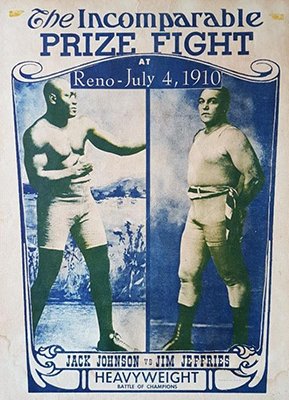
Poster, with pictures of 2 boxers, 1 Black and 1 white, for the Jack Johnson vs. Jim Jeffries boxing match of 4 July 1910

19 August 2026

In current parlance, a great white hope, sometimes simply white hope, refers to someone in a particular field in whom others place expectations and desires for success. Originally it referred to a white person who might have success in a field dominated by people of color, and specifically to any white boxer who might dethrone Black boxer Jack Johnson, who reigned as world heavyweight champion from 1908–15. While the phrase today may be used without any racist intent, its history makes its use highly problematic, to say the least.

It is claimed by some that Jack London coined the phrase, but there is no record of the writer using the term. He did, however, express the sentiment of the phrase in his reporting in the Baltimore Sun on Johnson’s 4 July 1910 fight with James J. Jeffries, a former heavyweight champion who had come out of retirement to battle Johnson. London wrote:

Once again, has Johnson sent down to defeat the chosen representative of the white race, and this time the greatest of them.

Riots broke out following the fight as white mobs attacked Blacks celebrating Johnson’s victory. More than twenty people died.

The phrase white hope predates London’s Baltimore Sun article, appearing in the months leading up to the Johnson-Jeffries fight. Here is the earliest example that I’m aware of, from a headline the Kansas City Star of 27 June 1910:

JEFFRIES PUT ON SPEED
Eleven Fast Rounds Indulged in by the White Hope

And here’s a post-fight example, from the Indianapolis Black newspaper The Freeman of 22 October 1910, although this use is an adjective phrase, not a noun phrase:

After being turned down by seven American life insurance companies in his quest for a $75,000 policy, Jack Johnson, the “white hope blaster,” was notified by a London company that it would insure his life in any sum up to $100,000. The premium demanded by the London company is said to be one of the highest on record.

A few months later, on 30 December 1910, the Los Angeles Daily Times used the noun phrase in reference to boxer Carl Morris:

WHITE “HOPE” TALKS LOUDLY.
Morris Sure He Can Thrash Big Jack Johnson

And we the great is added the following year, when it appears in the Oakland Tribune of 30 April 1911. The original paper used for the digital scan is damaged, hence the lacunae, but the phrase can still be made out clearly:

Wednesday night will decide once and for all whether or not “Gunboat” Smith is to become a real white hope among the heavyweights at present meandering about the globe in the hope of establishing a right to claim a match with Mr. John Artha Johnson.

[…]

With all the care with which a loving [m]other could nurse a baby Harry Foley [ ]ling and preparing the Gunboat [ b]attle of Wednesday. Foley as [ ] of the great white hope of the [ ]d amass a fortune.

Five years later, an out-of-shape Johnson would eventually lose the title in the twenty-sixth round of a bout with Jess Willard.

Discuss this post


Sources:

“Jack Johnson’s Insurance Policy.” The Freeman (Indianapolis), 22 October 1910, 7/2. Readex: America’s Historical Newspapers.

“Jeffries Put on Speed.” Kansas City Star (Missouri), 27 June 1910, 1/3. Newspapers.com.

“Live Doings in the Field of Sports.” Los Angeles Daily Times, 30 December 1910, 6/1. ProQuest Newspapers.

London, Jack. “Jeffries Falls a Victim” (4 July 1910). The Sun (Baltimore, Maryland), 5 July 1910, 1/8.

Oxford English Dictionary Online, March 2015, s.v. white hope, n.

Shapiro, Fred. “Re: (great) white hope (1910).” ADS-L, 25 July 2026.

Smith, Eddie. “Victory Means Much to Either Smith or Barry.” Oakland Tribune (California), 30 April 1911, 39/1. NewspaperArchive.com.

Image credit: unknown creator, 1910. Wikimedia Commons. Public domain image.

uncanny valley

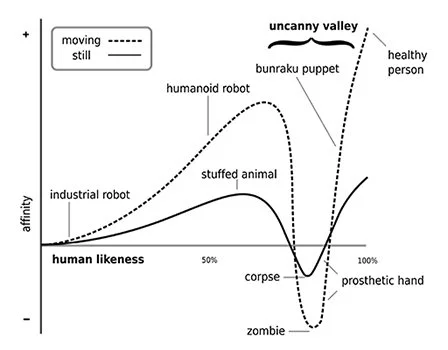
Graph showing the drop in affinity as an artificial humanoid becomes more lifelike

Graphic describing Masahiro Mori’s uncanny valley

17 August 2026

The phrase uncanny valley is a calque of the Japanese phrase bukimi no tani (bukimi (uncanniness + no (possessive particle) + tani (valley)).

The Japanese phrase was coined by Masahiro Mori in a 1970 article in which he observed people’s emotional affinity toward robots rising as they appeared more humanlike but then suddenly dropping as their appearance approached verisimilitude. A 2005 English translation of Mori’s 1970 article reads, in part:

Climbing a mountain is an example of a function that does not increase continuously: a person's altitude y does not always increase as the distance from the summit decreases owing to the intervening hills and valleys. I have noticed that, as robots appear more humanlike, our sense of their familiarity increases until we come to a valley. I call this relation the “uncanny valley.”

The root of the words canny and uncanny trace back to the Old English verb cunnan, meaning to know, to understand. And the use of uncanny in the particular psychological sense of something familiar suddenly revealed to be strange or unsettling dates to the translation of the title of a 1919 essay on the subject by Sigmund Freud, The Uncanny, or in the original German, Das Unheimliche. Freud, of course, was not thinking about robots or computer-generated graphics.

The earliest documented appearance of uncanny valley in English is in Jasia Reichardt’s 1978 book Robots: Fact, Fiction, and Prediction. In that book, one of the section headers reads:

Human reactions to imitation humans, or Masahiro Mori’s Uncanny Valley.

And in the text:

One of the robots at the 1970 Osaka World’s Fair incorporated twenty-nine facial muscles so that a range of expressions could be programmed, the idea being to make the robot smile. According to the engineer who made it, a smile is a sequence of facial distortions performed at a certain speed. If the speed is decreased by half, the robot’s smile, far from being charming, would become a frightening and uncanny grin. This is another example of the strange effect caused by something unexpected. If anything at all goes wrong, either with an artificial hand, or a doll, or a smiling robot, those witnessing the event shudder, and the particular devices immediately drop into the uncanny valley.

It took a while for the term uncanny valley to catch on. There are a handful of uses prior to 2001, usually referencing Mori’s work. The following appearance of uncanny valley in the Los Angeles Times of 8 May 2001 was prompted by the film Final Fantasy: The Spirits Within. The film was entirely CGI and, unlike prior all-CGI films such as those by Pixar, aimed for verisimilitude in its human characters:

Moreover, people generally relate better to animated figures that are distinctly outlandish than those that begin to approach the ideal. This is a phenomenon known to robotics researchers as “the uncanny valley”—the point where a robot is so close to lifelike yet still so short of ideal that people become focused on its imperfections.


Sources:

Hiltzik, Michael A. and Alex Pham. “Synthetic Actors Guild.” Los Angeles Times, 8 May 2001, A22/2. ProQuest Newspapers.

Mori, Masahiro. “The Uncanny Valley” (1970). Karl F. MacDorman and Takashi Minato, trans. Androidscience.com, 19 September 2005. Archive.org.  

Oxford English Dictionary Online, June 2015, s.v. uncanny valley, n.

Reichardt, Jasia. Robots: Fact, Fiction, and Prediction. Harmondsworth, England: Penguin, 1978, 26. Archive.org.

Image Credit: Karl MacDormand, 2005, based on an image by Masahiro Mori. Wikimedia Commons. Licensed under the Creative Commons Attribution-Share Alike 3.0 Unported license.

Anglo-Saxon

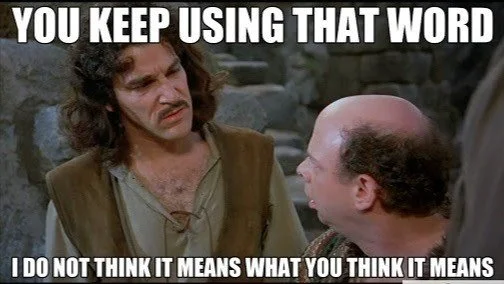
Meme from Princess Bride: Inigo telling Vizzini, “You keep using that word. I do not think it means what you think it means.”

14 August 2026

Anglo-Saxon is a problematic term. Historically, it is a misnomer, and in modern use it is strongly associated with ethnic, and often white supremacist, identity. As such, it should probably be avoided in favor of terms like English, Early English, pre-Conquest, and, for the language and literature, Old English.

Anglo-Saxon is a compound of two terms originally from the Latin Anglus and the proto-Germanic *sahso, relating to blades or cutting. Both were terms for groups of Germanic peoples who settled in what is now England starting in the late fourth century C.E. The origin of these names is a bit sketchy, but it is widely thought that Anglus, or Angle, refers to a region in southern Denmark and northern Germany thought to be their home. The Latin Anglus is the root of England and English. And sax, seax in Old English, refers to a short sword or knife associated with certain Germanic tribes. In addition to the insular use we see Saxon in the name of the modern German state of Saxony.

(The story related by Bede of the Angles, Saxons, and Jutes—this third group may not have actually existed—arriving in 411 C.E. in three ships is a simplified, mythical description of a migration that was more complex, started earlier, and took place over a longer period.)

The compound Anglo-Saxon only appears once or twice in English-language writing prior to the Early Modern period. There are more frequent uses in Latin—mostly in Continental, not English, sources—starting with a 786 C.E. letter by Alcuin, a clergyman and scholar from Northumbria who served in Charlemagne’s court, that uses Anglorum Sax[o]nia (Saxony of the English) to refer to England, and specifically to Mercia and Northumbria—both Saxon polities. Alcuin would not likely confuse the ethnic identity of his own people by labeling them as Angles.

Latin use of the compound to refer to the people of England is first documented in Paul the Deacon’s Historia Langobardorum, written sometime before 796, in a passage that refers to the clothing of the Anglisaxones (Anglo-Saxons). All of the Latin uses of the term in Continental Latin are similar, using it to distinguish the Germanic peoples of England from their Continental cousins.

Use in pre-Conquest Anglo-Latin, however, is rarer and quite different, demonstrating that the English did not use it to refer to themselves as a single people or nation. Variants of the term appear in the extant Anglo-Latin corpus thirty-seven times. All but one of these are in regnal or ecclesiastical titles. These begin with an 891 charter that refers to Alfred as Anglorum Saxonum rex (king of the Angle-Saxons). But here and in the later titles the reference is specifically to the unified kingdom of Mercia and Wessex. When Northumbria came under a unified English rule with Æthelstan in 934, it was listed as a separate land in the regnal title, indicating that the continued use of Anglo-Saxon in regnal titles was specifically to Mercia-Wessex. The one non-titular use of the compound is in Lantfred’s c.1000 life of St. Swithun, which refers to diversis Anglosaxonum finibus (diverse Anglo-Saxon regions). The intended geographic scope of this phrase is unclear to us today, but since Swithun was bishop of Winchester, the capital of Wessex, it is likely another reference to Mercia-Wessex and not England as a whole.

There are only three uses of Anglo-Saxon in pre-Conquest English-language texts. Two of the three texts are macaronic, blending both Latin and English, so the appearance in these two texts is likely a use of the Latin. Two of these are in regnal titles, one macaronic and one all-English, mirroring the Anglo-Latin usage. The third is in the tenth-century macaronic poem Aldhelm, which contains the lines, “Ealdelm æþele sceop etiam fuit / on æðele Angolsexna” (Aldhelm was a noble poet in the land of the Anglo-Saxons). Aldhelm was of the Wessex royal house and served as abbot at Malmesbury and as bishop of Sherborne, so the Mercia-Wessex sense is likely intended here as well.

So if the Germanic peoples of England did not refer to themselves as Anglo-Saxons, what did they call themselves? There are 43 appearances of seax (Saxon) as an ethnonym in the Old English corpus, but that is in contrast to some 407 appearances of saxon in compounds, such as westseax, eastseax, and suðseax, indicating that Saxon was primarily used to refer to specific groups, and not as a demonym for the people as a whole. Instead, the word that was overwhelmingly used in pre-Conquest writing for both Angles and Saxons was englisc.

With the Norman Conquest, the already rare use of Anglo-Saxon disappeared entirely in Middle-English writing. English continued as the primary demonym. Saxon, and the Anglo-Norman Sessoun, was used historically to refer to the pre-Conquest peoples. While the compound disappeared from Middle English, Anglo-Latin writing in post-Conquest period continued to sporadically use Anglo-Saxon, again usually to distinguish the people in England from those on the Continent..

Use of Anglo-Saxon as a demonym for the English people as a whole really started with William Camden’s 1586 Latin Britannia, in which he used the term as a section title. He would go on to use Anglo-Saxones in the body of the 1607 revision of the work. Camden’s use would be picked up by George Puttenham in his 1589 The Arte of English Poesie, the first post-Conquest, English language use of the term. This period was also when the term Middle Ages was coined—Camden being one of the first to adopt the term, a time when writers were looking to the past to establish a national patrimony. Reflecting this desire, the Corpus of Early Modern English has only Puttenham’s single sixteenth-century use, contrasted with 173 appearances of Anglo-Saxon in the seventeenth and eighteenth centuries, of which 172 of these are references to the pre-Conquest period.

But in the modern period, Anglo-Saxon acquires a new sense, that of a contemporary identity marker. That 173rd use of the term in the Corpus of Early Modern English is in the transcript of a 1794 sedition trial held in Edinburgh that uses the term to refer to the English politico-legal system, as opposed to that of the Scottish. It is with this very late eighteenth-century use, and subsequent ones in the nineteenth century, that we start to see Anglo-Saxon used for contemporary, rather than pre-Conquest contexts. This usage falls into two somewhat overlapping senses. The first is as an ethnonym, a marker for Englishness (as opposed to Scottish, Welsh, or Irish identity) or more broadly for whiteness. The second is to denote the politico-economic institutions and practices of the anglophone polities of the United States and Britain, with Canada, Australia, and New Zealand sometimes included (cf. the French le Anglo-Saxon in this sense).

In present-day usage, these two senses constitute the overwhelming majority of uses throughout the English-speaking globe—Britain and Ireland excepted—with historical reference to the pre-Conquest period being a minority use. In Britain and Ireland, because of continual references to those nations’ histories, the pre-Conquest sense dominates, but even there the use as a contemporary identity marker still makes up about a quarter of all uses of the term.

The use of Anglo-Saxon as a contemporary ethnonym ranges from contexts of hardcore white supremacy to the phrase and acronym white, Anglo-Saxon Protestant (WASP) to casual use as a ethnic distinction. And the politico-economic sense is not without tinges of racial identity, especially when used in a postcolonial context. As a result, the continued use of Anglo-Saxon as a historical term serves to legitimize and reinforce the racial uses, even if that is not intended.

Using Anglo-Saxon to refer to the pre-Conquest period is problematic even without considering that it may be read as legitimizing white supremacy. First, it’s anachronistic; it’s not a label the pre-Conquest peoples of England used (except, as we have seen, in regnal titles, and then only to refer to part of England). That, in and of itself is not disqualifying; many historical terms are anachronistic. More relevant is that using it carries an implication of unity in the period that did not exist. It causes us to lump together chronological, regional, religious, and political disparities. Its use also creates an artificial divide between the early medieval Anglo-Saxon and the modern English, severing the historical and cultural connections.

In short, there is no good reason for continuing to use the term Anglo-Saxon. It would be best to just let the term fade away until it only exists in the titles of old books.

Discuss this post


Sources:

Corpus of Middle English Prose and Verse (CoME),” Middle English Compendium.

Davies, Mark. “British National Corpus (BNC),” English-corpora.org.

———. “Corpus of Contemporary American English (COCA). English-corpora.org.

———. “Corpus of Early Modern English (CoEME),” BYU Law & Corpus Linguistics.

———. “Corpus of Historical American English (COHA)” English-corpora.org.

———. “Corpus of News on the Web (NOW),” English-corpora.org.

———. “Hansard Corpus.” Hansard-corpus.org.

———. “Strathy Corpus of Canadian English.” English-corpora.org.

Dictionary of Medieval Latin from British Sources. London: Oxford UP, 2013.

Dictionary of Old English Web Corpus.

Dockray-Miller, Mary. “Old English Has a Serious Image Problem,” JSTOR Daily, 3 May 2017.

Ellard, Donna Beth. “OED. ‘Anglo-Saxonist, n.’: Professional Scholar or Anonymous Person,” Rethinking History, 23.1, 16 January 2019, 16–33. DOI: 10.1080/13642529.2018.1561809,

Frantzen, Allen J., Desire for Origins: New Language, Old English, and Teaching the Tradition. New Brunswick: Rutgers UP, 1990.

Harris, Stephen J. Harris. Race and Ethnicity in Anglo-Saxon Literature. New York: Routledge, 2003, 21.

Horsman, Reginald. Race and Manifest Destiny: The Origins of American Racial Anglo-Saxonism. Cambridge: Harvard UP, 1981.

Kim, Dorothy. “Teaching Medieval Studies in a Time of White Supremacy.” In the Middle, 28 August 2017.

Livingstone, Josephine. “Racism, Medievalism, and the White Supremacists of Charlottesville,” The New Republic, 15 August 2017.

Lomuto, Sierra “White Nationalism and the Ethics of Medieval Studies,” In the Middle, 5 December 2016.

Miyashiro, Adam. “Decolonizing Anglo-Saxon Studies: A Response to ISAS in Honolulu.” In the Middle, 29 July 2017.

“On Race and Medieval Studies,” Medievalists of Color, 1 August 2017.

Oxford English Dictionary Online, December 2008, s.v. Anglo-Saxon, n. & adj., Anglo-Saxonist, n., English, adj. (& adv.) & n., Angle, n.3, Anglo-, comb. form; 1910, s.v. Saxon, n. & adj., sax, n.1.

Rambaran-Olm, Mary. “Anglo-Saxon Studies [Early English Studies], Academia and White Supremacy.” Medium, 27 June 2018.

Rambaran-Olm, Mary. “Misnaming the Medieval: Rejecting ‘Anglo-Saxon’ Studies.” History Workshop, 4 November 2019.

Remein, Daniel C. “ISAS Should Probably Change Its Name” (International Congress on Medieval Studies, Kalamazoo, MI, 2017), p. 3.

Symes, Carol. “Medievalism, White Supremacy, and the Historian’s Craft,” Perspectives on History, 2 November 2017.

Thomas, Carla María. “Reflections on ISAS 2017 and a Call to Action,” Muddling Through the Medieval, 23 August 2017.

Vernon, Matthew X. The Black Middle Ages: Race and the Construction of the Middle Ages. Cham, Switzerland: Palgrave Macmillan, 2018.

Cord Whitaker, “Making Race Matter in the Middle Ages,” Postmedieval, 6, 2015.

Wilton, David. “What Do We Mean by Anglo-Saxon? Pre-Conquest to the Present.” Journal of English and Germanic Philology (JEGP), 119.4, October 2020, 425–54. JSTOR.

Image credit: Fair use of a screenshot from Rob Reiner’s The Princess Bride (1987, 20th Century Fox) to illustrate the topic under discussion.

gala

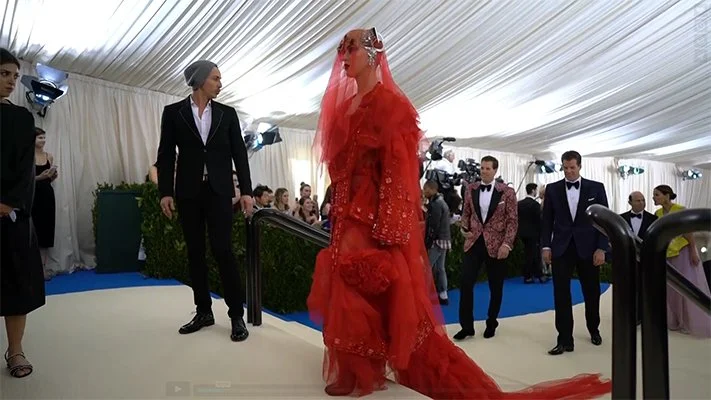
A woman in a haute couture, red dress with veil walking through a tented enclosure with people in evening wear following

Singer Katy Perry arriving at the 2017 Met Gala

12 August 2026

English use of gala is an eighteenth-century borrowing from French, and word originally comes from the Middle and Old French gale, meaning festivity, rejoicing. But the sources disagree about the early path the word took. In a very old entry, the Oxford English Dictionary and more recently the American Heritage Dictionary say the word sojourned in Italian for a while before being borrowed back into French. Merriam-Webster says the stopover was in Spanish. In any case, all this happened before English took the word from French.

That borrowing can be traced to 1625 in a letter by Walter Aston which uses the plural galas to refer to festive clothing:

I understand the French Embassadour by order from the King his Master, hath given account unto this King of the Conclusion of the Match betwixt the Prince his Highnesse, and Madam Christiene his Masters Sister. Whereupon this King, and the whole Court put on Galas: I conceive (howsoever I have not heard any thing thereof by any Letter unto me) that this is ground enough to Congratulate with your Grace this good beginning which I shall affectionately wish may in the successe in all times prove a happiness to his Highnes and a particular blessing to your Grace.

In the seventeenth century gala starts being used to mean festivity in general. Another letter, this time by Mary Wortley Montagu in 1716 uses the word:

They declare, that on such a day the assembly shall be at their house in honour of the feast of the count or countess——such a one. These days are called days of Gala, and all the friends or relations of the lady, whose saint it is, are obliged to appear in their best clothes, and all their jewels.

Toward the end of that century we see gala being used to refer to a specific event. One early use may be in Richard Brinsley Sheridan’s 1780 play The School for Scandal. But it is unclear if Sheridan is using the word to refer to a specific event or to festivity in general:

And yet, I chose with caution a girl bred wholly in the country, who had never known luxury, beyond one silk gown, or dissipation beyond the annual gala of a race ball—Yet now, she plays her part in all the extravagant fopperies of the town, with as good a grace as if she had never see a bush, or a grass plot out of Grosvenor Square.

In any case, by 1799 gala is definitely being used to mean a specific event, as this appearance in the October issue of The Sporting Magazine attests:

Some time ago a certain Lord gave a grand gala to the members of the Volunteer Corps in his neighbourhood, all of whom attended in full uniform.

And today, this last sense is perhaps most familiar in reference to the annual Met Gala, a fund-raising event for and at the Metropolitan Museum of Art in Manhattan that has been held since 1948.

Discuss this post


Sources:

American Heritage Dictionary, fifth edition, 2022, s.v. gala, n.

Aston, Walter. Letter, 10 December 1625. In Cabala, sive, Scrinia Sacra Mysteries of State & Government. London: G. Bedel and T. Collins, 1654, 53–54. ProQuest: Early English Books Online (EEBO).

“Feast of Wit, or Sportsman’s Hall.” The Sporting Magazine, October 1799, 50–52 at 51. HathiTrust Digital Library.

Merriam-Webster.com, 22 April 2026, s.v. gala, n.

Montagu, Mary Wortley. Letter, 1 October 1716. Letters of the Right Honourable Lady M—y W---y M---e. London: M. Cooper, 1775, 32–33. Archive.org.

Oxford English Dictionary Online, 1898, s.v. gala, n.1 and adj.

Sheridan, Richard Brinsley. The School for Scandal. Dublin: 1780, 11. Gale Primary Sources: Eighteenth Century Collections Online.

throw one’s hat into the ring

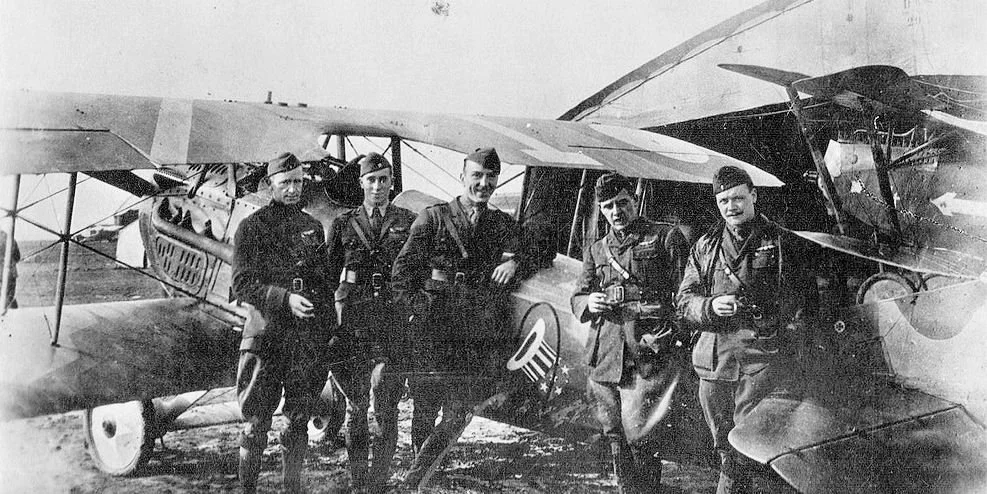
B&W photo of five pilots in front of a WWI aircraft bearing a squadron insignia of a stars-and-stripes top hat in a ring

Pilots of the US 94th “Hat in the Ring” Aero Squadron, 1918: 1Lt Joseph Eastman, Capt. James Meissner, Capt. Eddie Rickenbacker, 1Lt Reed Chambers, and 1Lt Thorne C. Taylor

10 August 2026

To throw one’s hat into the ring is to enter into a fray or contest, and in particular to announce one’s candidacy for an office. The metaphor has a very literal origin in early nineteenth-century boxing, when challengers would toss their hat into the boxing ring to signal their willingness to fight.

We see a literal use of the phrase in a Times of London article on 30 November 1804:

The champions arrived at Wilsdon Green at eleven o’clock, in two hackney coaches, with their rings, where a ring was formed by the spectators, who greeted the tools of their amusement by loud cheers.—Belcher first threw his hat into the ring over the heads of the spectators, as an act of defiance to his antagonist, who received him in the ring with a welcome smile.

And the phrase would soon start to be used as a metaphor for entering into a dispute or contest. Here is an example from the Blackwood’s Edinburgh Magazine of June 1822 that uses the metaphor, but that still clearly links it to its boxing origins. The quotation here is rather long, but I couldn’t resist the prose and the subject of Byron:

Lord Byron, too, has written something about us—but whether a satire or eulogy seems doubtful. The Noble Lord—great wits having short memories, and sometimes not very long judgments—has told the public and Mr Murray that he has forgotten whether his letter is on or to The Editor of Blackwood’s  Magazine. From this we fear his Lordship was in a state of civilation sic when he penned it; and if ever he publishes it, as we scorn to take advantage of any man, we now give his Lordship and the public a solemn pledge, to drink one glass of Sherry, three of Champagne, two of Hock, ditto of Madeira, six of Old Port, and fort-and-twenty of Claret, before we put pen to paper in reply. At the same time, Lord Byron should recollect that we are now an old man—just as Jeremy Bentham is now an old woman; and that he, who has youth on his side, ought not to throw up his hat in the ring, and challenge us for a bellyful. We think we can fit him with the gloves, and that is pretty light play for one at our time of life. But we have still a blow or two left in us; and if a turn-up with the naked mauleys there must be, a hit on the jugular may peradventure do his Lordship’s business.

A couple of years later we see the metaphor being used without direct reference to its boxing roots. The following is from a letter composed by Walter Scott that comments on his continuing personal friendship with Lord Melville, with whom Scott was engaged in a political disagreement over proposals for banking reform. The letters Scott refers to are pamphlets he penned under the pseudonym Malachi Malagrowther in which he took issue with the government’s proposed policies:

I remain of the same opinion respecting the Letters, which have occasioned so much more notice than they would have deserved, had there not been a very general feeling in this country, and among Lord Melville's best friends too, authorizing some public remonstrances of the kind from some one like myself, who had nothing to win or to lose—or rather, who hazarded losing a great deal in the good opinion of friends whom he was accustomed not to value only, but to reverence. As to my friend Croker, an adventurer like myself, I would throw my hat into the ring for love, and give him a bellyful. But I do not feel there is any call on me to do so, as I could not do it without entering into particulars, which I have avoided.

And in an American context, throwing one’s hat into the ring would become a metaphor for candidacy for office. The following headline appeared in Texas’s Austin Statesman of 7 June 1907 regarding Senator Philander Knox’s bid for the Republican nomination for president in 1908:

KNOX’S HAT IN THE RING

Pennsylvania Senator Will Make Race for Nomination by Republican Convention for Presidency

Knox would lose the nomination battle to William Howard Taft.

Perhaps the most famous use of the metaphor, only this time in graphic rather than lexical form, was during the First World War. The American 94th Aero Squadron used a squadron insignia of a top hat, decorated with stars and stripes, within a ring. In 1917, the unit was among the first US squadrons to arrive in France, hence the insignia as a metaphor for the United States entering the war. The squadron produced three aces, including Eddie Rickenbacker, the most decorated US pilot of the war, credited with twenty-six aerial victories, and the squadron’s exploits were widely reported in the press. Rickenbacker’s pre-war fame as a racecar driver contributed to the squadron’s notoriety and press coverage. The US Air Force’s 94th fighter squadron uses the hat-in-the-ring insignia to this day. 

Discuss this post


Sources:

Blackwood, William. “Preface” (20 June 1822)  Blackwood’s Edinburgh Magazine, June 1822, vii. HathiTrust Digital Library.

“Knox’s Hat in the Ring” (headline). Austin Statesman (Texas), 7 June 1907, 1/7. ProQuest Newspapers.

Oxford English Dictionary Online, March 2017, s.v. hat, n.

“Pugilism.” Times (London), 30 November 1804, 3/2. Gale Primary Sources: The Times Digital Archive.

Scott, Walter. Letter to Robert Dundas (1826). John Gibson Lockhart, ed. Memoirs of the Life of Sir Walter Scott, second edition, vol. 8 of 10. Edinburgh: Robert Cadell, 1839,296. HathiTrust Digital Library.

Photo Credit: US Army photograph, 1918. Wikimedia Commons. Public domain photo.