sapphire

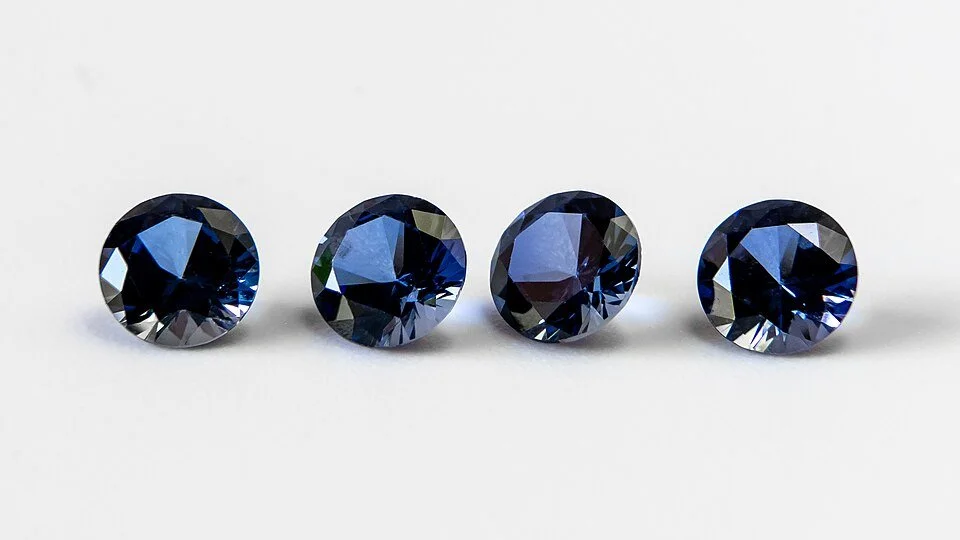
Photo of four, blue, faceted gemstones

Four man-made sapphires

23 February 2026

Sapphire is a gem, usually blue in color, a variety of corundum. The word came into English from the Anglo-Norman saphir, which is from the Latin sapphirus, which, in turn, is from the Greek σάπφειρος (sappheiros). After the Greek, the trail gets muddy. It may come from a Semitic root, akin to the Hebrew sappir or the Aramaic sampirina, or it may come from a Proto-Indo-European root, akin to the Sanskrit canipriya, literally meaning dear to the planet Saturn, and used to refer to some dark gemstone. The difficulty in tracing the origin stems from the possibility of earlier borrowings between Semitic and Indo-European languages.

The earliest use of the word in English may be in Thomas of Hales’s thirteenth-century Love Ron:

Hwat spekestu of eny bolde
þat wrouhte þe wise salomon
of iaspe, of saphir, of merede golde,
& of mony on-oþer ston?
Hit is feyrure if feole volde
more þan ich eu telle con;
Þis bold, mayde, þe is bihote
if þat þu bist his leouemon.

(What do you say of any temple that the wise Solomon built of jasper, of sapphire, of refined gold, and of many other stones? It [i.e., the dwelling that God will give you] is fairer by many times, for than I can tell you. This temple, maid, is promised if you are his lover.)


Sources:

Anglo-Norman Dictionary, AND2 Phase 5, 2018–21, s.v. saphir, n.

Middle English Dictionary, 3 January 2026, s.v. saphir(e, n.

Oxford English Dictionary Online, 1909, s.v. sapphire, n.

Thomas of Hales. “Friar Thomas de Hales’s Love Ron.” Carleton, Brown, ed. English Lyrics of the XIIIth Century. Oxford: Clarendon Press, 1932, lines 113–20, 71. Oxford, Jesus College, MS 29. Archive.org.

———. “Love Rune.” Susanna Fein, ed. Middle English Text Series (METS).

Photo credit: W. Carter, 2020. Wikimedia Commons. Licensed under the Creative Commons Attribution 4.0 International license.
airship

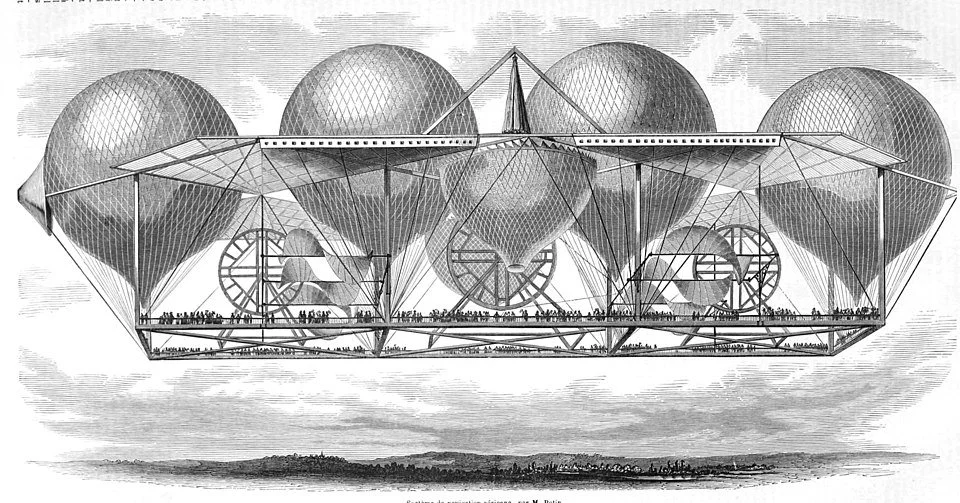
Engraving of a large platform carrying many people held aloft by four large balloons

Ernest Petin’s 1850 design of an airship

20 February 2026

As we use the word today, airship generally refers to a dirigible, but that specific usage became common only after 1900 and the launch of Ferdinand Zeppelin’s aircraft. The word appears as early as 1817 in reference to balloons and aircraft in general.

Airship is, quite obviously, a compound of air + ship. While the English word was formed within that language, it is preceded by the German Luftschiff, used in 1735 to denote a fictional craft and in 1783 to refer to the Montgolfier brothers’ balloon.

The first English use of the term is in reference to a failed attempt at a flying machine, which despite the claims to the contrary, seems to have only gained altitude by happenstance. From London’s Morning Post of 20 September 1817:

A country clergyman, in Lower Saxony, has been so happy as to succeed in accomplishing the invention of an Air Ship. The machine is built of light wood; it is made to float in the air chiefly by means of the constant action of a large pair of bellows, of peculiar construction, which occupies in the front the position of the lungs and the neck of a bird on the wing. The wings on both sides are directed with thin cords. The height to which the farmer’s boy (10 or 12 years of age) whom the inventor has instructed in the management of it has hitherto ascended with it, is not considerable, because his attention has been more directed to give a progressive than an ascending motion to his machine.

The Times of London of 11 October 1817 carried this item verbatim with the exception of the spelling with a hyphen and the term not being italicized: “air-ship.”

By 1823, the phrasal air ship was being used to refer to a balloon. From the Leeds Intelligencer of 11 September 1823:

The balloon would have been launched precisely at that hour, had not Mr. Green been requested by several respectable gentlemen present to defer it awhile, in consequence of the continued influx of company, which had not diminished at twenty-five minutes to four, when the signal of ascent was given and the balloon released. Nothing could exceed the magnificence with which, on bursting from her moorings, this air ship soured at once in a nearly perpendicular direction into the highest heavens.

And in 1850 we see the hyphenated air-ship being used to refer to something that approached what we would consider a dirigible, Ernest Petin’s design for a ligher-than-air flying machine. From the Paris correspondent of New York’s Ladies’ Repository of October 1850:

The subject of aerian [sic] navigation is exciting a good deal of interest here. A. M. Petin, member of the Academie Nationale de l’Agriculture and Commerce has been lecturing, for some months, in the Palais Nationale, upon the subject, and exhibiting models of an air-ship of his invention, which he thinks he can propel through the air at the rate of 20 to 120 miles an hour, and by means of which he promises to transport several thousand passengers, or a corresponding weight of freight, the air itself furnishing both the point of support and the motive power. This ship is an odd-looking machine of some 250 yards in length by 200 in width. It is open every-where, having neither top, bottom, nor sides, so that air may pass through every part of it without resistance. It is, in fact, like the frame of a bird-cage with all the wires taken out, and minus the floor.


Sources:

“Flying Machine.” Times (London), 11 October 1817, 2/4. Gale Primary Sources: Times Digital Archive.

“Letter to the Editor.” Ladies’ Repository (New York), October 1850, 317/1. Gale Primary Sources: American Historical Periodicals from the American Antiquarian Society.

Morning Post (London), 20 September 1817, 2/5. Gale Primary Sources: British Library Newspapers.

“Mr. Green’s Ascent.” Leeds Intelligencer (England), 11 September 1823, 3/4. Gale Primary Sources: British Library Newspapers.

Oxford English Dictionary Online, June 2008, s.v. airship, n.

Image credit: Unknown artist, 1850. Wikimedia Commons. Public domain image. 

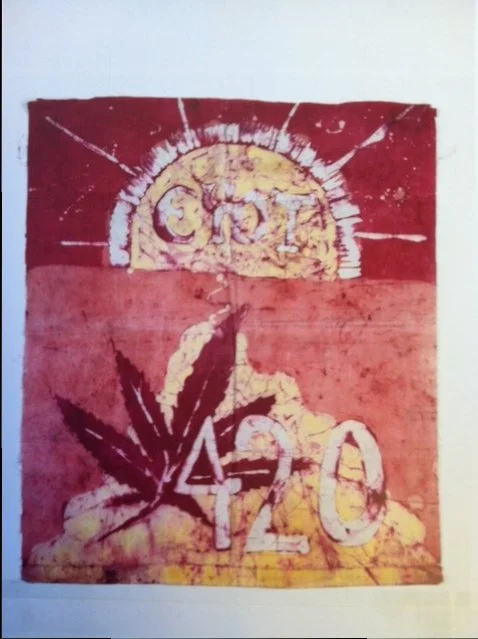
four-twenty / 420

Batik-dyed flag bearing the words “Eyot 420” and a cannabis leaf

Batik flag created by Patty, a friend of the Waldos, in the early 1970s

18 February 2026

There are many origin stories for 420, a slang term referring to marijuana, but unlike most slang terms, researchers have been able to pin down its actual origin with specificity. 420 was first used by a group of students at San Rafael High School in 1971, and it refers to the time of day, 4:20 pm, when they would meet to smoke pot and go off search for a mythical crop of marijuana plants.

San Rafael is in Marin County, on the other side of the Golden Gate Bridge from San Francisco, and in 1971 a group of students who called themselves the Waldos—because they used to congregate along a wall near the high school—got wind of a crop of pot plants allegedly growing near Point Reyes, further north. They would meet each day at 4:20 pm, after the school’s athletic practice, and venture north in search of the cannabis cache. They never found the pot, but in the course of their quest they smoked a lot of weed, had a lot of fun, and began using the term 420.

Marin County in the 1970s was also the stamping grounds of the Grateful Dead, and members of the Waldos had friends and family members associated with the band. 420 was picked up and used by Deadheads, as fans of the band call themselves, and from there the slang term spread to the wider world.

There is testimonial evidence that 420 was in use by the Waldos in 1971, but the first known use in print is from the “Question Man” column in the Red & White, San Rafael High School’s newspaper from 7 June 1974. The question reads: “If you had the opportunity to say anything in front of the graduating class, what would you say?”

The response from Question Man is “420.”

A 23 September 1975 letter from Dave Reddix to fellow Waldo Steve Capper, reads, in part:

My brother is Phil Lesh’s manager and last weekend I had a job as a doorman (backstage) at a concert. I smoked out with David Crosby and lesh [sic], got paid 20 bucks. I was laid off about three weeks ago Im [sic] collecting un-employment or “funenjoyment” that’s what it really is.

[…]

P.S. a little 420 enclosed for your weekend

The 420 in the letter is a reference to a joint that was enclosed.

420 got a big boost in May 1991 when the magazine High Times printed the text of a flyer that had been handed out at a Grateful Dead New Year’s concert. The flyer, however, gave a false origin for the term, that of 420 being a police code, one of many myths about the term that were to come. The flyer read:

Four-twenty started in San Rafael, CA in the late ’70s. It started as the police code for Marijuana Smoking in Progress. After local heads heard of the police call, they started using the expression “420” when referring to the herb—“Let’s go 420, dude!” After a while, something magical started to happen. People began getting stoned at 4:20 am and/or pm. There’s something fantastic about getting ripped at 4:20, when you know your brothers and sisters all over the country and even the planet are lighting up and tokin’ up right along with you. Now, there’s something even more grand than getting baked at 4:20. We’re talking about the day of celebration, the real time to get high, the grand master of holidays: 4/20, or April 20th. This is when you must get the day off work or school. We are going to meet at 4:20 on 4/20 for 420-ing in Marin County at the Bolinas Ridge sunset spot on Mt. Tamalpias [sic]. Just go to downtown Mill Valley, find a stoner and ask where Bolinas Ridge is. If you make it to Marin, you will definitely find it.

HELPFUL HINTS: Take extra care that nothing is going to go wrong within that minute. No heavy winds, no cops, no messed-up lighters. Get together with your friends and smoke pot hardcore.

After this was published in High Times, the term started to be widely used outside of Marin County and Deadheads.

Among the other false explanations that have been proposed over the years are:

  • It was a section of [insert state here]’s penal code referring to marijuana

  • It is the number of chemical compounds in marijuana

  • It was the date [insert name of famous rock musician here] died

  • It refers to Hitler’s birthday (Hitler was indeed born on 20 April, but the association with pot is never adequately explained).

And there are many other explanations. All without any evidence.

Discuss this post


Sources:

Green’s Dictionary of Slang, accessed 17 January 2026, s.v. four-twenty, n.

Grim, Ryan. “Here’s the Real Story of Why We Celebrate 4/20.” Huffpost, 20 April 2016.

Mikkelson, Barbara. “The Origins of 420.” Snopes.com, 20 April 2023.

Oxford English Dictionary Online, March 2017, s.v. 420, n.

Reddix, Dave. Letter to Steve Capper, 23 September 1975. 420Waldos.com.

“Wake ’n’ Bake!” High Times, May 1991, 20.

Zinko, Carolyn. “Heads of the Class: The High School Kids Who Created 420.” San Francisco Chronicle, 20 April 2019, A1, A8. Newsbank: Access World News.

Image credit: Patty, 1970s. 420Waldos.com. Fair use of a copyrighted image to illustrate the topic under discussion.

ring / ringleader

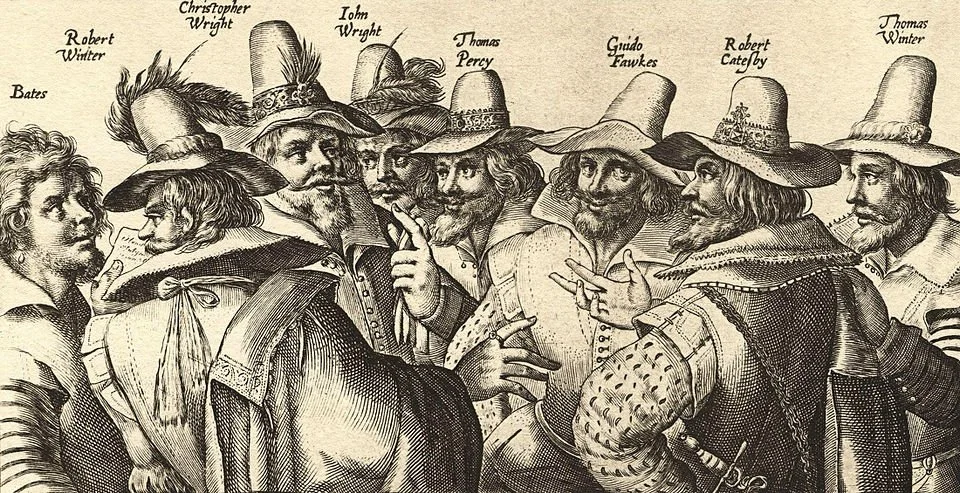
Engraving of 8 bearded men, all but one wearing hats, gathered in a circle, talking

Crispijn de Passe the Elder, c. 1605, engraving of the Gunpowder Plot conspirators; Guy Fawkes is third from right

16 February 2026

Ring comes down to us from the Old English hring with much the same meaning as today, a circlet, often made of metal, to be worn as an ornament, or more generally, any similar circular structure, or a group of people arranged in a circle, as in a dance. (Cf. ring around the rosie)

By the thirteenth century ring was being used metaphorically to refer more generally to a group of people joined by some association, not simply those arranged in a circle. We see this usage in Hali Meidenhad, a homily that encouraged young women to enter religious orders rather than be married:

For ȝif ha beoð acwiket & imaket hale, ha beoð i widewene ring, & ſchulen, i widewene ring, bifore þe iweddede ſingen in heuene.

(For if they are quickened and made whole, they are in the ring of the widowed, and must, in the widowed ring, sing before the wedded in heaven.)

And by the beginning of the sixteenth century, ring was being used to describe a criminal or mutinous conspiracy. This is evident by the appearance of the word ringleader, which can be found in a c. 1503 letter from English soldier and politician John Flamank to King Henry VII:

“Thees men,” he said, “never lovyd the kyngis grace, nor never woldo, with many mo of the same mynd within this toune. Now that I have shewed all the wyrst. This be a sherwde company sett in yll mynde. Dout ye not but this will falle in dede but good provysion be made for the remedy in tyme.

[…]

“And we do wysly, I doutnot but by good counsell we shalbe able by good polici to distrii alle the captayns and ryngledres that be of yll and contrarij mynde.”

The earliest citation of the sense of ring to mean a criminal conspiracy in the Oxford English Dictionary is from John Bee’s 1823 slang dictionary:

Ring—the word was applied by the city-officers to that connexion, circle, or secret understanding which is supposed to exist among the caddees of stage-coaches who are upon the lay—or kedge; and in this sense of a ring representing a circle, round, or connexion, better heads than their’s concur.

But the existence of ringleader from centuries before indicates that this sense of ring must have been circulating for at least as long, and probably earlier than c.1503.

Discuss this post


Sources:

Bee, John. (pseud. John Badcock). Slang. A Dictionary of the Turf, the Ring, the Chase, the Pit, of Bon-Ton, and the Varieties of Life. London: T. Hughes, 1823, 212. Archive.org.

Flamank, John. Letter to Henry VII (c. 1503). In Gairdner, John, ed. Letters and Papers Illustrative of the Reigns of Richard III and Henry VII, vol. 1. London: Longman, Green, Longman, and Roberts, 1961, 237–238. Archive.org.

Furnivall, F. J., ed. Hali Meidenhad: An Alliterative Homily of the Thirteenth Century (c. 1225). Early English Text Society O.S. 18. Oxford: Oxford UP, 1922, 29. London, British Library, Cotton MS Titus D.18. Archive.org.

Middle English Dictionary, 3 January 2026, s.v. ring, n.

Oxford English Dictionary Online, June 2010, s.v. ring, n.1, ringleader, n.

Image credit: Crispijn de Passe, the Elder, c. 1605. Wikipedia Commons. UK National Portrait Gallery, NPG 334a. Public domain image.

sur-

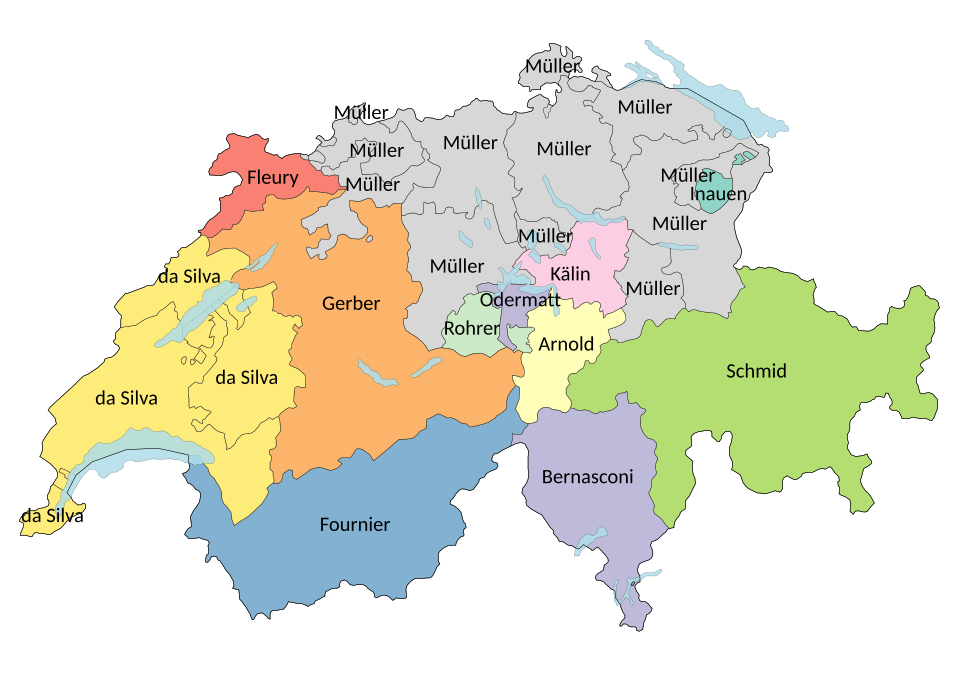
Map of Switzerland showing the most popular surname in each canton

Most common Swiss surnames by canton

13 February 2026

The other day I was wondering about the word surname. What is the sur-? prefix. The etymology, while perhaps not immediately obvious, is quite straightforward; the sur- is a French variation on the Latin super, meaning above or beyond. It comes to us, like many French roots, from the Normans. So a surname is one’s second or higher name, and the word dates to the fourteenth century.

But there are other sur- words, some like surname, borrowed whole from French (Anglo-Norman surnum, early fourteenth century), while others have been formed in English:

surcharge, an additional charge, originally a verb (fifteenth century) borrowed from the Old French surcharger and turned into a noun in English by 1601

survive, to live beyond or after (fifteenth century), from the Anglo-Norman survivre, which was formed from the Latin vivere, to live

surpass, to go over or beyond (sixteenth century), from the French surpasser.

Discuss this post


Sources:

Anglo-Norman Dictionary, AND2 Phase 5, 2018–21, s.v. sur2.

Oxford English Dictionary Online, 1918, s.v. sur-, prefix, surname, n.

Image credit: Pymouss44, 2024. Licensed under the Creative Commons Attribution-Share Alike 3.0 Unported License.