moonbat

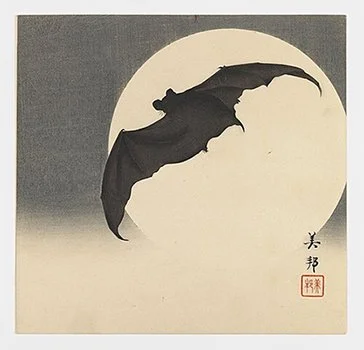
Japanese woodblock print of a bat flying in front of the moon

Biho Takashi, “Bat in Moon,” woodblock print, c. 1905

24 April 2026

Moonbat is a slang term for a crazy person that suddenly rose to prominence in 2003. Like most slang terms, its origin cannot be determined with certainty, but it likely formed through a mixing of two other metaphorical terms, barking/howling at the moon and bats in the belfry.

Green’s Dictionary of Slang has a citation from Peter Buckley and Duncan Clark’s 2003 edition of The Rough Guide to the Internet. I’ve only been able to locate the 2006 edition online, but the 2003 edition likely reads identically:

Over the years, the blogging community has developed its own language of labels, jibes and compliments. If you want to know the difference between a “blawg” and a “barking moonbat” stop off at: Blog Glossary www.samizdata.net/blog/glossary.html [URL no longer active]

That same year, on 31 August, we have this in Florida’s St. Petersburg Times about a woman who volunteered as a human shield in Baghdad prior to the US war with Iraq:

On the Internet, they are calling Faith Fippinger a “treasonous hippie” and a “peacenik bitch.” A “no-good, dictator-supporting, mass-murder-abetting loser.” A “barking moonbat.”

And there is this syndicated column by James Lileks that appeared in newspapers on 23 October 2003:

So why does Bush coddle the Saudis? If you’re of the barking moonbat persuasion, the reasons are clear: Oil! Halliburton! Prescott Bush was the love slave of King Faisal in a Skull and Bones ritual!


Sources:

Benham, Kelly. “A Soft Target.” St. Petersburg Times (Florida), 31 August 2003, F1/1. ProQuest Newspapers.

Buckley, Peter and Duncan Clark. The Rough Guide to the Internet. London: Rough Guides, September 2006, 283. Archive.org.

Green’s Dictionary of Slang, accessed 31 March 2026, s.v. moon, n.

Lileks, James. “Dean Tailors His Words to His Audiences.” Trenton Evening Times (New Jersey), 23 October 2003, A19/1. Readex: America’s Historical Newspapers.

Image credit: Takashi, Biho, c. 1905. Brooklyn Museum. Wikimedia Commons. Public domain image.

viking

B&W photo of a cat in a winged viking helmet and scale-mail breastplate, with the caption “Brünnhilde"

28 March 2025
[Edit: 23 April 2026, added 1801 and 1816 citations]

We all have a solid idea of what a viking was, one of a band of a horned-helmeted, Old Norse warriors who ravaged northern Europe in the medieval period. And that idea is wrong. Not only did viking helmets not have horns, the Norse people who sailed about the northern world were more likely to be peaceful merchants and traders than plundering raiders and pirates. Viking was an occupation, and an occasional gig at that, not an ethnic identity. Furthermore, the word viking is really three different, albeit etymologically related, words. There is the Old English wicing, the Old Norse vikingr, and our Present-Day English word viking. Each of these has slightly different meanings and very different histories.

The Old English wicing is formed through normal derivation, wic (camp) + -ing (person). So a wicing is a person who establishes a camp, much like a pirate might on a shore they were raiding. Wicing appears in the Épinal and Erfurt glossaries, two Latin-Old English word lists. The entriy in the Épinal glossary, which dates to the first half of the eighth century, reads:

piraticum    uuicingsceadan

And the Erfurt glossary, from the late eighth or early ninth century, reads:

piraticam    uuicingsceadae

The Latin piraticum means piracy, and the Old English wicingsceada literally means viking-like. Note that the Épinal glossary predates the period of Norse raids on the English coastline that started toward the end of the eighth century. The late ninth century translation of Orosius’s history also uses wicing, but that use is in the context of Philip of Macedon (the father of Alexander the Great) raiding in the Mediterranean:

Philippuse geþuhte æfter þæm þæt he an land ne mihte þæm folce mid gifum gecweman þe him an simbel wæron mid winnende; ac he scipa gegaderode, & wicingas wurdon, & sona æt anum cirre an C & eahtatig ceapscipa gefengon.

(Philip realized that on land he could not satisfy with gifts the people who had continually been fighting alongside him, so he gathered ships and went viking, and soon captured one hundred eighty merchant ships in one engagement.)

Similarly, in the Old English poem Exodus, a poetic retelling of some chapters of that biblical book, the Israelites making the Red Sea crossing are referred to as sæwicingas, or sea-vikings:

Æfter þære fyrde    flota modgade,
Rubenes sunu.    Randas bæron
sæ-wicingas    ofer sealtne mersc,
mana menio;    micel an-getrum
eode unforht.

(After that army the sea-force, the sons of Reuben, proudly marched. The sea-vikings, many a man, bore shields across the salt marsh. The great host went unafraid.)

As is the case with most Old English poetry, we don’t know when it was composed. But note that the term sea-vikings is being used to describe a land army, presumably because they are crossing the Red Sea. Depending on when the poem was written, it could also be an allusion to Norse raiders, but that would be a strange association for an English poet to make about the Israelites.

Indeed, wicing was used more generally to mean any plunderer. For instance, Wulfstan’s Sermo Lupi ad Anglos (Sermon of the Wolf to the English), written c. 1015, uses the word to refer to an enslaved person who has escaped and become an outlaw, in a passage condemning unjust laws:

Ðeah þræla hwilc hlaforde ætleape & of cristendome to wicinge wurþe, & hit æfter þam eft gewurþe þæt wæpengewrixl wurðe gemæne þegne & þræle, gif þræl þone þæne þegen fullice afylle, licge ægilde ealre his mægðe; and gif se þegen þone þræl þe he ær ahte fullice afylle, gilde þegengilde.

(Though a slave who escapes from their lord and from Christendom to become a viking, and afterward it happens that an exchange of weapons occurs between thane and slave, if the slave should outright kill that thane, [the thane] will lie without any compensation to his family; but if the thane kills outright that slave that he had once owned, he pays the price for killing a thane.)

Although here, unlike the Exodus poem, Wulfstan is undoubtedly also alluding to Norse raiders. Sermo Lupi ad Anglos is about how the decadent English society is being punished by God, and one of those punishments is viking raids.

In his grammar, written at the end of the tenth century, about two decades before Wulfstan’s sermon, Ælfric of Eynsham also deploys the word generally, but his use probably carries an allusion to Norse raiders as well. His gloss on the Latin pirata reads:

pirata wicing oððe scegðman

(pirate: viking or shipman)

Scegð being a type of fast sailing ship used by the Scandinavians.

There is an instance in Old English poetry where wicing is used as the name of a people, that is in the poem Widsith, which consists mainly of a long list of various peoples. One passage reads thusly:

Hroþwulf ond Hroðgar    heoldon lengest
sibbe ætsomne    suhtor-fædran,
siþþan hy forwræcon    wicinga cynn
ond Ingeldes    ord forbigdan,
forheowan æt Heorote    Heaðobeardna þrym.

(Hrothwulf and Hrothgar, uncle and nephew, together held the peace the longest, since they drove away the nation of vikings and humiliated the vanguard of Ingeld, cut down the Heathobard host at Heorot.)

The people and events in the passage are also referred to in the poem Beowulf. Exactly who the wicinga cynn were is not known, but since Hrothwulf and Hrothgar were Danes, it is unlikely that they refer to a Norse people. They may be a distinct group, or the phrase may be another name for Ingeld’s people, the Heathobards. Again, we don’t know exactly who the Heathobards were either, but they perhaps came from Saxony, or perhaps they were entirely fictional.

And in the poem the Battle of Maldon, written sometime after 991 C.E., wicing is used to refer to a Norse army invading England:

Þa stod on stæðe,    stiðlice clypode
wicinga ar,    wordum mælde,
se on beot abead    brimliþendra
ærænde to þam eorle,    þær he on ofre stod.

(Then stood on the shore, a viking messenger, sternly calling out, delivering a speech, uttering a vow, the seafarers’ message to the earl, where he stood on the opposite [shore].)

So the Old English wicing was used generically to refer to raiders or pirates, people of the camps. In some of these instances, it alluded to or specifically referred to Norse raiders, but that wasn’t its primary sense. And in one instance, it was used as the name of a people, but which people is not known, although it doesn’t seem to refer to a Nordic one. So what we have is the fact that the Old English wicing originally meant simply a generic pirate.

The Old English wicing fell out of use following the Norman Conquest.

As for the Old Norse vikingr, that is only first recorded later, in the late tenth century. It is most likely a borrowing from either the English or Anglo-Frisian wicing. It could, however, have been plausibly formed within Old Norse from the root vikr, meaning bay or inlet. In that case, a vikingr would be someone who ventured forth from a coastal inlet.

As for our Present-Day English word viking, that word is a nineteenth-century borrowing from the Old Norse. We see it in a review of Sharon Turner’s History of the Anglo-Saxons that appeared in the Critical Review in October 1801:

We will not, however, dwell on triffling objections, but shall proceed to consider the more important parts of the work, and select a passage concerning the first appearance of the Danish pirates.

Such were the depredations by which the kings, sea kings, and vikingr of the north were distinguishing themselves in reciprocal murder and domestic ruin at the commencement of the eighth century. Like tygers in disposition, but more dreadful from their weapons, their contriving ingenuity, and the all-powerful organization of the human hand, they lived but to plunder and to massacre.

Another early appearance is in George Chalmer’s 1807 history of Scotland, Caledonia, in a passage about Torfin, grandson of King Malcom II of Scotland:

At the age of fourteen, Torfin commenced his career as a vikingr. His sails often disquieted the coasts of Scotland during the reign of his grandfather.

And we see the anglicized spelling viking in a piece in the August 1816 issue of the Scots Magazine:

In 870, the Vikings, from the Irish shores, made a formidable descent on the Western confines of Strath-Cluyd; besieged their capital, sacked it, laid waste the surrounding country, and returned the subsequent year to Dublin, with immense spoil, and many captives.


Sources:

Ælfric. Ælfrics Grammatik und Glossar. Julius Zupitza, ed. Berlin: Weidmannsche, 1880, 24. Archive.org.

Anlezark, Daniel, ed. Old Testament Narratives. Dumbarton Oaks Medieval Library 7. Cambridge: Harvard UP, 2011, lines 331–35a, 228.

“The Battle of Maldon.” In Elliott van Kirk Dobbie, ed. The Anglo-Saxon Minor Poems. Anglo-Saxon Poetic Record 6. New York: Columbia UP, 1942, lines 25–28, 7.

Chalmers, George. Caledonia (1807), vol. 1 of 3. Paisley, Scotland: Alexander Gardner, 1887, 341. Archive.org.

Fell, Christine. “Old English Wicing: A Question of Semantics” (13 November 1986). Proceedings of the British Academy, 72, 1986 295–316. The British Academy

“On the Celtic Kingdom of Strath-Cluyd, called the Regnum Cambrense, in Scotland.” Scots Magazine and Edinburgh Literary Miscellany, August 1816, 577–533 at 533/1. ProQuest Historical Periodicals.

Orosius. The Old English History of the World. Malcolm Godden, ed. Dumbarton Oaks Medieval Library 44. Cambridge: Harvard UP, 2016, 3.7, 172.

Oxford English Dicitionary, second edition, 1989, s.v. viking, n.

Pheifer, J. D. Old English Glosses in the Épinal-Erfurt Glossary. Oxford: Clarendon Press, 1974, 39.

“The Second Part of the History of the Anglo-Saxons.” Critical Review, October 1801, vol. 33. London: S. Hamilton, 1801, 121–34 at 124. Google Books.

Shapiro, Fred. “Antedating of ‘Viking.’ ADS-L, 22 April 2026.

“Widsith.” In Robert E. Bjork, ed. Old English Shorter Poems; Vol. II: Wisdom and Lyric. Dumbarton Oaks Medieval Library 32, Cambridge, Harvard UP, 2014, lines 45–49, 46.

Wulfstan. “Sermo lupi ad Anglos.” In Dorothy Bethurum, ed. The Homilies of Wulfstan. Oxford: Clarendon Press, 1957, 261–66 at 263–64.

Photo credit: Adolph Edward Weidhaas, 1936. Wikimedia Commons. Library of Congress. Public domain image.

incumbent

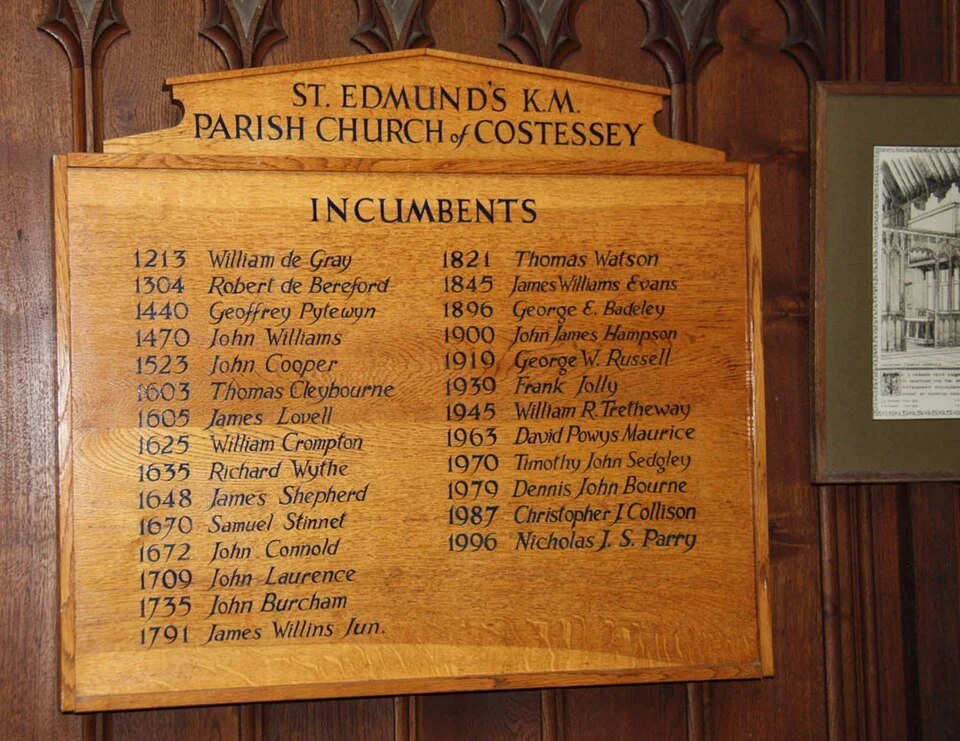
Wooden plaque listing the incumbent rectors of St. Edmond’s Church, Costessey, England, 1213–1996

22 April 2026

Today we usually find the word incumbent in the context of politics, referring to the current holder of a political office. But English use of the word was originally in the sense of the holder of an ecclesiastical office.

Incumbent comes from the medieval Latin incumbere, meaning to settle on, to sit or lie on, but it  was also used figuratively to mean to occupy a religious office or benefice. The earliest use of the word in English that I’m aware of is in one particular manuscript of Geoffrey Chaucer’s Canterbury Tales, London, British Library, Harley MS 7334, copied c. 1410. It appears near the beginning of the Wife of Bath’s Tale, where Chaucer is likening the mendicant friars of his day to the elves and fairies who supposedly used to wander the land:

For þer as wont was to walken an elf
Ther walkith noon . but þe lymytour himself
In vndermeles and in morwenynges
And saith his matyns and his holy þinges
As he goþ in his lymytacioun
wommen may saufly vp and doun
In euery bussch or vnder euery tre
Þer is non oþer incumbent but he
And ne wol but doon hem dishonour

(For where an elf was wont to walk
There walks no one but the mendicant friar himself
In late mornings and in early mornings,
And says his morning prayers and holy things
As he goes in his assigned district.
Women may go safely up and down.
In every bush and under every tree
There is no other incumbent but he
And he will do them no harm but dishonor.)

Most manuscripts of the Tales, including the Ellesmere and Hengist manuscripts which are considered the most authoritative, do not have this reading. Those manuscripts have incubus where this one has incumbent. And given the passage’s allusions to elves and fairies, incubus would indeed seem to be Chaucer’s original, but this manuscript does provide evidence of the use of incumbent.

We see the usual use of incumbent, referring to the holder of an ecclesiastical office, in a letter, written in 1424 or earlier, by John Hurlegh to Thomas Stoner:

I am enfourmed þat Osebarn and Cassy have pursued a new writ of quare impedit aȝeyns J. Golafre. J. Warfeld, and þe incumbent.

A writ of quare impedit (literally, why does he hinder) was an English a common law action requesting the court resolve a disputed benefice, typically brought against a bishop who has appointed someone else to the post.

And by the latter half of the seventeenth century we see incumbent used to refer to secular political offices. Here is an example from Andrew Marvell’s 1672 The Rehearsal Transpros’d, in which he refers to kings as incumbent stewards of their kingdoms:

For these Kings, Mr. Bayes, how negligent soever or ignorant you take'm to be, have, I doubt, a shrewd understanding with them. ’Tis a Trade, that God be thanked, neither you nor I are of, and therefore we are not so competent Judges of their Actions. I my self have oftentimes seen them, some of them, do strange things, and unreasonable in my opinion, and yet a little while, or sometimes many years after, I have sound that all the men in the world could not have contrived any thing better. ’Tis not with them as with you. You have but one Cure of Souls, or perhaps two, as being a Noblemans Chaplain, to look after: And if you make Conscience of discharging them as you ought, you would find you had work sufficient, without writing your Ecclesiastical Policies. But they are the Incumbents of whole Kingdoms, and the Rectorship of the Common people, the Nobility, and even of the Clergy, whom you are prone to affirm when possest with principles that incline to rebellion and disloyal parctices, to be of all Rebels the most dangerous, p. 49, the care I say of all these, rests upon them.

From there it is an easy jump to democratically elected political office and the sense we know today.

Discuss this post


Sources:

Chaucer, Geoffrey. “The Wife of Bath’s Tale.” In The Harleian MS 7334 of Chaucer’s Canterbury Tales. Frederick J. Furnivall, ed. The Chaucer Society. London: N. Trübner, 1885, lines 3:873–81, 219. London, British Library, Harley MS 7334, fol. 97v. HathiTrust Digital Archive.

Dictionary of Medieval Latin from British Sources, Oxford UP, 2013, s.v. incumbere, v. Brepols: Database of Latin Dictionaries.

Hurlegh, John. “Letter to Thomas Stoner” (28 September 1424, or earlier). The Stoner Letters and Papers, 1290–1483, vol. 1. Charles Lethbridge Kingsford, ed. London: Royal Historical Society, 1919, 35. HathiTrust Digital Library.

Marvell, Andrew. The Rehearsal Transpros’d, second edition. London: A.B., 1672, 134. ProQuest: Early English Books Online (EEBO).

Middle English Dictionary, 31 January 2026, s.v. incumbent, n.

Oxford English Dictionary Online, 1900, s.v. incumbent, n., incumbent, adj.

Photo credit: John Salmon, 2011. Wikimedia Commons. Licensed under the Creative Commons Attribution Share-alike license 2.0.


wild and woolly

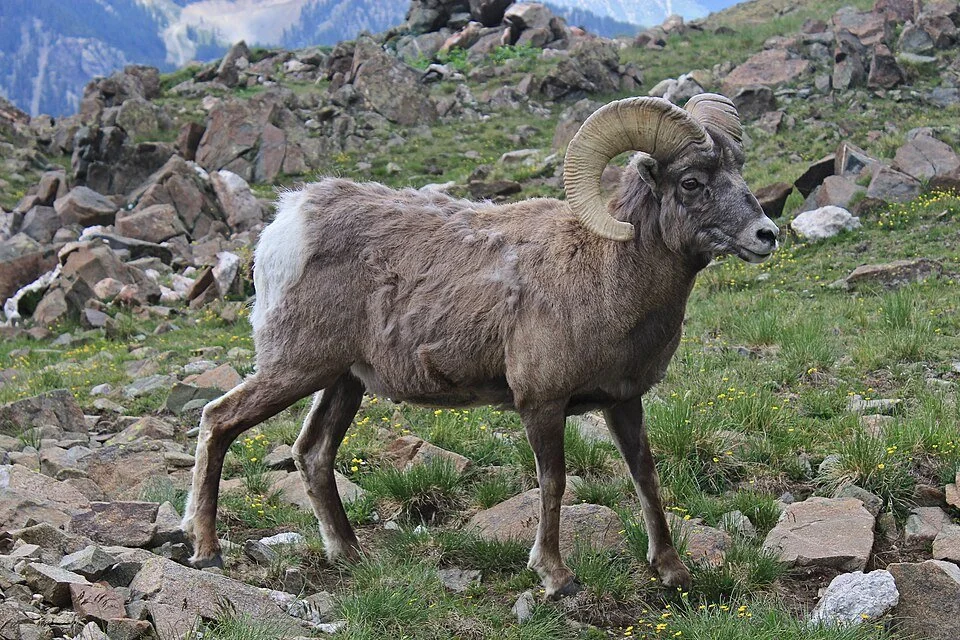
Photo of a bighorn sheep with unkempt wool on a rocky hillside

 A wild and woolly bighorn sheep

20 April 2026

The phrase wild and woolly is an Americanism referring to something, or someone, who is without order or control, untamed by law or social convention. Wild is clear enough, but why woolly? This is a case of a phrase that may seem baffling at first glance, but whose underlying metaphor becomes obvious once explained.

The phrase comes out of the America’s western frontier and is a metaphorical reference to a wild or feral animal, such as a sheep or horse. The earliest use in print that I’m aware of is from the Wichita City Eagle of 12 April 1872 in a column extolling the virtues of the paper’s advertisers:

In another line we find Houghton, Mills & Co.—the Blue Store—where is kept one of the largest, most fashionable and select stocks of men’s and boys’ clothing, gents’ furnishing goods, etc., west of the Missouri river cities. They take measures at their store and show samples of goods, with the latest New York fashion plates, and thus can transfigure in two weeks the long-haired, wild-and-wooly [sic] and hard-to-handle of the frontier into the finished-appearing Broadway swell.

A year later, on 18 May 1873, we get this in another Kansas newspaper, Topeka’s Kansas Daily Commonwealth:

Here we are right from the Chisholm trail, wild and woolly and hard to curry. Wichita is booming, the long horned lantern-jawed and speckle-top booted Texan is here, not singly, but in droves. He perambulates every saloon, bagnio, dance-house, gambling shop, and clothing store in town, and swaggers through it with that nonchalance and looseness peculiar only to Texas cattle and their drivers.

The mention of curry clearly refers to cleaning the coat of an animal.

A few months later we have this from the Dallas Daily Herald of 10 August 1873 describing a fight between two drunks in Brooklyn, Texas on 7 August of that year:

Griffin was led down the street some one hundred yards to the drug store. Valentine refused to be pacified when they met and clinched, and Va[l]entine drew another Derringer, but it dropped in the scuffle. Griffin got him down, when he was pulled off. When Valentine regained his feet he threw a short piece of plank at Griffin which he dodged, and yelled in return, “Wild and woolly and hard to curry.” This was fuel to the flame.

And a few years later the same Dallas paper has this letter by “Comanche Jim” from 18 January 1877:

Now that the law is touched in the person of Mr. Jeffries, the wild and woolly cow-boys no doubt wjll [sic] be compelled to lay aside their weapons on entering the township in order that the more peaceable and respectable members of the community may have a show for their lives. The excuse that Fort Griffin is a frontier town and that Indians are dangerous is now getting “too thin” to justify men necessarily carrying weapons, which, as a matter of consequence, they use, when frontier whisky makes them feel like it.

There is an earlier and racist use of “the wild and woolly-haired Negrillo, Alfouron, or Papuan” in the July 1855 issue of the Protestant Episcopal Quarterly Review, and Church Register. But this is woolly-haired and not just woolly and appears to be a nonce usage unrelated to the phrase used two decades later to describe cowboys on the western frontier of the United States. Still, one wonders if there might be some underlying racism in the early uses of the phrase. Black cowboys were common in the American West—they have been largely erased from our present-day fictional depictions of the era—and it’s not unthinkable that the phrase originated as a racist description of them. But we would need more evidence before reaching that conclusion.

Discuss this post


Sources:

Comanche Jim. “Frontier Racket” (18 January 1877). Dallas Daily Herald (Texas), 24 January 1877, 4/3. Portal To Texas History: Texas Digital Newspaper Program.

“Ethnology and the Scriptures.” Protestant Episcopal Quarterly Review, and Church Register, 2.3, July 1855, 373–99 at 378. Gale Primary Sources: American Historical Periodicals.

“From Wichita.” Kansas Daily Commonwealth (Topeka), 18 May 1873, 2/3. Newspapers.com.

O’Toole, Garson. “Re: [Ads-l] ‘Wild and wooly’ (1873).” ADS-L, 26 March 2026, Two emails in thread: first email; second email.

“Our Advertisers.” Wichita City Eagle (Kansas), 12 April 1872, 4/3. Newspapers.com.

Oxford English Dictionary Online, 1928, s.v. woolly, adj. & n.

Popik, Barry. “Wild and Woolly.” Barrypopik.com, 17 January 2009. https://barrypopik.com/blog/wild_and_woolly

“Wild and Woolly and Hard to Curry.” Dallas Daily Herald (Texas), 10 August 1873, 4/3. Portal To Texas History: Texas Digital Newspaper Program.

Photo credit: Jwanamaker, 2013. Wikimedia Commons. Licensed under the Creative Commons Attribution-Share Alike 3.0 Unported license.

breakfast / Continental breakfast / English breakfast / second breakfast

A breakfast plate containing two eggs, sausages, bacon, baked beans, and fried bread

A full English breakfast

17 April 2026

Breakfast has a very straightforward etymology. It is a compound of break + fast, that is a meal eaten after period of abstention from food, usually while sleeping overnight. The word dates to at least the mid fifteenth century, but exactly what food a breakfast consists of has varied over the years and from place to place. We have Continental breakfasts and English breakfasts, not to mention, for those fans of Peter Jackson’s Lord of the Rings movies, second breakfasts.

The earliest use of breakfast that I’m aware of is in the account books of John Howard, the first duke of Norfolk. Those records contain the following entry for the year 1463:

Item, the xxij. day off Septembyr, in exspensys in breffast,      xj.d.

And we see the verb to breakfast, meaning to eat a breakfast, in the 1644 pamphlet Huls Pillar of Providence Erected, an account of the siege of Hull by royalist forces during the English Civil War. It has the following description of the breaking of the siege by parliamentary forces on 12 October 1642. Note that the breakfasting here is metaphorical; the royalists are being served defeat by the parliamentary army:

How comfortably did the whole Towne almost look over the walles that whole day, and see this salvation of God?

15. Lastly, being thus breakfasted on wednesday, that night they sup with fears and curses, and hasty purposes of being gone from us. The Lord on a sudden sweeps them away, they steale away the remaining Ordnance in the night.

As traditionally conceived, a Continental breakfast is a light meal consisting of foods like toast, pastries, yogurt, and coffee, the continent in question being Europe. But I found an early example of the phrase being used to refer to a hearty meal served in the late morning. From an article in the New Sporting Magazine of April 1838 by one Nimrod, which describes such a meal served to a hunting party in Belgium:

For myself, I commenced with pig’s puddings, and finished with mutton cutlets, to say nothing of the most delightful brown bread and butter I ever tasted in my life; coffee, tea, et cetera—not forgetting a little drop of “something short,” to keep things in their places, as Mrs. Ramsbottom used to say. But speaking seriously, a continental breakfast at that hour is a most glorious meal.

But by mid century we see Continental breakfast used to describe the meal we’re familiar with today. From an 8 January 1851 letter published in the Louisville Weekly Journal:

Taking, then, Murray’s Guide Book, the faithful Friday of all English and American Crusoes, under my arm, my friend F. and I sallied forth in the direction of the Capitol, stopping on the way to take the usual continental breakfast, a cup of coffee or chocolate and bread.

In contrast to the Continental breakfast, the English breakfast is a large meal, with a full English breakfast traditionally consisting of bacon, sausages, eggs, black pudding, tomatoes, mushrooms, baked beans, and toast. And depending where you are in the islands, it can also be referred to as a full Scottish, Welsh, or Irish breakfast.

The earliest use of English breakfast that I’ve found is in an account of a visit to Holland dated 31 July 1817 that refers to a meal served aboard a British ship that has crossed the channel:

But after a little consultation, and as every one thought he could discover anguish in the countenance of his neighbour at the threatened durance, our pilot, who had speedily retired below to the comforts of a good English breakfast, was no less hastily called upon deck, when, much against his liking, he was directed to carry the ship into the Helvoet channel, where the Harwich packets go, and into which there is water at all times of tide.

But like the term Continental breakfast, what an English breakfast consisted of was not fixed in the early years. Susan Ferrier’s 1819 novel Marriage uses the term to denote a light meal, like that served on the Continent, in contrast to the fuller meal served in Scotland:

“I own I was surprised to see you cut so good a figure after the delicious meals you have been accustomed to in the north: you must find it miserable picking here. An English breakfast,” glancing with contempt at the eggs, muffins, toast, preserves, &c. &c. he had collected round him, “is really a most insipid meal: if I did not make rule of rising early and taking regular exercise, I doubt very much if I should be able to swallow a mouthful—there’s nothing to whet the appetite here; and it’s the same every where; as Yellowchops says, our breakfasts are a disgrace to England. One would think the whole nation was upon a regimen of tea and toast—from Land’s End to Berwick-on-Tweed, nothing but tea and toast.”

But by the opening years of the twentieth century the definition of an English breakfast had settled down, and we see the phrase full English breakfast. From Douglas Sladen’s 1908 Egypt and the English:

The catering, as I have said, was not done by the Sudan Government itself, but let out to a Greek contractor, who, all things considered, did his work pretty well, because he contrived to give his passengers a full English breakfast, lunch, and dinner, moderately well-cooked, and with hardly anything overhung; things must be very difficult to keep sound on a train in that temperature. Als the mineral waters were iced.

And there is this classified ad that appeared in the London Times on 4 June 1928:

A CHARMING RESIDENCE. facing gardens, two minutes Marble Arch: Bed-Sitting Room. full English breakfast. 2gns.; large double, 3gns.: optional four-course dinner, 3s.; best of food: hot and cold water.

Finally, what about the hobbits’ second breakfast in J. R. R. Tolkien’s The Lord of the Rings? The phrase does not appear in the books, existing only in Peter Jackson’s filmed version. The novels do refer to hobbits preferring to eat six meals a day, but it does not name them. But outside of Middle-Earth, second breakfast is traditionally a thing in central Europe, and there is this account of a second breakfast served in England in James Woodforde’s diary for 2 January 1775:

Dr. Wall breakfasted with me and went with me in the Bath Machine, it being a Frost so far as Burford. Mr. Fisher of University Coll: went with us in the Machine as did one Sally Kirby, a servant made of one Mrs. Horwood of Holton near Ansford who is now at Bath and bad in the gout. We stayed at Whitney and made a second breakfast, we treated the made at Whitney, I pd 0. 1. 6.


Sources:

“Accounts and Memoranda of Sir John Howard, first Duke of Norfolk, A.D. 1462 to A.D. 1471.”Manners and Household Expenses of England in the Thirteenth and Fifteenth Centuries. London: William Nicol, Shakspeare Press, 1841, 224. HathiTrust Digital Library.

Classified Ad. Times (London), 4 June 1928, 2/7. Gale Primary Sources: Times Digital Archive.

Coleman, Thomas. Huls Pillar of Providence Erected. London: Ralph Rounthwait, 1644, 13. ProQuest: Early English Books Online (EEBO). University of Michigan Early English Books Online Collection (EEBO-TCP).

Ferrier, Susan. Marriage, a Novel, vol. 2 of 3, second edition. Edinburgh: William Blackwood, 1819, 170–171. HathiTrust Digital Library.

“Journal of a Visit to Holland” (31 July 1817). Edinburgh Magazine and Literary Miscellany, vol. 3, July 1818, 36–38 at 36. ProQuest Historical Periodical.

Letter, 8 January 1851. Louisville Weekly Journal (Kentucky), 19 March 1851, 1/9. Readex: America’s Historical Newspapers.

Middle English Dictionary, 31 January 2026, s.v. breke-fast, n.

Nimrod. “The Feast of Saint Hubert—Or a Visit to Belgium.” New Sporting Magazine, 14.84, April 1838, 221. ProQuest Historical Periodical.

Oxford English Dictionary Online, March 2024, s.v. breakfast, n., breakfast, v.; 2012, s.v. all-day breakfast, n., American breakfast, n.; 2008, s.v. English breakfast, n.; 1911, s.v. second breakfast, n.; 1893, s.v. continental, adj. & n.

Sladen, Douglas. Egypt and the English. London: Hurst and Blackett, 1908, 315. Gale Primary Sources

Woodforde, James. Diary of a Country Parson, vol.1, (2 January 1775). John Beresford, ed. London: Humphrey Milford, Oxford UP, 1924, 1.144. HathiTrust Digital Library.

Photo credit: Acabashi, 2017. Wikimedia Commons. Licensed under the Creative Commons Attribution-ShareAlike 4.0 International license.