eighty-six

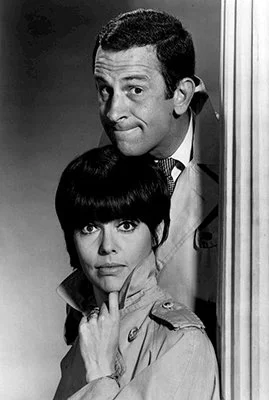
B&W photo of a man and a woman in trench coats

Publicity still of Don Adams as Agent 86 and Barbara Feldon as Agent 99 in the TV series Get Smart

2 May 2026

Eighty-six or 86 originated in restaurant slang with the meaning that an item was out of stock. It also came into use as a verb meaning to cancel an order and to eject or not serve a customer. It then passed into general slang to mean to cancel something or kill someone. Why the number eighty-six was chosen is not known. There are number of explanations floating about, but only two are plausible: that it is rhyming slang or that it is simply an arbitrary assignment of a number in a larger numbering scheme.

Use of eighty-six in diner slang meaning out of stock is recorded as early as 1920 in a 22 October article in the Topeka Daily State Journal:

They were breaking in a new waiter at one of the avenue restaurants. He turned in an order for a small steak, to be met with a curt “eighty-six.” The waiter stared at the cook and repeated the order. “Eighty-six, I toldcha,” roared the cook in so belligerent a tone that the waiter wilted. A brother hash-slinger broke it gently to him that in the argot of the restaurant “Eighty-six” means just what “Thirty” does to a printer—“That’s all. No more to come.”

Several years later, George Manker Watters and Arthur Hopkins’s 1927 play Burlesque contains an exchange where a waiter uses eighty-six, but it seems to be in the opposite sense, that of possessing something in short supply, specifically during Prohibition:

WAITER (opening bottles)—If you need any Scotch or gin, sir.
SKID—Yeah, I know.
WAITER—My number is Eighty-six.
SKID—That’s just Lefty’s age.
LEFTY (stirring in his doze—Ah, you big bum, why don’t you go to bed?
SKID (pays WAITER)—Keep the change.
WAITER—Thank you, sir. Thank you very much, and my number is…
SKID (up at table)—Yeah. Eighty-six. I know (WAITER exits. SKID draws enormous flask from pocket.) Do you want yours straight or highball, Mazie?

Researcher Barry Popik has found two other early uses. The first is in a 10 June 1929 Pittsburgh Post-Gazette article:

The Soda Jerkers’ Code

The young bartenders in one of those big soda emporiums downtown have a secret code. They use it in relaying orders behind the bar. It works much like the waitress’ “Two on a raft!” when she means poached eggs on toast.

When “Burn one!” for instance, is hollered fore and aft, it means the customer’s tongue is hanging out for a chocolate malted milk. Other signals we learned to identify at the rist of indigestion and strawberry rash are:

“Shake one!” (Chocolate milk shake.)
“Shoot one!” (Small coca cola.)
“Stretch one!” (Large coca cola.)
“Ten!” (Root beer.)
“Twenty-one!” (Limeade.)
“Thirty-one!” (Lemonade.)
“Forty-one!” (Orangeade.)
“Fifty-one! (Hot chocolate.)
“Eighty-six! (All out.)
“Eighty-nine!” (Look at the legs under the table.)

The second is in a Walter Winchell newspaper column from 23 May 1933 with a nationwide audience:

A Hollywood soda-jerker forwards this glossary of soda-fountain lingo out there... “Shoot one” and Draw one” is one coke and one coffee... “Shoot one in the red!” means a cherry coke... An “echo” is a repeat order... “Eighty-six” means all out of it... “Eighty-one” is a glass of water... “Thirteen” means one of the big bosses is drifting around... A “red ball” is an orangeade.

By 1947 eighty-six had become a verb meaning to cancel, as can be seen by this item in the 5 February 1947 issue of Variety—a publication famed for its use of slangy headlines—which also shows the term had moved beyond the food service industry:

Jeffries Eighty-Sixed?

Hollywood, Feb. 4.

Disk jockeys test their weight tonight when vocalist, Herb Jeffries, is named initial candidate for jockey’s nix list. He failed to show as promised to substitute for Bob McLaughlin, ill, on pilot’s daily show over KLAC, here. McLaughlin will ask his fellows to play no more Jeffries platters, and has had it indicated by organization sparkers, Bill Anson and Peter Potter that they’ll press the measure at regular meeting tonight.

And by 1978, the meaning of the verb had was also in use to mean to kill a person, as can be seen in this 15 March 1978 Los Angeles Times article about a left-wing activist who had been believed dead turning up alive and well and married to an undercover policewoman:

When later informed by a reporter that official records showed Dial and Miss Milazzo were married, Wells, one of his closest friends’ [sic] expressed mild surprise.

“At least it suggests that the police haven’t 86ed (disposed of) him,” Wells said. “But it still doesn’t resolve the question of whether he was a cop. We’d all like to know.

Various explanations have been put forward for the term. The most plausible is that it is rhyming slang for nix. The only issue with this explanation is the existence of a more comprehensive numbering scheme, as evidenced by the 1929 and 1933 citations. The larger scheme suggests the assignment of this meaning to eighty-six is arbitrary.

Most of the other proffered explanations aren’t worth discussing as there is no evidence to support them, but there is one that comes up so frequently that it needs to be mentioned. This explanation holds that eighty-six comes from Chumley’s Bar at 86 Bedford Street in Manhattan. Chumley’s opened as a Prohibition-era speakeasy in 1922—two years after eighty-six is recorded in print—and closed its doors for the last time in 2020, a victim of the Covid-19 pandemic. The explanation is clearly an after-the-fact attempt to make sense of an arcane term.

Discuss this post


Sources:

Danver, Charles F. “Pittsburghesque.” Pittsburgh Post-Gazette,” 10 June 1929, 8/6. Newspapers.com.

Green’s Dictionary of Slang, accessed 2 May 2026, s.v. eighty-six, adj., eighty-six, v.

“Jeffries Eighty-Sixed?” Variety, 5 February 1947, 46. ProQuest.

Lighter, J. E. Historical Dictionary of American Slang, vol. 1 of 2. New York: Random House: 1994, s.v. eighty-six.

Oxford English Dictionary Online, 1989 (modified June 2025), s.v. eighty-six, n.

Popik, Barry (@barrypopik.bsky.social), Bluesky, 1 May 2026.

Rosenzweig, Dave. “Vanished Leftist Believed Allive, Wed.” Los Angeles Times, 15 March 1978, 1, 26/3. ProQuest Historical Newspapers.

“Snap Shots.” Topeka Daily State Journal (Kansas), 22 October 1920, 6/4. Library of Congress: Chronicling America.

Watters, George Manker and Arthur Hopkins. Burlesque (1927). In Burns Mantle, ed. The Best Plays of 1927–28. New York: Dodd, Mead, 1928, Act 2, 122–45 at 135. Archive.org.

Winchell, Walter. “On Broadway” (syndicated column). Times-Union (Albany, New York), 23 May 1933, 8. NewsBank: America’s Historical Newspapers.

Image credit: NBC Television, 1965. Wikimedia Commons. Public domain image.
hokum

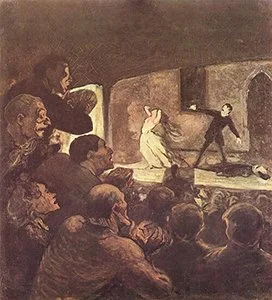
Painting of an enraptured audience watching a play where a body lies on the stage, a woman weeps, and a man points accusingly

“The Melodrama,” Honoré Daumier, c. 1858, oil on canvas

1 May 2026

Hokum is a slang term with two main senses. One is something that is overly sentimental or melodramatic; the other is nonsense, something that is false. Like most slang terms, its origin is a bit mysterious, but the most likely explanation is that it is a blend of hocus pocus and bunkum.

Hokum arises in American theater slang in the opening years of the twentieth century. We see the sentimental sense in the pages of New York’s Evening World of 3 March 1906:

No, I ain’t going out in a musical show. Musical shows are dead cards and you have to carry too many people. I’ve been studying plays that make hits and I’m going to write one myself that won’t be nothing but sure-fire hokum from start to finish.

And we see the false sense of hokum a couple of years later. From Kenneth McGaffey’s 1908 The Sorrows of a Show Girl:

Honest, to hear him spring that sure-fire hokum you would have thought he believed it. I know he passed the same line of dope out to me, and I fell for it.

Since the appearances in print are so close to one another and that the term was undoubtedly in oral use for some time before this, we can’t say which sense came first. They probably arose in tandem, as overly sentimental and nonsense aren’t all that much different from one another.

The adjective hokey and the term hokey-pokey, which has a plethora of meanings, probably influenced the development and use of hokum, but an exploration of those terms will be explored in a forthcoming entry. Hokey is too much work to take on all at once.

Discuss this post


Sources:

Green’s Dictionary of Slang, accessed 13 April 2026, s.v. hokum, n., hokum, adj., hokey, adj.

McCardell, Roy L. “The Chorus Girl.” Evening World (New York), 3 March 1906, 9/4. Library of Congress: Chronicling America.

McGaffey, Kenneth. The Sorrows of a Show Girl. Chicago: J. I. Austen, 1908, 214. Archive.org.

Oxford English Dictionary Online, 1933, s.v. hokum, n.; 1976, s.v. hokey, adj.

Image credit: Honoré Daumier, c. 1858. Wikimedia Commons. Public domain image.

docket / shadow docket

The US Supreme Court as it was composed in 2020–21. Chief Justice John Roberts is seated in the center. The associate justices are, left to right, Samuel Alito, Brett Kavanaugh, Clarence Thomas, Elena Kagan, Neil Gorsuch, Stephen Breyer, Amy Coney Barrett, and Sonia Sotomayor. Nine people in black robes arrayed in front of a red curtained background.

The US Supreme Court as it was composed in 2020–21. Chief Justice John Roberts is seated in the center. The associate justices are, left to right, Samuel Alito, Brett Kavanaugh, Clarence Thomas, Elena Kagan, Neil Gorsuch, Stephen Breyer, Amy Coney Barrett, and Sonia Sotomayor. Nine people in black robes arrayed in front of a red curtained background.

9 September 2021
[Edit: 29 April 2026; 1982 citation added]

The US Supreme Court under Chief Justice John Roberts has taken to deciding a number of highly consequential, and sometimes high-profile, cases via what is called the shadow docket. But what is the shadow docket? And for that matter, what is a docket and where does that word come from?

To answer that last question first, a docket is the filings in a particular legal case or the register of cases in front of a judge or a court.

There is an appearance of the phrase shadow docket in 1982, but it is used in a different, more general sense than how the term is used today. That sense is of a docket of filings of questionable legal merit, such as those that might be filed by a pro se defendant without the advice of legal counsel. It appears in a 29 October 1982 opinion of the Superior Court of Pennsylvania in the case Commonwealth v. Almeida:

On reargument, the Commonwealth has persuaded me that I was wrong, and that “[t]his Court should announce that it will not consider pro se pleadings until these are reviewed by counsel.” Brief for Commonwealth at 16. On reflection, I've concluded that the distinction between pro se arguments that “benefit[ ]” an appellant and those that “pose [a] danger” to him is unsound. Whatever the nature of the argument, by considering it we may, as the Commonwealth suggests, encourage other appellants to submit pro se briefs, which the Commonwealth “will have to decipher and respond to,” thereby “creat[ing] a shadow docket of hundreds of appeals.” Id.

The phrase shadow docket starts being used more widely in the early 2000s but in a slightly different sense and context than it was used in the 1982 Pennsylvania case or as it is currently being used in reference to the Supreme Court. But all these senses refer to items on a court’s agenda that hidden from plain view.

The earliest use that I have found is from the practice of county courts in Florida to not publish or publicize cases that involved those who were influential, rich, or famous. From an editorial in the Tampa Tribune of 21 June 2006:

The local scrutiny comes in response to an investigation by Attorney General Charlie Crist of whether Broward County has a shadow docket featuring prominent people. The existence of the hidden list creates the appearance that some people have received special treatment.

And around 2012, shadow docket was used in New York City courts to denote the list of real estate foreclosures that languished without action on the courts’ dockets because the lenders had stopped filing paperwork. From the New York Post of 15 July 2012:

According to attorneys at the non-profit MFY Legal Services based in Manhattan, plaintiffs by and large could not verify the documents and stopped filing RJIs [Requests for Judicial Interventions], leaving borrowers in limbo in the court system.

A study by MFY in April 2012 found that almost 75 percent of cases filed in Queens and Brooklyn in October 2011—one year after the rule was implemented—were held up in courts in what is known as the “shadow docket.”

Use of the phrase shadow docket in reference to the Supreme Court was first made by law professor William Baude in a New York Times op-ed column on 3 February 2015. Baude uses shadow docket as a synonym for what is more conventionally known as the orders docket. Baude explains:

Mr. Warner’s execution illustrates the high stakes in a crucial part of the court’s work that most people don’t know anything about: its orders docket.

Work at the Supreme Court is divided into two main categories. One is deciding the cases it hears on the merits: the 70-some cases each year that the court selects for extensive briefing, oral argument and a substantial written opinion, sometimes with dissents. These are the cases we hear about in the news.

The orders docket includes nearly everything else the court must decide—which cases to hear, procedural matters in pending cases, and whether to grant a stay or injunction that pauses legal proceedings temporarily. There are no oral arguments in these cases and, as in Mr. Warner’s situation, they are often decided with no explanation.

This docket operates in such obscurity that I call it the “shadow docket.” (I was a law clerk for Chief Justice John G. Roberts Jr. in 2008–9, but these views are solely mine.)

Despite their obscurity, these orders—there are thousands each year, if you count decisions not to hear cases—are significant. Consider the flurry of orders issued in the month before the 2014 election. The court stopped Wisconsin from implementing a strict voter identification law while it allowed a similar law to be implemented in Texas, and it also stopped lower courts from expanding early voting in Ohio or voter registration in North Carolina.

The orders docket exists for good reason. Many procedural decisions are routine, even pro forma, and need no lengthy consideration. Others, such as a decision as to whether executing someone is constitutional, cannot wait for a full hearing, so the court may grant a stay on the orders docket to give themselves time to decide whether it should consider the case on the merits. But when substantive decisions are made in secrecy and with little or no explanation, justice can be short-circuited, lower courts are left in limbo as to what to do with similar cases, and faith in the court is eroded.

Baude claimed coinage in this op-ed, and it is likely that, those being localized uses, he had never seen the term shadow docket before, or at most he was not conscious of having seen them. In any case, he deserves credit for applying the term to the Supreme Court. It is not at all unusual for a term to have multiple related, but slightly different, senses in early usage—different groups will independently coin a term or interpret and apply a term in slightly different ways, before the term settles down into a single, widely accepted meaning.

That explains where the shadow part comes from, but what about docket?

The origin of docket is a bit more uncertain, but it probably comes from the word dock, meaning the fleshly part of an animal’s tail, as opposed to the hair—think of a horse’s tale. The origin of dock is obscure, but the word has cognates in other Germanic languages. The word is first recorded c.1390 in the anonymous poem Sir Gawain and the Green Knight in a passage describing the Green Knight’s horse:

Þe tayl and his toppyng twynnen of a sute
And bounden boþe wyth a bande of a bryʒt grene
Dubbed wyth ful dere stonez, as þe dok lasted,
Syþen þrawen wyth a þwong.

(The tail and his mane were twins of a set, and both were bound with a band of bright green, arrayed with very precious stones, extending to the dock, then drawn up with a thong.)

At around the same time the verb to dock, meaning to cut something short, also appears. From the description of the Reeve in the General Prologue to Geoffrey Chaucer’s The Canterbury Tales:

The REVE was a sclendre colerik man.
His berd was shave as ny as ever he kan;
His heer was by his erys ful round yshorn;
His top was dokked lyk a preest biforn.

(The Reeve was a slender, choleric man. His beard was shaved as close as could be; his hair was shorn all around by his ears; the top of his head was docked in front like a priest’s.)

This verb is still used in reference to cutting animals’ tails. But the verb to dock is also used in reference to cutting or curtailing other things, as in the phrase to dock someone’s pay. This use is also quite old, recorded only a decade or so after Sir Gawain and the Canterbury Tales. It appears in an anonymous, anti-clerical poem titled Jack Upland, set down in 1402. The poem, which draws upon William Langland’s Piers Plowman for inspiration, details exchanges between a man, Jack Upland, and a friar, exposing the corruption in the friar’s order:

And so þou mysse takist Ierom, & lyest on Bernarde,
For Alrede his clerke wrote þis reson
Þat þou mysse layst & dokkist it as þe likiþ.

(And so, you mistake Jerome and lie about Bernard, for Alrede, his clerk, wrote this argument, that you sinfully beat and dock it as you like.)

The word docket appears within a century, meaning a summary or abstract of official proceedings—an abridgement, after all, is a form of cutting. From the Liber niger domus regis Angliae (Black Book of the King of England), which isn’t a list of the those with whom the king has had dalliances, but which sets forth regulations for the governing of the household of King Edward IV. We don’t know exactly when it was written, but it must date to sometime before 1483, the year of Edward’s death:

For the resorte of the comers, as it is before sayde, yf her noble presence be in this courte, then the doggettes in the countyng house bere witnesse bothe of her venit et recessit ad curiam, vel a curia, post prandium sive ante, tociens queeins.

(For the benefit of the arrivals, as has been said before, if her noble presence is in this court, then the dockets in the counting house should bear witness both of her coming and departure to the court, or from the court, before or after dinner, as often the queen likes.)

By the mid seventeenth century, docket had come to mean a registry of legal judgments. We see this sense in the Diary of Samuel Pepys for 12 March 1669. The passage here is longer than it need be, but I couldn’t bear to dock it for reasons that will be clear upon reading:

And here I did set a clerk to look out for some things for me in their books, while W Hewers and I to the Crowne Office, where we met with several good things that I wanted and did take short notes of the Dockets; as so back to the Patent Office and did the like there, and by candle-light ended; and so to home, where thinking to meet my wife with content, after my pains all this day, I find her in her closet, alone in the dark, in a hot fit of railing against me, upon some news she hath this day heard of Deb's living very fine, and with black spots, and speaking ill words of her mistress; which with good reason might vex her, and the baggage is to blame; but God knows, I know nothing of her nor what she doth nor what becomes of her; though God knows, my devil that is within me doth wish that I could.

And on the other side of the Atlantic, docket took on a related, but slightly different, sense, that of a register of pending cases before a court of law. From the minutes of the Pennsylvania General Assembly for 23 March 1790:

Whereas a respectable number of the inhabitants of the western part of York county have, by their petition to this Assembly, set forth, that they labour under very considerable difficulties and inconveniences, in consequence of their being obliged to attend at York-Town as their seat of justice, owing to the great distance many of them are from it, and the crouded situation of the docquet, whereby they are much difficulted to obtain justice.

So, that’s how docket went from an animal’s tail to the agenda before a court of law.

Discuss this post


Sources:

Andrew, Malcolm and Ronald Waldron. “Sir Gawain and the Green Knight.” The Poems of the Pearl Manuscript. Exeter: U of Exeter Press, 2002, lines 191–94, 214. London, British Library, Cotton Nero A.10.

Baude, William. “The Supreme Court’s Secret Decisions.” New York Times, 3 February 2015, A23. ProQuest Historical Newspapers.

Bockmann, Rick. “SE Queens Leads City with 42% of Foreclosures.” New York Post, 15 July 2012, Queens Weekly 16. Readex: America’s Historical Newspapers.

Chaucer, Geoffrey. “General Prologue.” The Canterbury Tales, lines 1.587–90. Harvard’s Geoffrey Chaucer Website.

Com. v. Almeida, 306 Pa. Super. 197, 215–16, 452 A.2d 512, 521 (1982). Westlaw.

“Court Dockets Should Not Be Kept Secret.” Tampa Tribune, 21 June 2006, 12. ProQuest Historical Newspapers.

Heyworth, P.L., ed. “Upland’s Rejoinder.” Jack Upland, Friar Daw’s Reply and Upland’s Rejoinder. Oxford: Oxford UP, 1968, lines 342–44, 112. HathiTrust Digital Archive. Oxford, Bodleian Library, Digby 41.

Liber niger domus regis Angliae; id est, Domus regiae sive aulae Angliae Regis Edw. IV.  (The Black Book of the King of England; that is, the Royal House or Court of the King of England Edward IV.) In A Collection of Ordinances and Regulations for the Government of the Royal Household. London: Jon Nichols for the Society of Antiquaries, 1790, 24. Gale Primary Sources: Eighteenth Century Collections Online (ECCO).

Middle English Dictionary, 2019, s.v. dok, n., dokken, v.  

Minutes of the Second Session of the Fourteenth General Assembly of the Commonwealth of Pennsylvania (23 March 1790). Philadelphia: Hall and Sellers, 1790, 207. Gale Primary Sources: Eighteenth Century Collections Online (ECCO).

Oxford English Dictionary, second edition, 1989, s.v. docket, n.1, dock, n.2, dock, v.1.

Pepys, Samuel. The Diary of Samuel Pepys (12 March 1669), vol. 9 of 10. Robert Latham and William Matthews, eds. Berkeley: U of California Press, 1976, 480–1. HathiTrust Digital Archive.

Shapiro, Fred. “More on ‘Shadow Docket.’” ADS-L, 24 April 2026.

Photo credit: Fred Schilling, 2020, Collection of the Supreme Court of the United States. Public domain image.

buck up

Photo of a male, pygmy goat with black-and-white fur

29 April 2026

Today, buck up usually means to cheer up, to be encouraged. But in the past it was used in a wider range of meanings with the base sense of to become confident and assertive. The metaphor underlying the phrase is the behavior and attitude of a male goat or buck, especially the ram’s assertive behavior when it comes to the females in the flock.

The present-day word buck comes from the Old English bucca, a male goat. In a single late manuscript, buc glosses the Latin cervus, a stag or male deer, but the overwhelming number of uses in Old English mean goat.

The earliest use of buck up that I have found are in the writing of James Kirke Paulding. In his 1828 New Mirror for Travellers, Paulding writes:

Single gentlemen of a certain age should beware how they “buck up” to widows, unless they have previously brought themselves, as Lady Macbeth—who was undoubtedly a widow when Macbeth married her—says, “to the sticking place,” that is, to the resolution of committing matrimony at a moment’s warning. Your widows, if they mean to marry again at all, never like to linger on the funeral pyre of a bachelor’s indecision.

And a few years later, Paulding’s 1831 The Dutchman’s Fireside has this:

The noisy, but well-meaning Ariel, made matters still worse, by occasionally urging the young man to “buck up,” as he called it, to the young lady, and show his breeding.

And buck up could mean to smarten up, to dress in finer clothes, especially when courting the ladies. There is this from Ohio’s Jefferson Democrat of 29 August 1832, an article which assumes the character and dialectal spelling of a country bumpkin, which was a newspaper trope of the era (cf. okay):

I seed her at church one day fixed up kinder pretty snug; so says I to myself; I recon that aint a slow kind of bit furniture, and darn [dam?] my sealskin pumps if I don’t buck up to her next First-day; she’s a dreadful nice gal I tell you.

But early use wasn’t confined to America. The following appeared in London’s New Sporting Magazine of July 1833 in “A Trip to Paris with Mr. Jorrocks,” written by “A Yorkshireman,” where buck up is used in the cheer-up sense we’re used to today:

That’s right, Colonel, you are yourself again; I always thought you would come back to the right course; and now you are good for a glass of claret or light hermitage. Come old boy, buck up, and give a loose to pleasure for once in your life, and may you never know what it is to want, as the beggarboys say.

But buck up could also mean to pay or provide support for. An ad in the Norwich, New York’s Anti-Masonic Telegraph of 22 January 1834 uses it in a warning to those who have not paid their debts to the advertiser:

Buck Up.

All persons indebted to the subscriber, must pay up before the 20th of February, or they will be dealt with according to the revised statutes, (and a number of dull ones will get a job before that time.)

All that have promised grain, wood, or Lumber, must redeem their promise before the first of February, or cash well [sic] be required.

JAMES M. D. CARR
Norwich, Jan. 15, 1834.

The ad continued to run in the paper through June (always with the due date of 20 February), indicating that not many actually bucked up and paid Mr. Carr.

And the Pennsylvania Republican of 23 March 1842 ran a similar ad aimed at subscribers who had not paid their bill:

BUCK UP!

The Banks have resumed Specie Payments they say, and of course the HARD STUFF is plenty! We beg leave very disinterestedly of course, to advise those who owe the printer, of the fact, that the First of April is close at hand, and that therefore now is the time to “BUCK UP THE READY DOWN JOHN DAVIS,” either in specie or notes!—“we’re no ways particular which!!” Money we WANT—Money we MUST HAVE—so look out!

The support sense could be political as can be seen in this from Ohio’s Elyria Republican of 19 February 1835:

[…] and the Hon. Benjamin Tappan of Ohio. Out of this long list of candidates, the convention cannot but select a proper man. They are all “good men and true.” We have no like or dislike to express. But if urged into an expression, we should have no objection to buck up for the last named gentleman.

Or it could mean to support the downtrodden. From the Baltimore Sun of 12 August 1837:

And finally we have known men who would praise the press, and patronize the printer; but who would be among the last to signify or buck up the needful.

The earliest citation of buck up in the Oxford English Dictionary (in an old, yet-to-be revised entry) is from Joseph C. Neal’s short story “Silverton Shakes,” which was serialized in Philadelphia’s Spirit of the Times. In this appearance it returns to the sense of having confidence when courting women. From the 20 December 1843 issue of that paper:

“They’ve got free schools and high schools and universities and colleges—they learn to cypher—to read languages—to understand mathematics and all sorts of things—comparatively useless things—but who is taught confidence—that neat kind of confidence which don’t look like confidence. […] Isn’t it doleful?”

“Very,[”] said Shiverton, mournfully.

“Well, now, for my part, I don’t see the trouble,” said Mrs.Fitzgig; “why can’t a man buck up?”

“Nor I,” added Miss Jemima Fitzgig, who wanted to be Mrs something. “It is the easiest thing in the world to get along, especially among the ladies,” and she glanced tenderly at Mr. Dashoff Uptosnuff.

“You must make an effort, Shiverton—one plunge and all will be over—go to Marygold’s determined on boldness. Sooner or later, you must begin. It is impossible to dodge in this way forever.”


Sources:

“Buck Up.”  Anti-Masonic Telegraph (Norwich, New York), 22 January 1834, 3/2. Readex: America’s Historical Newspapers.

“Buck Up!” Pennsylvania Republican (York), 23 March 1842, 3/1. Newspapers.com.

Dictionary of Old English: A to Le, 2024, s.v. bucca, bucc, n.

Elyria Republican (Ohio), 19 February 1835, 1/5. Readex: America’s Historical Newspapers.

Green’s Dictionary of Slang, accessed 12 April 2026, buck up, v.2, buck up, excl.

“Joe Bunker’s Story.” Jefferson Democrat (Steubenville, Ohio), 29 August 1832, 1/3. Readex: America’s Historical Newspapers.

Neal, Joseph C. “Shiverton Shakes.” Spirit of the Times (Philadelphia), 20 December 1843, 1/6. Readex: America’s Historical Newspapers.

Oxford English Dictionary, 1888, s.v. buck, v.7., buck, n.1.

Paulding, James Kirke. The Dutchman’s Fireside, vol. 1 of 2. New York: J. & J. Harper, 1831, 25. HathiTrust Digital Library.

———. New Mirror for Travellers. New York: G. & C. Carvill, 1828. HathiTrust Digital Library.

“We Have Known, and We Have Not Known.” Sun (Baltimore, Maryland), 12 August 1837, 2/1. Readex: America’s Historical Newspapers.

Yorkshireman, A. “A Trip to Paris with Mr. Jorrocks.” New Sporting Magazine (London), 5.27, July 1833, 207. ProQuest Historical Periodical.

Photo credit: Stuart Caie, 2009. Wikimedia Commons. Licensed under the Creative Commons Attribution 2.0 Generic license.

college widow

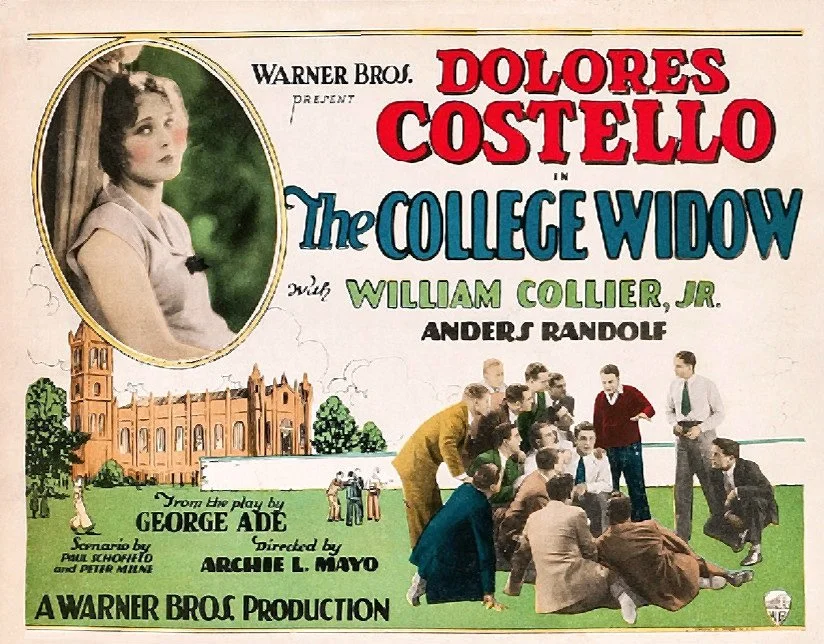
Advertisement for a film with photographs of a young woman and of a group of young men against a collegiate background

Lobby card for the 1927 film The College Widow, starring Dolores Costello

27 April 2026

College widow is a term you don’t hear anymore, except in historical usage. It harkens back to a time when only men attended university and short-lived love affairs between the male students and female residents of college towns were common.

A college widow was often, but not always, an older woman. Whether she was a naïve romantic wronged by a series of men or a predatory cougar using and discarding the students varies with the perspective of the user of the term.

The term is an Americanism dating to the middle of the nineteenth century. (The Oxford English Dictionary has an 1829 citation for college widows, but that seems to be a nonce collocation of the words in a different sense, that of a charitable institution.) The earliest I have been able to date it to is a piece entitled “An Old Maid’s Soliloquy” that appeared in the Temperance Crusader of Penfield, Georgia on 15 March 1856 that very succinctly defines the term college widow:

Twenty years have I been on the carpet. I have had numerous suitors, and visitors without number. I have been besonnetted by poetical geniuses in almost every class graduated since my debut. Yet despite of all this, I am a “college-widow” with as little prospect as ever of being comforted in my widowhood.

I particularly like the use of "besonnetted."

And on the same day, this appeared in Pennsylvania’s Sunbury American:

Was there any mental stimulant, such as love, hate, remorse, that I had not tried? No. I hated every body. I had been in love with all the “college widows,” and several beside.

A few years later, on 2 April 1859, this piece appeared in Illinois’s Springfield Daily Republican advising a young man who was disenchanted with the affections of college widows to switch schools to a seminary where he would learn the Christian benefits of the institution of marriage:

Meanwhile, this case of yours is easily sealed. I understand it all. You conceived a disgust for the college widows of your Alma Mater. I plead guilty to the same soft impeachment. You have come home and generously[?] distributed your dislike for a few over the best half of creation; I went to the seminary a year ago, and have been purged of mine most effectually. You should go to the seminary, sir. Capital place, that, to dissipate your monkish notions, and to impress upon your mind the sacredness and blessedness of that good old Gospel institution, wedlock; with all the beneficial appurtenances which do either accompany or flow therefrom.

The Bomb, a humor magazine of Middlebury College in Connecticut published this poem on “flamming” in its 24 April 1860 issue:

In college halls this word is found;
The college walls this word resound;
By college boys is flamming done;
From this do “college widows” come.
“But flamming! pray what may it mean?”
Is asked quite oft by Freshmen green;
[…]
The student claims with all his heart
To love the maid—that ne’er must part;
But when his college course is done,
He’ll seek for her and him a home;
And there they’ll live in constant bliss;
The vow is sealed by mutual kiss.

It happens oft by such pretensions,
He shields at first some vile intentions.
At best, for her no more he cares,
Than she herself for what she wears;
For swiftly as the fashions glide,
Old robes are shed and new ones tried;
So students oft their flams arrange;
That every year they make a change.

The 21 March 1861 issue of the Democrat and Reflector of Schenectady, New York has this that bemoans the fate of such wronged women:

“College Widows.”—To go into mourning in the spring time is peculiarly incongruous. Sad must be the heart that bleeds amid the birds caroling. […] Their mammas told them students could not always be trusted, but who could believe mamas against a mouse—tach? “A look so young—so ingenious—so kind?” “I told you he was only flirting.” Well, term has ended—he is not even coming to commencement! Oh! O is he gone! Lucinda calls on Julia—Julia calls on Cecilia, all are weeping.—Let us go to society meeting to-night Boys part—well primed—last drink “To the College Vidders.”

This piece in Massachusetts’s Pittsfield Sun of 28 May 1863 casts the archetypical local gossip and scold, Mrs. Grundy, as a college widow; one speculates that perhaps she acquired her prudish attitude as a result of being wronged by a series of young men:

However, we would not have you believe that nothing at all has happened, that Williams, buried in her winter’s snows, has been in a state of grand lethargy like the hibernation of bears, that for the past three months the numerous ladies of the place have lived wholly without anything to talk about, for that would be impossible. Mrs. Grundy, though quite a college widow, still has managed to exist through the winter.

Finally, there is this letter of 1 October 1869, published in the Detroit Free Press a few days later, that turns the table and casts the young student as the wronged party. It is my favorite of all these early examples. Not only does it use the term anchorite, which excites the medievalist in me, but the description of his rival for the woman’s affections as a “long-haired resident ‘lit.’” is simply delightful:

Ann Arbor is renowned not only for her natural charms and educational advantages, but also for the beauty and amiability of her fair daughters, and for their devotedness to their loves. It isn’t considered the correct thing for any young lady to accept over a dozen proposals during one winter, and it’s a breach of etiquette for her to maintain over three matrimonial engagements at one and the same time. Some of these “naughty, naughty girls” are the most “engaged” as well as the most engaging young persons that it ever was my misfortune to meet; and he must be an Anchorite indeed who can hope to resist their charms. Some one has had the malignity and ungallantry to style these young ladies “college widows,” which perhaps is no misnomer after all. Last night I went to see my college widow, the faithful young angel who during the past few months has consumed quire after quire of monogram paper in imparting to me the “inexpressible loneliness” which she experienced in my absence, and the “anxious longing” with which she looked forward to my return to the classic shades of Ann Arbor, but who I now find has been consoling herself in my absence in the delectable society of “Buggs,” a long-haired resident “lit.,” whom she knows I never could tolerate. However, not that I am enabled to look after my case in person I shall enter a “demurrer,” or demand a “nolle prosequi.” [unwillingness to continue]


Sources:

“College Widows.” Democrat and Reflector (Schenectady, New York), 21 March 1861, 2/4. Readex: America’s Historical Newspapers.

“Flamming.” The Bomb (Middlebury College, Connecticut), 24 April 1860, 6/1. Newspapers.com. (Metadata mistakenly credits this to the Bennington Banner, Vermont.)

Green’s Dictionary of Slang, accessed 11 April 2026, s.v. college, n.

“Letter from Williamstown.” Pittsfield Sun (Massachusetts), 28 May 1863, 1/4. Readex: America’s Historical Newspapers.

“An Old Maid’s Soliloquy.” Temperance Crusader (Penfield, Georgia), 15 March 1856, 2/3. NewspaperArchive.com.

Oxford English Dictionary, March 2026, s.v. college widow, n.

“A Story about Love and a Fortune.” Springfield Daily Republican (Illinois), 2 April 1859, 6/1–2. Readex: America’s Historical Newspapers.

“The Terrible Tree.” Sunbury American (Sunbury, Pennsylvania), 15 March 1856, 1/2. Newspapers.com.

“The University. A Gossipy Letter from ‘Athens’” (1 October 1869). Detroit Free Press (Michigan), 4 October 1869, 4/3. ProQuest Historical Newspapers.