looksmaxxing / -maxxing

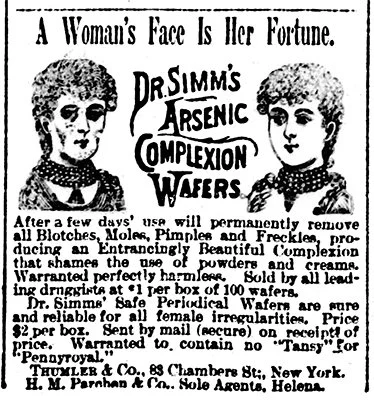
1889 newspaper ad for “Dr. Simm’s Arsenic Complexion Wafers,” a “proven harmless” skin-lightening treatment

27 July 2026

Looksmaxxing is the practice of using aggressive, and sometimes dangerous, methods to improve one’s physical appearance. Methods range from improved grooming habits to extreme cosmetic surgery procedures. The term grew out of the incel community, which tends to believe that appearance is the only, or at least overwhelming, factor in attracting women.

The term also has given rise to the combining form -maxxing, which has been applied in many other contexts. A few examples: baldmaxxing (embracing one’s baldness), proteinmaxxing (increasing protein in one’s diet), tokenmaxxing (enhancing AI performance), travelmaxxing (getting the most out of a vacation).

But we have uses of the maxing/maxxing suffix from before the appearance of looksmaxxing. There is this tweet from 2013 that uses bench maxing in the context of weightlifting:

Still riding this adrenaline high from bench maxing #PlatesOnPlates #GrabOneWeEatin #SwolePatrol #DoYouEvenLiftBro

The earliest use of looksmaxxing that I’m aware of is in a title of a discussion forum on Lookism.net. The forum Looksmaxing (written with one <x>) has a first post on 29 June 2015.

And on 8 November 2015 an anonymous user posted the following bit of sage advice to incels on 4chan that uses the double <x>:

try limiting your internet use to 1-3 hours a week, nofao, no porn, no vidya, no anime. study standup comedy, buy nice clothes, exposure therapy by forcing through your social crippledness talking to random people, get fit, looksmaxx your face.

never be yourself.

To which another anonymous user replied:

Getting fit wont fix your ugly face
Looksmaxxing is pure snake oil
G E T O U T N O R M I E

Another early use is on a now-deleted incel subreddit from 26 February 2016:

I'm looksmaxxing harder than anyone on this forum, and doing everything I can to go from nervous paranoia to being as low-inhibition as humanly possible.

after these things are theoretically achieved i have no clue what happens next. I'll be going to school next year, i guess that'd be last opportunity to become "normal" but I relate to no one anyway so eh who gives a shit

And the subreddit r/acne has this from a few months later, on 16 May 2016:

Because I think it is worth the risk and liver damage...

What the 10 years of my 20s taught me was that looksmaxxing is what we all should be doing... There was a night and day difference between how I was treated when I had totally clear skin (early to mid 20s) after my 2nd course of accutane and how I have been treated in the past 4 years or so.

Quality of life and not quantity is what I am aiming for now.

By 2020, the term was being discussed in mainstream media. From the New York Times Magazine of 23 August 2020:

Many self-identified incels have a highly mechanistic understanding of human relationships and believe they can improve their station in the sexual hierarchy through a practice called “looksmaxxing”: enhancing one’s sex appeal through weight lifting, skin and hair treatments and even plastic surgery.


Sources:

4chan. /r9k/ - ROBOT9001, 8 November 2015. Desuarchive.org.  

Bower, Quinn (@Q_Bower28). Twitter.com (now X.com), 25 October 2013.

Brennan, William. “Bite Club.” New York Times Magazine, 23 August 2020, 22–27, 47, 49 at 26/2. ProQuest.

DerPhilosoph. “Starting a 3rd Course of Accutane…” Reddit.com/r/acne, 16 May 2016.

“Looksmaxing” (title). Lookism.net, 29 June 2015. Archive.org.

Merriam-Webster, 24 February 2026, s.v. looksmaxxing, n.

“Other Than Suicide, What Our Plans for Getting Out of This?” Reddit.com/r/ForeverUnwanted, 26 February 2016. (The subreddit has been deleted, but the post is available via PullPush.io search)

O’Toole, Garson. “Re: looksmaxxing (2016).” ADS-L, 3 July 2026.

Zimmer, Ben. “Re: looksmaxxing (2016).” ADS-L, 3 July 2026.

Image credit: Helena Independent (Montana), 9 November 1889, 7. Newspaperarchive.com. Public domain image.

Mrs. Grundy

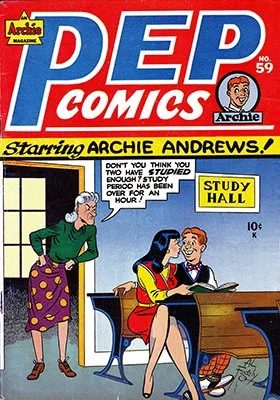
Cover of an Archie comic with teacher Miss Grundy looking disapprovingly at Archie & Veronica sitting together in study hall

 Pep Comics, #59, October 1945

24 July 2026

Mrs. Grundy is a proverbial character, a scold and purveyor of society’s moral sentiments. She has her origin in Thomas Morton’s play Speed the Plough, penned in 1798 and first performed in 1800. While largely forgotten today, the play was enormously popular in its day. Multiple characters refer to her throughout the comedy, although she herself does not appear on stage—fittingly, the threat of moral judgment looms unseen, off stage—and the line “What will Mrs. Grundy say?” is repeated several times during the play.

Here’s an instance from Act 1, Scene 1, in which Farmer Ashfield and his wife are talking:

Dame. And I assure you Dame Grundy’s butter was quite the crack of the market.

Ash.. Be quiet, woolye? aleways ding, dinging Dame Grundy into my ears—what will Mrs. Grundy zay? What will Mrs. Grundy think?—Casn’t thee be quiet, let ur alone, and behave thyzel pratty?

And another from Act 4, Scene 1:

Ash.. How many silk gowns have thee got, Dame?

Dame. Three, Tummas—and sell them all—and I’ll go to church in a stuff one—and let Mrs. Grundy turn up her nose as much as she pleases.

References to “What would Mrs. Grundy say?” start popping up shortly after the play’s debut. Here’s one from Francis Lathom’s 1803 novel, Very Strange, But Very True!:

“Oh Lord,” exclaimed Lady Catherine with a sigh, “I cannot bear marrying out of a church; it is a thing I can’t bear to see.”

“Oh don’t get up,” replied his lordship, “we can get on very well without you.”

“Not get up sir!” rejoined her ladyship, “strange indeed if my own daughter was to be married under my own roof, and I not present at the ceremony.”

“Aye, what would Mrs. Grundy say to that?” cried Sir Luke with an arch smile at Jane.

“Spare your jests, son, if you please,” replied her ladyship, “none of your jokes out of plays upon me, they are out of place and out of person.”

Or this one, from Amelia Opie’s 1809 short story, The Uncle and Nephew:

Fear of what the world may think will never, I trust, deter us from acting prudently: indeed, my dear Charles, I hope that neither you nor I shall be in the habit of exclaiming, like the woman in the comedy, “But what will Mrs. Grundy say?”—No, no, we will have no Mrs. Grundies; or rather, you shall be my Mrs. Grundy, and I yours.

There were even songs about it. Here’s a 22 July 1810 advertisement for a theatrical revue that appeared in London’s Observer:

NEW COMIC PANTOMIME.
AQUATIC THEATRE, SADLER’s-WELLS.

To-morrow (Monday, July 23), and following Evenings, a New Dance, composed by Mr. Grimaldi, Called THE BOLD SERGEANT.—A New Comic Pantomime (including four Scenes from three of the Author’s most popular Pantomimes), with new Music, Scenery, &c. […] Songs in the Pantomime: “Bang up,” sung by Mr. A. Slader […] and “Tea-table Talk; or, What’ll Mrs. Grundy say?” sung by Mr. Grimaldi.

And not to be left out, here’s a North American use of the phrase from Philadelphia’s National Recorder of 18 November 1820:

“What will Mrs. Grundy say?” is the constant exclamation of some of our ultrapatriots. If any abuse in or governments or any striking instance of depravity is pointed out, there is an immediate reference to the opinions that foreigners will have of it, and it is often said that it is better to hush up any disgraceful matter as quietly as we can.

It is a testament to the power of peer pressure and society’s moral judgments that Mrs. Grundy lives on, long after Morton’s play is forgotten by all except those who study eighteenth-century drama.

Discuss this post


Sources:

“The American Character.” National Recorder (Philadelphia), 18 November 1820, 1.1. ProQuest Magazines.

Lathom, Francis. Very Strange, But Very True! or, the History of an Old Man’s Young Wife, vol 3 of 4. London: A. Strahan for T. N. Longman and O. Rees, 1803, 70–71. Gale Primary Sources: Eighteenth Century Collections Online.

Opie, Amelia Anderson. “The Uncle and Nephew.” Simple Tales, vol. 4, third edition. London: Longman, Hurst, Rees and Orme, 1809, 12. Gale Primary Sources: Nineteenth Century Collections Online.

Morton, Thomas. Speed the Plough (1798), fourth edition. Dublin: William Porter, 1800, 1.1, 5–6 and 4.1, 52. Gale Primary Sources: Eighteenth Century Collections Online.

“New Comic Pantomime” (advertisement). Observer (London), 22 July 1810, 3/3. ProQuest Newspapers.

Oxford English Dictionary Online, 1900, s.v. Grundy, n.3.

Image credit: Pep Comics, #59, October 1945. Archiecomics.com. Fair use of low-resolution copy of a copyrighted image to illustrate the topic under discussion.

blog

Screenshot of a blog template with the title “A WordPress Weblog,” a generic picture, and a first post titled “Hello world!”

An empty WordPress blog template, 2010

20 July 2026

[22 July 2026: added discussion of Evan Williams and Pyra Labs]

A blog, as most of you probably know, is a website where a writer posts commentary, reflections, and personal anecdotes. It can also be a portion of a commercial website that provides product updates and commentary. And, as most of you also probably know, blog is a clipping of weblog. Weblogs and blogs became a thing in the closing years of the twentieth century.

There is, however, a slightly older and semantically unrelated sense of web log. That is an automatically produced file that records all traffic to and from a web server. This older sense dates to at least 3 November 1993, when “Web log” appears in the title of a post to the Usenet group comp.infosystems.www.

But the more familiar sense of weblog is in place by 23 December 1997 when Jorn Barger used the term in the URL for his commentary website:

After talking a lot about Frontier and Scripting News (www.scripting.com), I decided to start my own webpage logging the best stuff I find as I surf, on a daily basis:

URL:http://www.mcs.net/~jorn/html/weblog.html

This will cover any and everything that interests me, from net culture to politics to literature etc.

Appearance in URL is one thing, but weblog appears some nine months later in a Village Voice article of 8 September 1998 that refers to Barger’s website:

Jorn Barger's Robot Wisdom WebLog (mcs.net/ -jorn/html/weblogs/weblog.html) might not be pretty, but it's one of the best collections of news and musings culled from the Web-and updated daily

And the clipped form blog appears the next year on 19 May 1999 when writer and web guru Peter Merholz used the term and the term blogger, for one who writes a blog, on his own blog:

Blog coverage continues apace. Scott Rosenberg favorably contrasts bloggers to traditional journalists.

For those keeping score on blog commentary from outside the blog community, there's:
- JonKatz at Freedomforum
- JonKatz at Slashdot
- Dan Gillmor discussing Slashdot
- Smug on weblog-rolling

So when do we inevitably ascend to the next meta level, covering the blog coverage?

In the sidebar to his website, Merholz included the statement that may be an earlier use of blog, “I've decided to pronounce the word ‘weblog’ as wee’- blog. Or ‘blog; for short.” Exactly when he wrote this is uncertain, but it was between 4 May 1999 and 2 March 2000, the bracketing captures on Archive.org.

Merholz is often given credit for coining blog, and that may very well be true. But it seems likely that the word was “in the air” at the time, and Merholz was merely the first person to put it down in writing that survives—and that only because of Archive.org’s Wayback Machine.

Evan Williams is often credited with coining blogger, and as with the claim about Merholz’s coinage of blog, this may be true, but again it is also possible, even likely, that multiple people independently coined the term at about the same time. Williams was co-founder of Pyra Labs, which launched the blogging software product Blogger on 23 August 1999. The domain name blogger.com was registered by Pyra Labs on 22 June 1999. But the tool was in use as an in-house tool for some time before this, so we don’t know exactly when Pyra Labs started using blogger. Whether or not Williams was the first to coin the word, Pyra Labs’s Blogger product greatly contributed to the popularity and spread of the word.

Regardless of who coined the terms, both blog and blogger came into use in the spring of 1999.

Discuss this post


Sources:

Baker, John. “Origins of ‘Blog’ and ‘Blogger.’” ADS-L, 20 April 2008.

Barger, Jorn. “Lively New Webpage.” Usenet. comp.ai, 23 December 1997.

Bunn, Austin. “Machine Age: Can the Web Be a Model for Real-World Race Relations?” Village Voice (New York City), 8 September 1998, 33/3. ProQuest Newspapers.

Hughes, Kevin. “Announcing getsites 1.5, a Web log analyzer.” Usenet: comp.infosystems.www, 3 November 1993.

Merholz, Peter. “For What It’s Worth.” Peterme.com, between 4 May 1999 and 2 March 2000. Archive.org.

———. Peterme.com (blog), 28 May 1999. Archive.org.

Oxford English Dictionary Online, March 2003, s.v. blog, n., blog, v.; June 2017, weblog, n.

Image credit: Uusijani, Wordpress.org, 2010. Wikimedia Commons. Licensed under the GNU General Public License.

botulism / botox

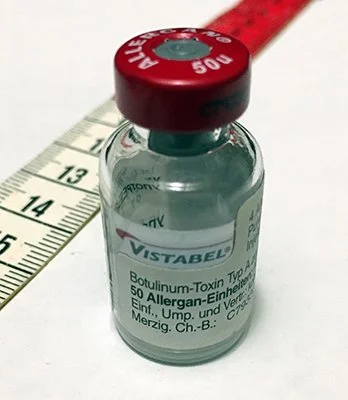
Photo of an ampoule of botulinum toxin

22 July 2026

Botulinum toxin is a neurotoxic protein produced by the bacterium Clostridium botulinum. It is generally considered the deadliest poison known to humanity, and in years past had been developed as a biological weapon by the United States, the Soviet Union, and Iraq. Despite its toxicity, it has medical and cosmetic applications, used to reduce the symptoms of dystonia (involuntary muscle contractions) and to reduce wrinkles in the skin due to aging. The disease it causes is botulism, and the name of the toxin is commonly clipped to botox. The clipped Botox has been trademarked, but use predates the application for a US trademark by several years.

The name comes from the Latin botulus, meaning sausage, as the disease was first recognized as coming from tainted wurst. It is a calque of German pharmacologist Johann Andreas Buchner’s 1827 coinage Würstfettsaüre (literally, sausage fat acid).

We first see the term Botulinic acid in Robert Christison’s 1832 Treatise on Poisons:

Although it does not possess an acid reaction on litmus, it forms a soap with alkalis, and is separated again by acids unchanged; and consequently it may be considered a fatty acid, to which Buchner proposes to give the name of Botulinic acid (Würst-fett-saüre). It concentrates in itself the poisonous properties of the crude sausage.

The name of the disease, in the form botulismus, appears in the Eclectic Medical Journal of June 1858:

Botulismus (poisining [sic] by sausages) is recognized by the occurrence of giddiness and stupefaction, dryness and livid coloration of the conjunctiva, angular arrangement of the edge of the pupils, pain in the eye-balls, and paralytic condition of the eye-lids. Comatose drowsiness, burning in the throat, difficulty in swallowing, obstinate constipation, exfoliation of the epidermis, asphyxia, or slight convulsions, precede death.

And we see the form botulism by the end of the nineteenth century. From the Clinical Journal of June 1899:

ILLNESS CAUSED BY THE BACILLUS BOTULINUS.

The only account we have as yet of an outbreak, which has been proved to have been caused by this organism, is due to its discoverer, Professor van Ermengem. The symptoms of the illness, however, are so characteristic that this author has been able to collect a number of accounts of other outbreaks, which were probably due to the same or some similar microbe. This disease or botulism is quite different in its nature from the disease which we have just been discussing. The Bacillus enteritidis acts largely by its great power of causing a general infection, whilst the Bacillus botulinus be- longs apparently more to the toxic type of disease germs, like that of tetanus. The outbreak in which the B. botulinus was discovered occurred amongst the members of a musical society, who supped together; the incriminated victual was a ham.

And we see the phrase botulinus toxin a few years earlier. From the British Medical Journal of 27 November 1897:

The authors think as the results of their investigations that microbes of the coli type have nothing to do with meat poisoning, but that the poison produced by decomposing albuminous substances is due to microbes not yet discovered. From decomposing blood they have isolated by the Brieger-Boer method a very deadly poison. Thus, suspected food should be examined by this method. The authors refer to one suspected case which the examination proved to be a sepsis due to the streptococcus. Botulinus toxin given to animals in nonlethal doses eventually produces a fatal cachexia, with paralysis and degeneration of the parenchymatous organs.

Botulinum toxin is in place by 1923 when it appears in a University of Illinois publication:

Two samples of spinach supposedly related to illness in man, upon examination indicated the presence of C. botulinum toxin. Cultures of the spinach yielded type A Clostridium botulinum.

Finally, the clipped form BoTox appears in a 1981 conference presentation:

The site of action of BoTox is at the pre-terminal cholinergic motor neuro-fibril.

And throughout the 1980s botox makes its appearance in medical journals for treatment of various types of dystonia. From an abstract published in the journal Neurology in April 1986:

Medical or surgical treatment of focal dystonia usually results in an incomplete response or has unacceptable complications. We evaluated local injections of botulinum toxin-A (Botox) to treat focal dystonia.

And in a letter to the journal Laryngoscope published in November 1986:

We recently read with interest the letter in your column from Dr. G. J. Spector. We would like to share our experience using botulinum toxin (BOTOX) for the treatment of “spastic dystonia” as part of a trial of toxin injections for the treatment of other cranial dystonias. The clinical syndrome of “spastic dystonia” includes patients with focal dystonia of the larynx, in addition to patients with essential tremor and other movement disorders of the larynx.

In 1987 doctors started using botox cosmetically, at first to treat paralysis resulting from cosmetic surgery and within a few years for aesthetic purposes. The first application for Botox as a trademark was filed in 1990.

Discuss this post


Sources:

Ball, A. P., M. Snow, and R. Paul. “Use of 4-Aminopyridine in Human Botulism” (1981). In P. Lechat, S. Thesleff, and W. C. Bowman, eds. Aminopyridines and Similarly Acting Drugs: Effects on Nerves, Muscles, and Synapses. Oxford: Pergamon, 1982, 297.

Blitzer, Andrew, et al. Letter. Laryngoscope, 96.11, November 1986, 1300–01. Wiley Online Library.

BOTOX (trademark). United States Patent and Trademark Office. Serial # 74126661. Registration # 1692384. Filed: 21 December 1990. Registered: 9 June 1992.

Brin, Mitchell F., et al. “Injections of Botulinum Toxin for Treatment of Focal Dystonia” (abstract). Neurology, 36.4, Supplement 1, April 1986, 120.

Christison, Robert. A Treatise on Poisons, second edition (1831). Edinburgh: Adam Black, 1832, 559. HathiTrust Digital Library.

Davenport, Eugene. Thirty-Fifth Annual Report, Agricultural Experiment Station, University of Illinois, for the Year Ended June 30, 1922. Urbana Illinois: U. of Illinois, 1923, 18. HathiTrust Digital Library.

Durham, Herbert E. “Acute Infections Due to Unsound Meat.” Clinical Journal, 14.7, 7 June 1899, 109–112 at 112. HathTrust Digital Library.

“An Epitome of Current Medical Literature. British Medical Journal, 27 November 1897, 85/2–3. HathiTrust Digital Library.

Oxford English Dictionary Online, June 2016, s.v. botulism, n., botulinum, n., Botox, n., botulinic, adj.

“The Uræmic Convulsions of Pregnant, Parturient, and Lying-In Women.” Eclectic Medical Journal, June 1858, 249–56 at 254. HathiTrust Digital Library.

Photo credit: Pittigrilli, 2023. Wikimedia Commons. Licensed under the Creative Commons Attribution 4.0 International license.

scrub / shrub

Photo of a newspaper clipping of a baseball league’s standings

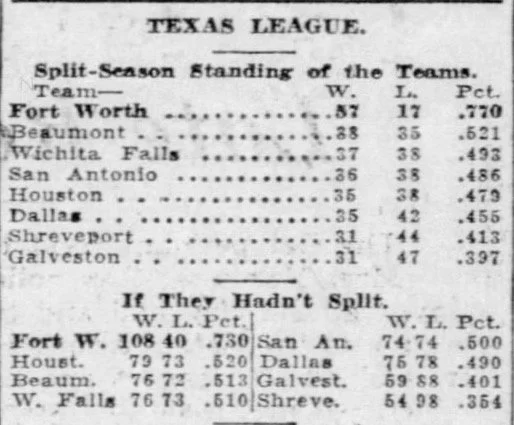
Standings of baseball’s Texas League, one of the minor leagues, as of 14 September 1934

17 July 2026

[Edit 20 July: added paragraph on the sound change in Middle English]

The nouns scrub and shrub are essentially variants on the same word. They both come from the Old English scrybb, meaning bushes or brush. In addition to literal meaning of low or stunted plant growth, scrub has been applied to small breeds of cattle, in a figurative use referring to a low or disreputable person, and in North American colloquial speech to a second-tier athlete.

The /ʃ/ or /sh/ pronunciation developed in Middle English. As a general rule, an initial /sk-/ sound in a Present-Day English word indicates the word is not originally from Old English, most often a borrowing from Old Norse in the late Old English or early Middle English period. An exception to this rule is the initial /skr-/, a combination rarely found in Old Norse, which indicates an Old English root. The shift from /skr-/ to /ʃr/ is a regular sound change and resulted in the creation of two different forms in several other word pairs: shred/screed from the Old English screade and shrew/screw from the Old English screawa, for example. (Screw here is an English dialect term for the animal.)

The verb to scrub, meaning to clean, comes into English from a different source and is etymologically unrelated. It’s a fifteenth-century borrowing from either the Middle Dutch or Middle Low German schrubben, originally meaning to curry a horse.

The Old English scrybb, meaning brush, only appears once in the extant corpus. It’s in the will of Ælflæd, daughter of King Edmund I and Æthelflæd of Damerham, dated c. 972. Scrybb appears in a section of the will demarcating land boundaries. While such legal documents are primarily in Latin, sections describing geographic boundaries are typically in English:

Ðis synd þa landmearca to Byligesdyne. […] of the stanstræte &lang scrybbe þ[æt] hit cymð to Acantune.

(These are the land-boundaries at Bilson. […] From the stone-road along the scrub until it comes to Acton.)

We can see the split between scrub and shrub in John Trevisa’s translation of Bartholomæus Anglicus’s De proprietatibus rerum. Trevisa uses both forms in book 17 of the work, which describes herbs and plants. One passage reads:

Balsamum is a tree oþer a scrub þat neuere growiþ passyng þe height and quantite.of tweye Cubites, as Isider seiþ.

(Balsum is a tree or a scrub that never grows beyond the height and measure of two cubits, according to Isidore.

And another reads:

A busshe hatte rubus and is þikkenesse of þornes and of breres, and of oþer sshrubbes and prikkes whanne (he) groweth in a place yfere, as Ysider seith.

(A bush that is called rubus is a thicket of thorns and briars, and of other shrubs and pricks when it grows in a place with them, according to Isidore.)

Scrub is applied to small breeds of cattle in the sixteenth century. And it comes to mean a low or disreputable person in the seventeenth. From a 1687 translation of Cervantes’s Don Quixote:

And now they were got into the open Plain, at what time they discover'd the three Countrey Girls within a Stone's throw. Upon which, Don Quixote casting his Eyes towards Toboso, and seeing no other then these three Tatterdemallions upon the Road, strangely dejected in Spirit, quo he to Sancho, Was the Princess come forth of the City, when you left her? How d' ye mean forth of the City, quo Sancho?— Where be your Eyes? i' the Nape of your Neck? I see nothing, Sancho, quo Don Quixote, but three tatter'd Scrubs upon three ragged Colts.

And this sense of a disreputable person came to refer to a low-quality or ad hoc baseball team in North America of the mid nineteenth century. We see it in phrases like scrub game, scrub match, scrub nine, and scrub team. Here’s an example of scrub nine from the New York Herald of 11 August 1868:

A club boasting of such a large number of members as the Mutual, having so many good players at command, should never contract a match game unless the club can be properly represented and without players being put to the humiliating necessity of borrowing parts of a ball suit from one place and other parts from another place and presenting on the field the appearance of a “scrub nine.”

And here’s another example in a very sexist article that appeared in the Dallas Morning News of 12 January 1886:

The young ladies’ base ball club and young ladies’ military company visited this city and “took in” a few of the populace, this week. They are the biggest humbug that every visited Texas, except “Goheen,” the boy mesmerist. They cannot play base ball at all. A scrub nine was gotten up among the boys of the city (they should all be ashamed of being caught in such company) and at the first inning the boys made ten tallies and the girls made nothing, and one of them got a black eye. Their character is rather doubtful. However, no lady will put herself out of her sphere, and base ball is certainly no game for young ladies, and no girl of good morals will ever be caught playing it.

And we see scrub referring to an individual player in an article in Outing magazine of November 1891, this time in the context of American football:

Upon most of the college fields up to the last few weeks of practice the scrub side can and do show a better understanding of the kicking game than do the ’varsity. This arises from the fact that, owing to the preponderance of weight and strength in the ’varsity rush line, the scrubs are forced to kick more often, and hence their ends and tackles learn far more as to the movements they should make than they would upon the other side.

It’s tempting to try and link this sense of scrub to the phrase bush league, but while scrub may have reinforced and influenced the popularity of this other phrase, it more likely comes from the sense of bush meaning rural or wilderness. A bush league plays far away from the bright lights of the big city.

Discuss this post


Sources:

Bartholomæus Anglicus. On the Properties of Things (De proprietatibus rerum), vol. 2 of 3. John Trevisa, trans. M. C. Seymour, ed. 17.18, 916 and 17.140. 1036. London, British Library, Additional 27944.

Bosworth Toller’s Anglo-Saxon Dictionary Online, 2019, s.v. scrybb, n.

Camp, Walter. “Football of 1891.” Outing (New York), November 1891, 153–57 at 156/1. ProQuest Magazines.

Cervantes, Saavedra, Miguel de. The History of the Most Renowned Don Quixote and His Trusty Squire Sancho Panza, book 1, part 2. John Phillips, trans. London: Thomas Hodgkin, 1687, 334. ProQuest: Early English Books Online (EEBO).

Dickson, Paul. The Dickson Baseball Dictionary, third edition. New York: W. W. Norton, 2009, s.v. scrub game, scrub match, scrub nine, scrub team, 751.

Green’s Dictionary of Slang, accessed 27 June 2026, s.v. scrub, n.1.

Middle English Dictionary, 17 June 2026, s.v. shrub(be, n., shrubben, v.

“The National Game.” New York Herald, 11 August 1868, 9/4. Library of Congress: Chronicling America.

Oxford English Dictionary Online, 1911, s.v. scrub, n.1, scrub, v.1; 1914, s.v. shrub, n.1; 1909, s.v. S, n.1 (etymology updated since 1909).

“The State Press.” Dallas Morning News (Texas), 12 January 1886, 4/6. Readex: America’s Historical Newspapers.

Thorpe, Benjamin. “Ælflæd’s Will, Reciting Queen Æthelflæd’s, circa 972.” Diplomatarium Anglicum ævi Saxonici. London: Macmillan, 1865, 519–26 at 525. Archive.org.

Image credit: Fort Worth Star-Telegram, 14 September 1924. Wikimedia Commons. Newspapers.com. Public domain image.