tea (drink)

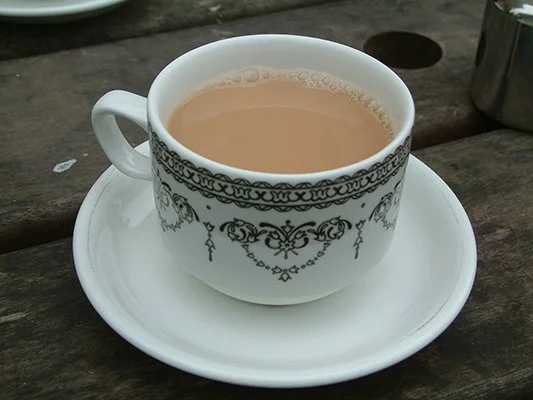
Photo of a cup of black tea with milk

5 October 2026

The word tea ultimately comes from Chinese, which in Mandarin is 茶 (ch’a) and in the Fujian dialect of Xiamen (Amoy) is tiä or te. These words were borrowed several times into European languages, often through intermediary languages. Hence, in addition to the English tea, we have the French thé, the Spanish te, the Italian tè, the Dutch and German thee, and the Danish and Swedish te. The /t/ forms may have come to Europe via the Malay te or teh. And we see /ʧ/ form in the Portugeuse cha, the Russian чай (chai), the Hindi चाय (chai) the Persian and Urdu چای (chā), the Arabic شاي (shay), and the Turkish çay.

The earliest English uses are in the /ʧ/ form. We see it in the diary of Richard Cocks, an English merchant in Japan, for 6 December 1616:

I sent the China Capt. Brother a kerymon and 2 salmons […] and a silver chaw pot and a fan to Capt. China wife; and pear tabis with string and fan to his doughter.

The /t/ form makes its way into English by 1655 when it appears in a translation of Alvaro Semedo’s history of China:

Chá is a leafe of a tree, about the bignesse of Mirtle; in other provinces, of the herbe Basil; and in others, of the smal Pomgranat. They drie it over the fire in iron-sives, where it hardens and sticketh together. There is of many sorts of it, as well because the plant is various, as also the upper leaves do exceed the other in finenesse; a property almost of all plants. There is of it, from a Crown a pound to four farthings according to the quality of it, there being so many differences therof. It being thus dryed and cast into warme water, it giveth it a colour, smell, and tast, at the first unpleasing, but custome makes it more acceptable; Tis much used in China and Giappone, for it serveth not only for ordinary drink in stead of water, but also for entertainment to strangers when they visit them, as wine doth in Northern parts.

To this paragraph is attached the following marginal note:

See a larger discourse of the ordering of this leafe, and of the many vertues of the drink in the voyage and missions of Alexander d Rhodes (printed at Paris 1653. I part. 13 cap. its called also Tay.

The /t/ form would become the dominant one in English, but the /ʧ/ form would make a comeback in the latter half of the twentieth century with chai, various preparations of tea, often with sweetened and mixed with milk and other spices. Here is an example from the Chicago Tribune of 18 April 1957:

Mayflower guild of the Assyrian Congregational church, 447 Hazel st., recently sponsored a benefit, “An Afternoon in Iran,” which the group made as typically Iranian as possible with authentic costumes, music, and food.

Waitresses dressed in authentic costumes served typical near eastern food. The menu included pilau, heavily buttered rice; koorush, meats, vegetables, and spices in a tomato gravy; dolma kalama, herbs, spices, rice, and meat wrapped in cabbage leaves; lawasha, a leavened bread made in sheets, and chai, tea specially prepared in a samovar.

Chai is perhaps most often used to refer to masala chai, an Indian preparation consisting of tea, sweetened milk, cardamon, cinnamon, and anise.

Tea can also refer to a meal or social gathering where the drink is served. This sense appears in the eighteenth century referring to light meal in the late afternoon at which tea is served. We see this sense in Jonathan Swift’s 1738 Collection of Genteel and Ingenious Conversation:

So, there is no Point wherein I have so much laboured, as that of improving, and polishing all Parts of Conversation between Persons of Quality, whether they meet by Accident or Invitation, at Meals, Tea, or Visits, Mornings, Noons, or Evenings.

In England, especially in the north, and in Australia and New Zealand, this sense of tea as a meal is often applied to the evening meal. We see this sense in Beatrice Harraden’s 1897 short story The Remittance Man. Oddly, the story is set in California, but the character speaks in Briticisms:

Jesse Holles immediately appeared at the door, holding a frying-pan in one hand and a dish in the other.

“Hi  there  old man!” he said in his own cheery way. “You're just in time for a rattling good tea—hot rolls, fried potatoes, and quail; and if you're not satisfied, the devil take you!”

And there is a slang use of tea to mean gossip, but that's another story.

Discuss this post


Sources:

Cocks, Richard. Diary entry for 6 December 1616. Diary of Richard Cocks, vol. 1. Edward Maunde Thompson, ed. Hakluyt Society 66. London: 1883, 215. HathiTrust Digital Library.

Harraden, Beatrice. “The Remittance Man.” In Hilda Strafford and The Remittance Man, eighth edition. Edinburgh: William Blackwood and Sons, 1897, 226. HathiTrust Digital Library.

“Iranian Fete Aids Assyrian Church Fund.” Chicago Daily Tribune, 18 April 1957, part 4, 4/3. ProQuest Historical Newspapers.

Oxford English Dictionary Online, 1910, s.v. tea, n.; 1889, cha, n.; 2008, s.v. chai, n.2, masala chai, n.

Semedo, Alvaro. The History of that Great and Renowned Monarchy of China. London: E. Tyler for John Crook, 1655, 19. HathiTrust Digital Library.

Swift, Jonathan (pseud. Simon Wagstaff). A Compleat Collection of Genteel and Ingenious Conversation. London: For B. Motte and C. Bathurst, 1738, i–ii. Google Books.

Image credit: Aesop, 2005. Wikimedia Commons. Flickr. Licensed under the Creative Commons Attribution-Share Alike 2.0 Generic license.

enshittification

Image of the poop emoji

2 October 2026

Use of enshittification exploded in 2023, leading to its being voted as the Word of the Year by the American Dialect Society when that organization met the following January. Enshittification was popularized by writer Cory Doctorow in a blog post of 21 January 2023 that went viral:

Here is how platforms die: first, they are good to their users; then they abuse their users to make things better for their business customers; finally, they abuse those business customers to claw back all the value for themselves. Then, they die.

I call this enshittification, and it is a seemingly inevitable consequence arising from the combination of the ease of changing how a platform allocates value, combined with the nature of a "two sided market," where a platform sits between buyers and sellers, holding each hostage to the other, raking off an ever-larger share of the value that passes between them.

And Doctorow had previously used the word, as well as enshittified, in a post to Medium on 28 November 2022:

In Bezos’s original plan, the company called “Amazon” was called “Relentless,” due to its ambition to be “Earth’s most customer-centric company.” Today, Amazon is an enshittified endless scroll of paid results, where winning depends on ad budgets, not quality.

[…]

This brings me back to the enshittification of Amazon search, AKA late-stage (platform) capitalism. Amazon’s dominance means that many products are now solely available on the platform. With the collapse of both physical and online retail, Prime isn’t so much a choice as a necessity.

Doctorow would go on to pen a 2025 book titled Enshittification: Why Everything Suddenly Got Worse and What to Do about It.

But Doctorow did not coin the word. The form shittification has been used, off and on, since at least 1922, when it appears in an English translation of Charles Baudouin’s Studies in Psychoanalysis. The original French word was merdalisation. The word appears in a list of word associations by a psychoanalytic patient:

Psychoanalysis itself comes in for:

verbal shittification (merdalisation verbale)
I spit
tiring colloquy
internal radiography
infantile radiography.

Application of shittification to the internet dates to at least 3 September 2012, when the following appeared on the subreddit r/circlebroke in a discussion of attempts to eliminate the downvoting of posts on Reddit:

So, no cynical circlebroke-ness yet? well this is related to the shittification of Reddit and its about to get a little more cynical so I think it belongs here. Have these lonesome subs found the solution to reddit's problems?

And the en- is added by 19 November 2013 when enshittification appears on Twitter:

Wow. The Onion's AV Club just turned into a pile of hot garbage. Who is behind the ongoing enshittification of web design?

While enshittification is certainly a feature of late-stage capitalism, as Doctorow claims, the concept is hardly unique to our present age.

Discuss this post


Sources:

@St_Rev. Twitter.com (now X.com), 19 November 2013.

acetylserine. “Downvote-free subreddits probably aren't the future, or, why ‘it still might be poop’.” r/circlebroke, Reddit.com, 3 September 2012.

Baudouin, Charles. Studies in Psychoanalysis. Eden and Cedar Paul, trans. New York: Dodd Mead, 1922, 428. Google Books.

Doctorow, Cory. “How Monopoly Enshittified Amazon.” Medium, 28 November 2022.

———. “Tiktok’s enshittification.” Pluralistic.net, 21 January 2023.

Friedman, Nancy. “Enshittification.” Strong Language (blog), 1 February 2023.

Merriam-Webster.com, 25 August 2026, s.v. enshittification, n.

O’Toole, Garson. “enshittification.” ADS-L, 29 June 2023.

———. “Enshittify, enshittification.” ADS-L, 3 February 2023.

Oxford English Dictionary Online, June 2026, s.v. enshittification, n.

Walker, Aiden and Triplem. “Enshittification.” Knowyourmeme.com, 2024.

Zimmer, Ben. “2023 Word of the Year is ‘enshittification.’” ADS-L, 6 January 2024.

Image credit: Microsoft Corporation, 2022. Wikimedia Commons. Licensed under the MIT License.

Broadway / off-Broadway / off-off Broadway / Obie

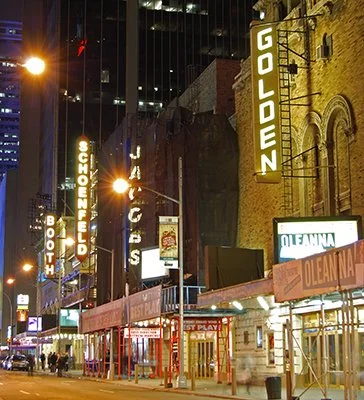
Nighttime photo of a New York City Street with neon signs displaying the names of theaters

Broadway theaters on West 45th Street, New York City

30 September 2026

Broadway is the metonym for the major theatrical productions in New York City, so called because many of the big theaters are on that street. But smaller theaters and productions are labeled off-Broadway, and even smaller productions are referred to as off-off-Broadway, regardless of their actual location. Off-off-Broadway productions are often avant-garde or experimental theater. 

Use of Broadway as a metonym for New York theater dates to the middle of the nineteenth century. We see it in the Wisconsin State Journal of 29 May 1853, a use that shows that the word Broadway had resonance in middle America by that date:

Messrs. Langrishe & Atwater, with their Theatrical campany [sic], are about to visit Kenosha, and a Correspondent of the Tribune, in that place, goes into ecstacies over it. In the communication we find the following sentence, which must be very gratifying to Mr. Atwater’s feelings:

“In the real Tragedy, one who has not a censorious spirit and false taste, can enjoy more in one night of Atwater’s Othello or William Tell, than in a month of this Broadway star playing.”

The phrase off-Broadway makes its appearance at the turn of the twentieth century. Hamilton Ontario’s Spectator reprinted the following from the New York Telegraph on 12 December 1903

Mantell is an accomplished actor, but he is making his present appeal for favor in an off-Broadway theater, where robust activity tells and quiet subtlety doesn’t count at all and where he responds with no sign of unwillingness to the demand for noisy force.

And the phrase appears in the New York Times on 2 October 1904

“Checkers” at the Academy of Music has won a success seldom given to off-Broadway plays. It has been here three weeks this year and isn’t ready to leave yet.

Off-off-Broadway premieres half a century later. The earliest use of the phrase that I’m aware of is in the Brooklyn Eagle of 27 February 1954. Geographically, Brooklyn is quite literally “off-off-Broadway”:

“Off-Broadway” plays have been numerous and stimulating this theatrical season—and now the first “off-off-Broadway” production has cropped up in Brooklyn.

And here is a piece from the Chicago Tribune of 27 March 1955 that nicely encapsulates the ethos of off-Broadway and off-off-Broadway productions:

The neighborhood of “off Broadway” is a strange one, for it is no place in particular. It might be right in the Broadway, or commercial theater district itself, as is the case of “Shoestring Revue,” playing in the little President theater in W. 48th st.

It might be in a church. One church group is having off-off-Broadway tryouts of its shows, sending them to out of town churches before bringing them in. It might be in a full size playhouse which progress has passed by, like the Phoenix and downtown National, both on lower 2d av. It might be in a loft building, a hotel, or a converted movie house.

“Off-Broadway,” is a state of mind and a condition of the pocketbook, rather than a place. As a state of mind, it is the domain of the true torch bearers—people who just can’t be kept from acting.

As a condition of the pocketbook, it is impoverished—the last resort of the shoestringer.

And like the big Broadway productions with their Tony awards, off-Broadway productions have their Obie awards, the name being an initialism for, of course, off-Broadway. The Obies have been awarded since 1956, first sponsored by the Village Voice newspaper, and since 2014 by the American Theater Wing, the organization that sponsors the Tonys. The name Obie appears in an announcement of the upcoming first award ceremony in the Village Voice of 13 June 1956:

Shelley Winters, star of Broadway’s “A Hatful of Rain,” will be the master of ceremonies at the first annual Village Voice Off-Broadway (“Obies”) Awards, which are to be given out at a ceremony attended by many prominent stage personalities, Monday afternoon at 3 at the Limelight Coffee House, 91 Seventh Avenue South.


Sources:

Chapman, John. “A True Actor Can’t Be Kept from Theater.” Chicago Sunday Tribune, 27 March 1955, Part 7, Section 2, Page 4/1. ProQuest Historical Newspapers.

“‘In Brooklyn’ May Be New Stage Trend.” Brooklyn Eagle (New York), 27 February 1954, 2/4. Newspapers.com.

“Mantell as an Actor.” Hamilton Spectator (Ontario), 12 December 1903, 16/1. Newspapers.com.

Oxford English Dictionary Online, December 2022, s.v. Broadway, adj.2 & n.2; March 2004, s.v. Obie, n.; off-Broadway, adj., adv. & n.; off-off-Broadway, adj., adv. & n.

“Plays that Hold.” New York Times, 2 October 1904, Part 4, 3/3. ProQuest Historical Newspapers.

“Voice ‘Obie’ Awards Monday; Shelly Winters to Be MC.” Village Voice, 13 June 1956, 1/4. Google News.

Wisconsin State Journal (Madison), 29 August 1853, 2/4. Newspapers.com.

Photo credit: Matt Wade, 2009. Wikimedia Commons. Licensed under the Creative Commons Attribution-Share Alike 3.0 Unported license.

Wild West

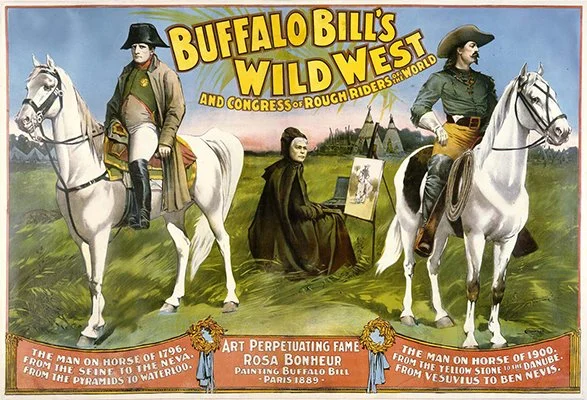
Poster advertising Buffalo Bill Cody’s Wild West Show featuring images of Cody, Napoleon, and painter Rosa Bonheur

Poster advertising Buffalo Bill Cody’s Wild West Show, created after 1889 when Rosa Bonheur painted images from the show, possibly made during or just after the show’s 1889–90 European tour, which could explain the otherwise inexplicable appearance of Napoleon in the poster

28 September 2026

The phrase Wild West usually refers to the American frontier, and it conjures up mythic images of gunslingers, cattle rustlers, Indian raids, and the dead-eyed lawmen who eventually tamed the region and made it habitable for civilized folks. The period most often evoked by the phrase is the late nineteenth-century, between the end of the Civil War in 1865 and the official declaration that the frontier had been closed in 1890. Of course, that myth was not reality, and the phrase was in use decades before that period.

Wild West is a simple, open compound. The earliest appearances of the phrase are not as a fixed phrase but rather just an alliterative colocation of the two words. The earliest use that I have found is in an 1823 travel narrative throughout the United States by a W. Faux. The passage in question is a discussion Nathan Boone, the son of the frontiersman Daniel Boone:

He was the first white man in Old Kentucky, and the wide wild west is full of his licks. A flourishing settlement always rises wherever he has once squatted, and whenever any settlers begin to approach near his location, he quits it for ever, and moves on further west; and the place, which he thus abandons, is called Boon’s [sic]Lick.

And there is this poem that appeared in the Pennsylvanian on 10 July 1824. It was composed for a Fourth of July campaign event for Andrew Jackson’s first bid for the presidency. The wild west here is a reference to the bayous of Louisiana in 1814:

Far in the wild west our clarion sounded,
   The groans of the foe to our charges replied;
The plains of New Orleans Old England astounded,
   The modern-built rampart so lower’d her pride:
             Those on that eventful day,
            Who outliv’d the bloody fray,
     Think of Old Hick’ry with fear and with awe;
             Loud should Columbia, then,
             Ring through her farthest glen,
     Huzza for the Chieftain! Huzza! Huzza!

A few years later Wild West starts to be used as a fixed phrase. Here’s an example from the Connecticut Mirror on 29 October 1831:

“Yes, sir,” replied Whistler, and mounted his horse but so unskillfully (for he was as ignorant of horsemanship as his brethren of the wild west) that Charles thought “every body must see the Indian now,” when a new alarm reached him.

And there is this transcript of a convention in South Carolina published in Washington, DC’s Daily National Intelligencer on 18 March 1833

This little State, in the mere panoply of courage and high principles, has foiled the swaggering giant of the Union. Thirty thousand Carolinians have not only AWED the wild west into respect,—COMPELLED Pennsylvania stodility into something like sense—N. York corruption into something like decency—Yankee rapacity into a sort of image of honesty; but all this has been loftily and steadily done, in the face of 17,000—what shall we call them? What epithet is of a shame wide, lasting and deep enough, for the betrayers of the liberties of their own country—the instigators of merciless slaughter—the contrivers of irretrievable servitude, against our own struggling State?


Sources:

Baker, John. “Antedating of ‘Wild West.’” ADS-L, 4 March 2010.

“Dauphin Cavalry.” Pennsylvanian (Harrisburg), 10 July 1824, 3/2. Newspapers.com.

Faux, W. Memorable Days in America. London: W. Simpkin and R. Marshall, 1823, 230–31. HathiTrust Digital Library.

Lighter, Jonathan. “Antedating of ‘Wild West.’” ADS-L, 9 August 2026.

Oxford English Dictionary Online, 1986, s.v. Wild West, n.

Sedgwick, Miss. “Berkeley Jail.” Connecticut Mirror (Hartford), 29 October 1831, 2/1. Readex: America’s Historical Newspapers.

Shapiro, Fred. “Antedating of ‘Wild West.’” ADS-L, 9 August 2026.

“Washington.” Daily National Intelligencer (Washington, DC), 18 March 1833, 3/1. Newspapers.com.

Tony award

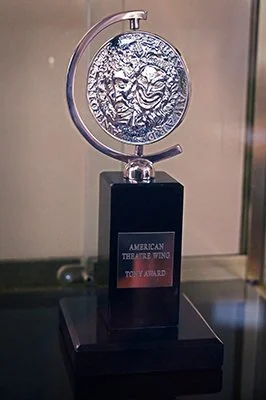
Photo of a Tony statuette

2017 Tony for Best Revival, awarded to Jitney

25 September 2026

The Tonys, or officially the Antoinette Perry Awards for Excellence in Broadway Theatre, are, of course, named for Antoinette Perry (1888–1946), a Broadway actor, producer, and director, and also the co-founder of the American Theatre Wing. That organization was created in 1940 as a branch of the British War Relief Society, a charitable organization that provided non-military aid to Britain during the war. During war, the Wing operated Stage Door Canteens in New York and other cities that provided meals and entertainment to military service members. Following the war, the organization changed its mission to that of promoting the history of and excellence in American theater. The annual awards, part of this changed mission, were named after Perry, who had died the previous year.

The first awards were given out on 6 April 1947, and the nickname Tony, parallel to Hollywood’s Oscar, starts appearing in the press shortly before. New York’s Daily News, for instance, has this from 27 March 1947:

Theatre Award Season Here, Stage Folk to Receive Tonys

[…]

A little while back in this space I noted that the theatre has no equivalent, in the respect and publicity it gets, to the Oscars bestowed by the Academy of Motion Picture Arts and Sciences. Brock Pemberton, president of the League of New York Theatres, thinks that I am wrong—that on Easter Sunday evening at the Waldorft, the bestowing of Tonys upon deserving stage workers will be every bit as important as the heaping of Oscars in Hollywood. Says Brock:

“Your statement that the stage probably never would have a real Oscar was just a tiny bit inaccurate. It won’t have Oscars, but will have their counterpart, Tonys. Haven’t you been told about the Antoinette Perry Awards to be given out annually in memory of that great lady under the sponsorship of the American Theatre Wing?”

The above quotation from Pemberton indicates that Tony was already in circulation among theater folks by this date.

Another early example is from the Daily News a few days later, on 2 April 1947:

The balloting for recipients of Tonys has been secret but there are indications that several “important theatre personalities will be taking bows” Sunday night, not for “firsts” or “bests” but for “original contributions, innovations and departures considered to further a good trend in the theatre.”


Sources:

Chapman, John. “Theatre Award Season Here, Stage Folk to Receive Tonys.” Daily News (New York), 27 March 1947, 67/1. Newspapers.com.

Oxford English Dictionary Online, accessed 8 June 2026, s.v. Tony, n.1.

Shapiro, Fred. “[Ads-l] ‘Tony’ award, slight antedating. ADS-L, 8 June 2026.

Watt Douglas. “Reproduce Canteen for Perry Awards; an Atomic Comedy.” Daily News (New York), 2 April 1947, 63/1. ProQuest Newspapes.

Photo credit: Philip Romano, 2026. Wikimedia Commons. Licensed under the Creative Commons Attribution-Share Alike 4.0 International license.