stay in your lane

Photo of cars driving on the New Jersey Turnpike near Exit 8A

15 May 2026

The underlying metaphor under the clichéd piece of advice to stay in your lane is rather obvious, but the use of the phrase appears to have moved from the literal to the metaphorical in US military in the closing decade of the twentieth century.

That metaphor is one of driving. Automobiles should, of course, stay in their respective lanes to avoid accidents. And literal use of stay in your lane in the context of driving has been around for as long as roads have been marked with lane divisions. You can also find literal use of the phrase in sports like track and swimming that have demarcated lanes.

In the 1970s we start to see quasi-literal uses in sports that don’t have clear lane markers, but the phrase is still used in reference to position on the field of play. For instance, there is this about American football in Cleveland’s Plain Dealer of 22 November 1972:

ROMAN GOT TO Terry Bradshaw twice. He also hurried the passer on several other occasions and help reasonably well against the Steelers’ powerful ground attack.

“Against Bradshaw you just have to stay in your lane and he’ll eventually come to you,” said Roman. “Walter Johnson and Jerry Sherk do such a great job it makes it easier for the ends here.

And there is this in the context of hockey in Rhode Island’s Providence Journal of 21 December 1976:

Last night Vermont coach Jim Cross told his players, “Stay in your lane, play your position and don't get any stupid penalties.” The Catamounts followed orders and their right forechecking completely disrupted  RPI’s freewheeling attack which had averaged almost seven goals a game going into the tournament.

It’s not unusual for slang phrases to make early print appearances as the names of racehorses, and in 1989 there was horse named Stay In Your Lane. Whether the name was inspired by the idea of a horse running in a “lane” (horseracing doesn’t have demarcated lanes) or if it represented a more general figurative use is unknown.

Purely figurative use of stay in your lane can be found in the US Army by the mid-1990s. An article of that title appears in the Spring 1995 issue of NCO Journal, and the text of that article reads in part:

“You have to know what you’re supposed to do and then do it. Don’t waste your time worrying about how an officer does his job. That’s officer’s business. If your soldiers fail, it won’t be an officer’s fault.” What he told that sergeant was “…stay in your lane.”

The January–April 1998 issue of Infantry magazine has an article titled “Lane Training in Haiti.” What lane training means is not explicitly defined, and the phrase appears in quotation marks, indicating that it is not a usual term of art. From the context, however, lane training appears to refer to training on adhering to the rules of engagement prior to deployment to Haiti. The article also uses stay in your lane:

The soldier should first ask the reporter for press credentials and picture ID. Soldiers will not answer any question dealing with operational security or national policy. Soldiers may answer questions about personal matters, such as those in b, e, j, and q. (Only talk about your area of expertise: Stay in your lane. If you own it, drive it, carry it, you can talk about it.)

Another article in Infantry, this time from January–April 2000, clearly links the military phrase to driving a car:

A key rule of the road is to stay in your lane. Your fellow staff officers and the company commanders will appreciate your active support, but not your active involvement in their business.

The figurative stay in your lane starts appearing in non-military contexts in the early 2000s. In an 8 December 2002 article in the Washington Post, dancer and actor Chita Rivera reminisces about going to an audition early in her career (c. 1948) and places the phrase in the mouth of her ballet teacher, Doris Jones:

When Jones, her ballet teacher in Washington, escorted her to the tryout, she calmed her student with a piece of advice Rivera has never forgotten: “Conchita, stay in your lane.” She meant: Don’t worry about the long bodies and blond ponytails lining up next to you for the auditions, be who you are.

It is common for the brain to insert anachronistic phrases into memories as it recalls and reconstructs them. Given that there are no other known figurative uses of the phrase from that era, it is all but certain that Jones did not actually utter the phrase in the late 1940s. But the article does tell us that stay in your lane had moved out of the military and into the world of entertainment by 2002.

The Newark, New Jersey Star-Ledger of 8 March 2006 quotes singer Mary J. Blige as using the prhase:

Mary J. Blige says conglomerate-owned music companies force musicians to choose a certain niche and stay in it: “You have to stay in your lane.”

And the New York Post has music producer Russell Simmons using the phrase in its 13 July 2007 issue in an article about the “laws” of success in the industry:

Law No. 2: Always do you. Never change for the mainstream—stay in your lane, and if you’re talented and resilient enough, the mainstream will come to you.


Sources:

Brooks, Lieutenant Colonel Leo A. and Captain Michael O. Lacey. “Lane Training in Haiti.” Infantry, January–April 1998, 88.1, 25/2. HathiTrust Digital Library.

Heaton, Chuck. “To Browns He’s Noblest Roman.” Plain Dealer (Cleveland, Ohio), 22 November 1972, 2-C/4. Readex: America’s Historical Newspapers

Hooker, Lieutenant Colonel Richard D. “‘On the Staff’: Success through Teamwork.” Infantry, 90.1, January–April 2000, 35/2. HathiTrust Digital Archive.

“Matter of Fact: Horse Racing.” Cincinnati Post (Ohio), 12 January 1989, 4C/5. Readex: America’s Historical Newspapers.

Pendry, J. D. “Stay in Your Lane.” NCO Journal, 5.2, Spring 1995 [?], 4/3. HathiTrust Digital Library. (The date in the printed journal reads “Winter 94–95,” but issue 5.1 bears that same date. Issue 5.3 is dated “Summer 95.”)

Philips, Dave. “Vermont Victory in Bruin Tourney.” Providence Journal (Rhode Island), 21 December 1976, B-10/6. Readex: America’s Historical Newspapers.

Simmons, Russell. “Uncommon ‘Laws’: Excerpts from Rap’s Keys to Success.” New York Post, 13 July 2007, 45/3. Readex: America’s Historical Newspapers.

Trescott, Jacqueline. “For Chita Rivera, a Career with Legs.” Washington Post, 8 December 2002, G10/2. ProQuest Historical Newspapers.

Zoller Seitz, Matt. “Passing Fancy.” Star-Ledger (Newark, New Jersey), 8 March 2006, 27/2. Readex: America’s Historical Newspapers.

Photo credit: Mlaurenti, 2006. Wikimedia Commons. Licensed under the Creative Commons Attribution-Share Alike 3.0 Unported license.
sophism / sophomore / sophomoric

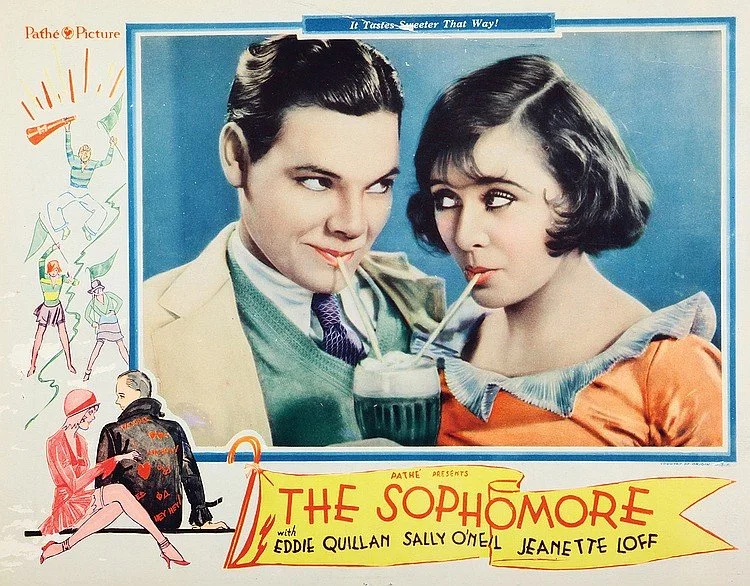
Advertisement for the 1929 film The Sophomore featuring a picture of a young man and woman sharing a soda through two straws

Lobby card for the 1929 film The Sophomore

8 May 2026

(Edit: 13 May 2026, clarified the Middle English roots)

An argument or statement that is sophomoric is pretentious and crudely reasoned (cf. sophisticated). It is no surprise that it comes from sophomore, a word for second-year university student. And that word’s root is sophism (in the seventeenth-century form sophom), which brings us full circle as that word refers to a fallacious argument or an ambiguous or paradoxical sentence, and often one that is used as an exercise in logic.

Sophism is a borrowing, partly from the Anglo-Norman sofisme and partly directly from the Latin sophisma. The Latin, in turn, comes from the Greek σόϕισμα (sophisma), meaning a clever trick or argument. We have evidence of English use of the word from the late fourteenth century but was probably in use somewhat earlier than the surviving manuscripts that have it.

One of these early English uses is in John Trevisa’s translation of Ranulf Higden’s Polychronicon, written sometime before 1387, which has this passage:

And for no pompe and boste schulde faille, þe kyng maked þe ȝonge sones of þe eorle of Mollent appose þe cardinales þat were þo presente, and upbroyde hem and snarlede him wiþ sotil sophyms.

(And in case pomp and boast should fail, the king made the young sons of the earl of Mollent examine the cardinals that where then present, and upbraided them and ensnared them with subtle sophisms.)

Higden’s Latin is sophismatibus.

The use of sophism in the sense of an exercise in logic dates to at least 1566, when we find it in the record of a disciplinary proceeding against a professor at Corpus Christi College, Oxford, as recorded in Thomas Fowler’s history of that school:

Item, he harde no sophisme, as he ys bounde twise or thrice a weke, these iii yeres.

(Item, he heard no sophisms these three years, as he is obligated to do twice or thrice a week.)

The Middle English sophim(e went through various forms and spellings, and by the early seventeenth century one of this was sophom, which bequeathed to us sophomore (sophom + -or) by 1688, when it appears in Randle Holme’s The Academy of Armory:

Commoners, are such as are at the University Commons, which till they come to some Degree or Preferment there, are distinguished according to their time of being there; as 1. Fresh Men. 2. Sophy Moores. 3. Junior Soph, or Sophester. And lastly Senior Soph.

And the sense of sophomoric, meaning a pretentious or badly reasoned argument, like that a sophomore, that is someone who has not yet mastered the arts of logic and argumentation but knows just enough to be dangerous, was originally an Americanism. It appears by 1810, when the Boston Patriot, a Democratic-Republican paper, in its 23 June 1810 issue, praises the newly elected Democratic-Republican governor, Elbridge Gerry, and slights his Federalist predecessor:

We think it justifies the popular opinion of the learning, the genius, and the abilities of this statesman [i.e. Elbridge Gerry] of forty years—While the boyish pedantry, the foppish learning, the sophomoric rant, the college style, and the garish metaphors of his predecessor [i.e., Christopher Gore] are forgotten.

Gerry, of course, is best known in etymological circles as the namesake for gerrymander.

Discuss this post


Sources:

Anglo-Norman Dictionary, 2018–21, s.v. sofisme, n.

Fowler, Thomas. The History of Corpus Christi College. Oxford Historical Society. Oxford: Clarendon Press, 1893, 112. HathiTrust Digital Library.

“Governor Gerry’s Speech.” Boston Patriot (Massachusetts), 23 June 1810, 2/3. Readex: America’s Historical Newspapers.

Higden, Ranulf. Polychronicon, vol. 7. John Trevisa, trans. Joseph Rawson Lumby, ed. London: Longman, 1879, 431. HathiTrust Digital Library.

Holme, Randle. The Academy of Armory. Chester: 1688, 198–99. ProQuest: Early English Books Online (EEBO).

Middle English Dictionary, 31 January 2026, s.v. sophim(e, n.

Oxford English Dictionary Online, 1913, s.v. sophism, n., sophomore, n., sophomoric, adj. & n.


hodad

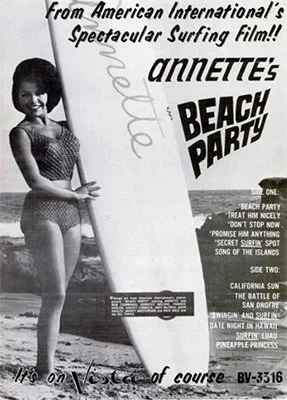
Ad with a B&W photo of Annette Funicello in a bathing suit, holding a surfboard

Ad for the soundtrack from the 1963 film Beach Party, starring Annette Funicello and Frankie Avalon

11 May 2026

Hodad is surfing jargon. Exactly what it means has shifted a bit. It started out as a deprecatory term for non-surfers, but it quickly shifted to become a general term of opprobrium.

The origin of the term, like that of many slang terms, is unknown. J. E. Lighter’s Historical Dictionary of American Slang offers up the possibility that it may be from the greeting Ho! Dad, or that it is a variation on hodag, an imaginary monster. This latter suggestion is rather unlikely as hodags prowl the wilds of Wisconsin, not the beaches of California where hodads make their first appearance. Another possibility is that Hodad is a surname, and the term may have originated with one particular annoying person. But the origin is probably lost in time, never to be known.

The earliest instance in print that I have found is in the Long Beach, California Independent of 9 May 1960:

At this time of the year on the beach, it is very hard to tell a mere tourist from a ho-dad or even a surfer. The sun has been away, and everyone is white and untanned. Howsoever, the surfers have crew cuts. Some of them bleach their hair with peroxide. They will be sitting on their foam boards out a ways, waiting for the big ones. The ho-dads have long hair with lots of gunk on it. They will be horsing around on the beach, trying to impress the girls. They do not like to get wet, ho-dads don’t.

The tourists? they stare at the girls just like the ho-dads do, only they let their mouths hang open. They also kick sand when they walk. They don’t mean to, but they can’t help it.

And another early use is this from Omaha’s Sunday World-Herald of 16 July 1961. Don’t let the paper’s location fool you, the article is about California surf culture:

One girl explained recently that there are three groups in high school: The surfers, the ho-dads, and the socs.

The ho-dads, also known as ho-daddies, are the hot-rod and car-club enthusiasts. They like well-oiled, Elvis Presley-type pompadours, wear boots, jeans or pegged slacks, drive cars with souped-up motors and go for rock n’ roll.

The socs (pronounced, for some tribalistic reason, as so-cees) are the “society types”—the ones who belong to campus clubs and get good grades. Surfers and ho-dads have another name for them: “Kooks.”

The Oxford English Dictionary’s earliest citation shows that surfers had quickly carried hodad around the world as it’s from Australian Women’s Weekly of 24 October 1962:

HO-DAD: Anyone who annoys board-riders while they surf.

And this one from the Dallas Morning News of 13 March 1963 uses hodad without definition or quotation marks. It’s still being hyphenated, though:

But to a true Surfer, or even a Gremmie or Ho-Dad, paradise would not be complete without Dick Dale and his Surfers’ Stomp.

And this one from the Miami Herald of 23 April 1963 expands the definition beyond that of non-surfer, encompassing dilettantes of the sport:

To give you an idea, in the future if you want to designate someone as the lowest form of pond life, just call him a hodad. Among surfers, hodads are looked on with considerable distaste because of their wild antics and lack of dedication to the sport.

And I could not leave hodad behind without including this rather unusual classified ad that appeared in the Trenton Evening Times in September 1963. It’s for a drive-in theater in neighboring Lawrenceville, New Jersey (sadly, the theater is no longer in existence) and coincides with the release of the film Beach Party, starring Annette Funicello and Frankie Avalon, which is often credited with kicking off the genre of beach party films:

ATTENTION GREMMIES AND BEACH BUNNIES—Don’t be a hodad kook, let a hotdogger show up those goofy foots and pearl divers, bring your tag-along and do some hotdogging yourself, don’t worry, you won’t bail out or bomb, the worst thing that can happen is to catch a rail, you might go over the falls or even pearl, one thing sure, you’ll shoot the curl when you finally go angling, you’ll agree with the hotdoggers that his thing called surfing is really glassy. Call the Lawrence Drive-In Theater at TU 2-9700 and find out the glassiest, the most stoke movie ever, it’s a real cowabunga.


Sources:

Classified ad. Trenton Evening Times (New Jersey), 3 September 1963, 21/5. Readex: America’s Historical Newspapers.

Dictionary of American Regional English, vol. 2. Cambridge: Harvard UP, 1991, s.v. hodag, n2.

Green’s Dictionary of Slang, accessed 19 April 2026, s.v. hodad, n.

Lighter, J. E. Historical Dictionary of American Slang, vol. 2 of 2. New York: Random House, 1997, s.v. hodad, n.

Oxford English Dictionary Online, 1976, s.v. hodad, n.

Roe, Dorothy. “STOMP: The Dance for Surf-Mad Teens.” Dallas Morning News (Texas), 13 March 1963, 2—Section 3/1. Readex: America’s Historical Newspapers.

“Surfing Lingo.” Miami Herald (Florida), 23 April 1963, 3/1. Readex: America’s Historical Newspapers.

Torgeson, Dial. “They’re Dedicated to Fun-in-the-Sun.” Sunday World-Herald (Omaha, Nebraska), 16 July 1961, G2/4. Readex: America’s Historical Newspapers.

Wells, Bob. “Eye Opener: Plus Long Weekends.” Independent (Long Beach, California), 9 May 1960, A-3/2. Newspapers.com.

Yates, Kerry. “Surf-Riders’ Dictionary.” Australian Women’s Weekly, 24 October 1962, Teenager’s Weekly 3/2. National Library of Australia: Trove.

Image credit: Buena Vista Records, 1963. Wikimedia Commons. Public domain image.

religion

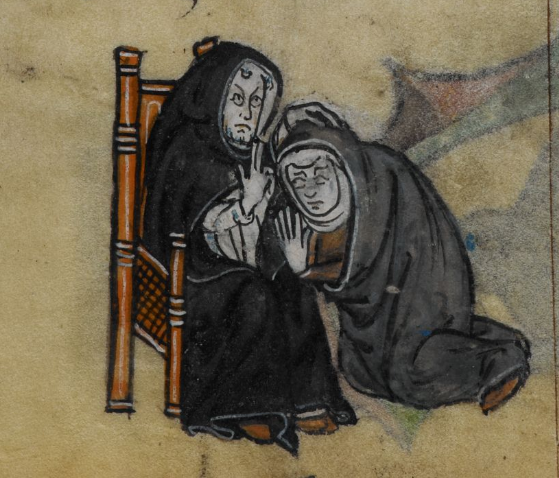
Medieval illustration of a seated monk blessing a woman kneeling before him in prayer

Detail from an early fourteenth-century manuscript

6 May 2026
(Update: 8 May 2026, added discussion of classical Latin root)

Religion has a straightforward etymology, but its original English meaning is rather different from how it is commonly used today. It is a late twelfth-century borrowing, partly from the Anglo-Norman religiun, and partly from the post-classical Latin religio, both referring to a system of beliefs about divine beings.

In classical Latin, religio had a range of meanings relating to the divine. It could refer to reverence for the gods; conscientiousness or scrupulousness, especially in matters of faith; or the more abstract holiness or sanctity. The root appears to be lig-, meaning to bind. The verb religo (not to be confused with the noun religio discussed above) means to fasten up or bind fast. Cicero, probably reflecting the prevalent view of his time, argued that the root was the verb relegare, meaning to read again, but modern scholarship generally discounts this explanation. (As a rule, present-day scholars have more resources and knowledge of language development than those living in earlier eras.) But either way, the noun religio was associated with the idea of adherence to divine rites..

Its original English sense was that of a monastic order, and it could also refer to a member of such an order, a monk, nun, canon, or friar or even a small community of such people.

The earliest surviving appearance of the word in English is from the Ancrene Wisse (or Ancrene Riwle), a handbook for anchoresses, women who withdrew from society, even monastic society, opting to live alone in cells attached to churches where they led a life of intense prayer and devotion. The Ancrene Riwle was probably composed in the late twelfth century, with the earliest surviving manuscript from c. 1230:

Rihten hire & smeðin hire is of euch religiun ant of euch ordre the goð & al þe strengðe. þeos riwle is imaket nawt of monnes fundles, a is of godes heaste.

(The goodness and strength of each religion and each order is to govern her & to smooth her [i.e., keep her heart free of sin]. This rule is not made of man’s invention, but it is of God’s instruction.)

We don’t see religion used in the abstract sense until the late fourteenth century. That sense appears in a Wycliffite translation of the Latin Vulgate Bible from c. 1384. Colossians 2:20–23 reads, in part:

For if ȝe ben deed with Crist from the elementis of this world, what ȝit as men lyuynge to the world deman ȝe? That ȝe touche not, nether taaste, nether trete with hoondis tho thingis, whiche alle ben in to deth bi the ilke vss, aftir the comaundementis and the techingis of men; whiche han a resoun of wisdom in veyn religioun and mekenesse.

(For if you are dead with Christ from the elements of this world, why do you, as if you were men living in the world, submit to them? That you do not touch, neither taste, nor treat with your hands those things, which all lead to death with such use, according to the commandments and the teachings of men, which have a foundation of wisdom in vain religion and humility.)


Sources:

Ancrene Wisse. Cambridge, Corpus Christi College, MS 402. Stanford University Libraries: Parker on the Web.

Ancrene Wisse. J. R. R. Tolkien, ed.  Early English Text Society 249. London: Oxford UP, 1962, 7. Cambridge, Corpus Christi College, MS 402. Archive.org.

Anglo-Norman Dictionary, AND Phase 5, 2018–21, s.v. religiun, n.

Dictionary of Medieval Latin from British Sources, 2013, s.v. religio, n. Brepols: Database of Latin Dictionaries.

The Holy Bible Containing the Old and New Testaments with the Apocryphal Books in the Earliest English Versions made from the Latin Vulgate by John Wycliffe and His Followers, vol. 4. Josiah Forsall and Frederic Madden, eds. Oxford, Oxford UP, 1850, 433/2. HathiTrust Digital Library.

Lewis, Charlton T. and Charles Short. A Latin Dictionary. Oxford: Oxford UP, 1879, s.v. religio, n., religo, v. Brepols: Database of Latin Dictionaries.

Middle English Dictionary, 31 January 2026, s.v. religioun, n.

Oxford English Dictionary Online, December 2009, s.v. religion, n.

Image credit: Unknown artist, first quarter of the fourteenth century. London, British Library, Stowe MS 17, fol. 191r. Wikimedia Commons. Public domain image.

English (spin)

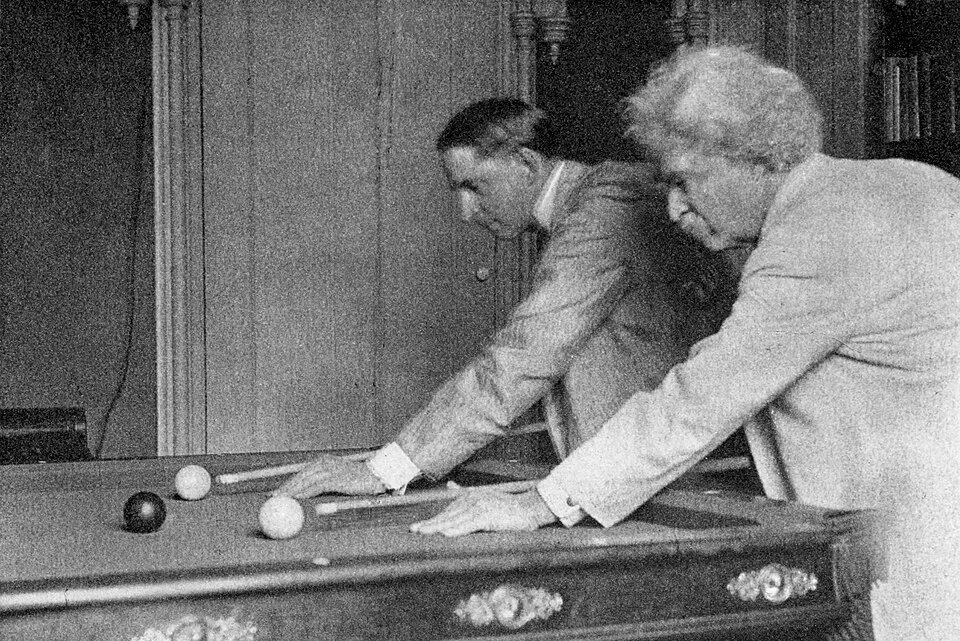
Grainy B&W photo of two men playing billiards

Mark Twain and his biographer Albert Bigelow Paine playing billiards, 1907

4 May 2026

In billiards, and in other sports, to put English on a ball is to cause it to spin so that it’s course changes. In billiards, this is done by striking the ball on one side, and the course change often occurs after it caroms off the cushion. The term arose in the United States in the mid nineteenth century.

Why this is referred to as English is not known. The most likely explanation is that billiard players from England introduced the technique to those in the United States, but there is no firm evidence of this. The Oxford English Dictionary has a quotation from a 1959 letter written to London’s Sunday Times in claiming that it was a man named English who introduced the technique to the Americas, but this is almost certainly an after-the-fact invention to explain the term.

The earliest use of English in this sense that I’m aware of is in the Cleveland Daily Plain Dealer of 14 October 1861:

The following are tricks most frequently practiced at billiards by a cunning adversary, of which I desire to warn you:

[…]

3. Immediately after shooting using his cue as a magic wand and flourishing it in the air above the table to give an increased “English” to his ball.

And Mark Twain used the term in his 1869 Innocents Abroad in a description of Parisian pool halls:

The cushions were hard and inelastic, and the cues were so crooked that in making a shot you had to allow for the curve or you would infallibly put the “English” on the wrong side of the ball.

And English as a verb appears in the Atlanta Constitution of 31 January 1875 in an article about King Kalakaua of Hawaii playing billiards in Omaha, Nebraska:

His royal highness again scored several, and to make up for his miscue he “jawed” the balls, and would and would [sic] have made a big run had not the balls “shewed” round so that it was impossible to make the shot without going to cushion first, and “Englishing.” The king failed on his “English,” not putting enough of it on.

The Constitution credits this article to the Omaha Bee, but that paper’s digitization is spotty, with only two issues of the Omaha paper from January 1875 available. In those, I see coverage of the king’s visit to the city, but not of this particular event.

Discuss this post


Sources:

“Kalakaua as a Billiard Player. Atlanta Constitution (Georgia), 31 January 1875, 2/5. ProQuest Historical Newspapers.

Oxford English Dictionary Online, December 2008, s.v. English, adj. (& adv.) & n., English, v.

Smith, Norman. “Giving It English.” Sunday Times (London), 5 April 1959, 4/3. Gale Primary Sources: The Sunday Times.

“Tricks at Billiards.” Cleveland Daily Plain Dealer (Ohio), 14 October 1861, 4/3. Readex: America’s Historical Newspapers.

Twain, Mark. The Innocents Abroad. San Francisco: H. H. Bancroft, 1869, 116. HathiTrust Digital Library.

Photo credit: Unknown photographer, 1907. Wikimedia Commons. From Paine, Albert Bigelow. Mark Twain: A Biography, vol. 4 of 4. New York: Gabriel Wells, 1923, facing page 1326. Archive.org. Public domain image.